
Exam Name: Certified Kubernetes Security Specialist (CKS)
Certification Provider: Linux Foundation
Corresponding Certification: Kubernetes Security Specialist

Over 171491+ Satisfied Customers
Instant Download Linux Foundation : CKS Questions & Answers

 1334 Customer Reviews
Check Updated on: Nov 12, 2026
No. of Questions: 66 Questions & Answers with Exam Engine
Download Limit: Unlimited
Instant Download: Upon successful payment, Our systems will automatically send the product you have purchased to your mailbox by email. (If not received within 12 hours, please contact us. Note: don't forget to check your spam.)
100% Money Back Guarantee
Fast2test has an unprecedented 99.6% first time pass rate among our customers.  We're so confident of our products that we provide no hassle product exchange.
- Three formats are optional
- 10+ years of excellence
- 365 Days Free Updates
- Learn anywhere, anytime
- 100% Safe shopping experience
CKS PDF Practice Q&A's
- Printable CKS PDF Format
- Prepared by Linux Foundation Experts
- Instant Access to Download CKS PDF
- Study Anywhere, Anytime
- 365 Days Free Updates
- Free CKS PDF Demo Available
- Download Q&A's Demo
- Total Questions: 66
- Updated on: Nov 12, 2026
- Price: $129.00 $69.98
CKS Desktop Test Engine
- Installable Software Application
- Simulates Real CKS Exam Environment
- Builds CKS Exam Confidence
- Supports MS Operating System
- Two Modes For CKS Practice
- Practice Offline Anytime
- Software Screenshots
- Total Questions: 66
- Updated on: Nov 12, 2026
- Price: $129.00 $69.98
CKS Online Test Engine
- Online Tool, Convenient, easy to study.
- Instant Online Access CKS Dumps
- Supports All Web Browsers
- CKS Practice Online Anytime
- Test History and Performance Review
- Supports Windows / Mac / Android / iOS, etc.
- Try Online Engine Demo
- Total Questions: 66
- Updated on: Nov 12, 2026
- Price: $129.00 $69.98
Linux Foundation CKS Exam Syllabus Topics:
| Topic | Details |
|---|---|
| Topic 1 |
|
| Topic 2 |
|
| Topic 3 |
|
| Topic 4 |
|
Reference: https://training.linuxfoundation.org/certification/certified-kubernetes-security-specialist/#exams
Mock examination function
The contents of CKS study materials are all compiled by industry experts based on the examination outlines and industry development trends over the years. It does not overlap with the content of the question banks on the market, and avoids the fatigue caused by repeated exercises. CKS exam guide is not simply a patchwork of test questions, but has its own system and levels of hierarchy, which can make users improve effectively. Our study materials contain test papers prepared by examination specialists according to the characteristics and scope of different subjects. Simulate the real Certified Kubernetes Security Specialist (CKS) test environment. After the test is over, the system also gives the total score and correct answer rate.
Only 20-30 hours learning before the exam
In peacetime, you may take months or even a year to review a professional exam, but with CKS exam guide, you only need to spend 20-30 hours to review before the exam, and with our study materials, you will no longer need any other review materials, because our study materials has already included all the important test points. At the same time, CKS study materials will give you a brand-new learning method to review - let you master the knowledge in the course of the doing exercise. There are many people who feel a headache for reading books because they have a lot of incomprehensible knowledge. At the same time, those boring descriptions in textbooks often make people feel sleepy. But with CKS test torrent: Certified Kubernetes Security Specialist (CKS), you will no longer have these troubles.
Whether you are a newcomer or an old man with more experience, CKS study materials will be your best choice for our professional experts compiled them based on changes in the examination outlines over the years and industry trends. CKS test torrent: Certified Kubernetes Security Specialist (CKS) not only help you to improve the efficiency of learning, but also help you to shorten the review time of up to several months to one month or even two or three weeks, so that you use the least time and effort to get the maximum improvement.
Free trial before buying
CKS study materials provide free trial service for consumers. If you are interested in our study materials, you only need to enter our official website, and you can immediately download and experience our trial question bank for free. Through the trial you will have different learning experience on CKS exam guide , you will find that what we say is not a lie, and you will immediately fall in love with our products. As a key to the success of your life, the benefits that our study materials can bring you are not measured by money. CKS test torrent: Certified Kubernetes Security Specialist (CKS) can not only help you pass the exam, but also help you master a new set of learning methods and teach you how to study efficiently, our study materials will lead you to success.
Linux Foundation Certified Kubernetes Security Specialist (CKS) Sample Questions:
SIMULATION
Documentation
Installing the Sidecar, PeerAuthentication, Deployments
You must connect to the correct host . Failure to do so may result in a zero score.
[candidate@base] $ ssh cks000041
Context
A microservices-based application using unencrypted Layer 4 (L4) transport must be secured with Istio.
Task
Perform the following tasks to secure an existing application's Layer 4 (L4) transport communication using Istio.
Istio is installed to secure Layer 4 (L4) communications.
You may use your browser to access Istio's documentation.
First, ensure that all Pods in the mtls namespace have the istio-proxy sidecar injected.
Next, configure mutual authentication in strict mode for all workloads in the mtls namespace.
Correct Answer:
See the Explanation below for complete solution
Explanation:
Below is the CKS exam-ready, step-by-step solution for QUESTION 15.
Follow exactly in this order. No extra changes.
QUESTION 15 - Istio mTLS (EXAM MODE)
1) Connect to the correct host
ssh cks000041
sudo -i
export KUBECONFIG=/etc/kubernetes/admin.conf
2) Ensure sidecar injection is enabled for the mtls namespace
2.1 Check current namespace labels
kubectl get ns mtls --show-labels
2.2 Enable automatic Istio sidecar injection
kubectl label namespace mtls istio-injection=enabled --overwrite
Verify:
kubectl get ns mtls --show-labels | grep istio-injection
Expected:
istio-injection=enabled
3) Ensure ALL Pods get the istio-proxy sidecar
Existing Pods will not get sidecars automatically.
You must restart workloads in the namespace.
3.1 Restart all Deployments in mtls
kubectl -n mtls rollout restart deployment
3.2 Verify Pods now have 2 containers (app + istio-proxy)
kubectl -n mtls get pods
Then check one Pod:
kubectl -n mtls get pod <pod-name> -o jsonpath='{.spec.containers[*].name}{"\n"}' Expected output includes:
istio-proxy
4) Configure mutual TLS (mTLS) in STRICT mode
4.1 Create a PeerAuthentication for the mtls namespace
cat <<EOF | kubectl apply -f -
apiVersion: security.istio.io/v1beta1
kind: PeerAuthentication
metadata:
name: mtls-strict
namespace: mtls
spec:
mtls:
mode: STRICT
EOF
5) Verify mTLS policy is applied
kubectl -n mtls get peerauthentication
kubectl -n mtls describe peerauthentication mtls-strict
Expected:
Mode: STRICT
6) Final verification (exam confidence check)
6.1 Confirm all Pods are Running
kubectl -n mtls get pods
6.2 Confirm sidecar injection everywhere
kubectl -n mtls get pods -o jsonpath='{range .items[*]}{.metadata.name}{" -> "}{.spec.containers[*].name}{"\n"}{end}' Each line must include istio-proxy.
SIMULATION
Documentation Deployments, Pods, bom Command Help bom-help
You must connect to the correct host. Failure to do so may result in a zero score.
[candidate@base] $ ssh cks000035
Task
The alpine Deployment in the alpine namespace has three containers that run different versions of the alpine image.
First, find out which version of the alpine image contains the libcrypto3 package at version 3.1.4-r5.
Next, use the pre-installed bom tool to create an SPDX document for the identified image version at /home/candidate/alpine.spdx.
You can find the bom tool documentation at bom.
Finally, update the alpine Deployment and remove the container that uses the idenfied image version.
The Deployment's manifest file can be found at /home/candidate/alpine-deployment.yaml.
Do not modify any other containers of the Deployment.
Correct Answer:
See the Explanation below for complete solution
Explanation:
1) Connect to the correct host
ssh cks000035
sudo -i
export KUBECONFIG=/etc/kubernetes/admin.conf
2) List the 3 container names + images in the Deployment
kubectl -n alpine get deploy alpine -o jsonpath='{range .spec.template.spec.containers[*]}{.name}{"\t"}{.image}{"\n"}{end}' You'll get 3 lines like:
c1 alpine:3.xx
c2 alpine:3.yy
c3 alpine:3.zz
3) Identify which alpine image has libcrypto3 at 3.1.4-r5
Fastest reliable method (since it's Alpine, just query apk inside each image):
Run these one-by-one for each image you saw in step 2:
docker run --rm <ALPINE_IMAGE_1> sh -c 'apk info -v libcrypto3 2>/dev/null | head -n1' docker run --rm <ALPINE_IMAGE_2> sh -c 'apk info -v libcrypto3 2>/dev/null | head -n1' docker run --rm <ALPINE_IMAGE_3> sh -c 'apk info -v libcrypto3 2>/dev/null | head -n1'
✅ The correct image is the one that prints exactly:
libcrypto3-3.1.4-r5
Note that full image tag, e.g.:
IMG=alpine:3.xx
4) Create SPDX document with bom for that identified image
(Use the identified image from step 3.)
bom generate --image $IMG --format spdx --output /home/candidate/alpine.spdx Verify file exists:
ls -l /home/candidate/alpine.spdx
5) Remove ONLY the container that uses that image version
The manifest to edit is:
vi /home/candidate/alpine-deployment.yaml
In the spec.template.spec.containers: list, find the container entry whose image: equals the identified $IMG, and delete that one container block only (name/image/ports/etc for that container).
Save:
:wq
6) Apply the updated Deployment (do not change other containers)
kubectl apply -f /home/candidate/alpine-deployment.yaml
Wait rollout:
kubectl -n alpine rollout status deployment/alpine
7) Verify only 2 containers remain
kubectl -n alpine get deploy alpine -o jsonpath='{range .spec.template.spec.containers[*]}{.name}{"\t"}{.image}{"\n"}{end}' You should now see 2 lines, and the $IMG line should be gone.
If bom generate ... errors (quick fix)
Check exact syntax on that system:
bom --help
bom generate --help
Then rerun with the flags it expects, keeping:
image = $IMG
output = /home/candidate/alpine.spdx
format = spdx
SIMULATION
Create a PSP that will prevent the creation of privileged pods in the namespace.
Create a new PodSecurityPolicy named prevent-privileged-policy which prevents the creation of privileged pods.
Create a new ServiceAccount named psp-sa in the namespace default.
Create a new ClusterRole named prevent-role, which uses the newly created Pod Security Policy prevent-privileged-policy.
Create a new ClusterRoleBinding named prevent-role-binding, which binds the created ClusterRole prevent-role to the created SA psp-sa.
Also, Check the Configuration is working or not by trying to Create a Privileged pod, it should get failed.
Correct Answer:
Create a PSP that will prevent the creation of privileged pods in the namespace.
$ cat clusterrole-use-privileged.yaml
---
apiVersion: rbac.authorization.k8s.io/v1
kind: ClusterRole
metadata:
name: use-privileged-psp
rules:
- apiGroups: ['policy']
resources: ['podsecuritypolicies']
verbs: ['use']
resourceNames:
- default-psp
---
apiVersion: rbac.authorization.k8s.io/v1
kind: RoleBinding
metadata:
name: privileged-role-bind
namespace: psp-test
roleRef:
apiGroup: rbac.authorization.k8s.io
kind: ClusterRole
name: use-privileged-psp
subjects:
- kind: ServiceAccount
name: privileged-sa
$ kubectl -n psp-test apply -f clusterrole-use-privileged.yaml
After a few moments, the privileged Pod should be created.
Create a new PodSecurityPolicy named prevent-privileged-policy which prevents the creation of privileged pods.
apiVersion: policy/v1beta1
kind: PodSecurityPolicy
metadata:
name: example
spec:
privileged: false # Don't allow privileged pods!
# The rest fills in some required fields.
seLinux:
rule: RunAsAny
supplementalGroups:
rule: RunAsAny
runAsUser:
rule: RunAsAny
fsGroup:
rule: RunAsAny
volumes:
- '*'
And create it with kubectl:
kubectl-admin create -f example-psp.yaml
Now, as the unprivileged user, try to create a simple pod:
kubectl-user create -f- <<EOF
apiVersion: v1
kind: Pod
metadata:
name: pause
spec:
containers:
- name: pause
image: k8s.gcr.io/pause
EOF
The output is similar to this:
Error from server (Forbidden): error when creating "STDIN": pods "pause" is forbidden: unable to validate against any pod security policy: [] Create a new ServiceAccount named psp-sa in the namespace default.
$ cat clusterrole-use-privileged.yaml
---
apiVersion: rbac.authorization.k8s.io/v1
kind: ClusterRole
metadata:
name: use-privileged-psp
rules:
- apiGroups: ['policy']
resources: ['podsecuritypolicies']
verbs: ['use']
resourceNames:
- default-psp
---
apiVersion: rbac.authorization.k8s.io/v1
kind: RoleBinding
metadata:
name: privileged-role-bind
namespace: psp-test
roleRef:
apiGroup: rbac.authorization.k8s.io
kind: ClusterRole
name: use-privileged-psp
subjects:
- kind: ServiceAccount
name: privileged-sa
$ kubectl -n psp-test apply -f clusterrole-use-privileged.yaml
After a few moments, the privileged Pod should be created.
Create a new ClusterRole named prevent-role, which uses the newly created Pod Security Policy prevent-privileged-policy.
apiVersion: policy/v1beta1
kind: PodSecurityPolicy
metadata:
name: example
spec:
privileged: false # Don't allow privileged pods!
# The rest fills in some required fields.
seLinux:
rule: RunAsAny
supplementalGroups:
rule: RunAsAny
runAsUser:
rule: RunAsAny
fsGroup:
rule: RunAsAny
volumes:
- '*'
And create it with kubectl:
kubectl-admin create -f example-psp.yaml
Now, as the unprivileged user, try to create a simple pod:
kubectl-user create -f- <<EOF
apiVersion: v1
kind: Pod
metadata:
name: pause
spec:
containers:
- name: pause
image: k8s.gcr.io/pause
EOF
The output is similar to this:
Error from server (Forbidden): error when creating "STDIN": pods "pause" is forbidden: unable to validate against any pod security policy: [] Create a new ClusterRoleBinding named prevent-role-binding, which binds the created ClusterRole prevent-role to the created SA psp-sa.
apiVersion: rbac.authorization.k8s.io/v1
# This role binding allows "jane" to read pods in the "default" namespace.
# You need to already have a Role named "pod-reader" in that namespace.
kind: RoleBinding
metadata:
name: read-pods
namespace: default
subjects:
# You can specify more than one "subject"
- kind: User
name: jane # "name" is case sensitive
apiGroup: rbac.authorization.k8s.io
roleRef:
# "roleRef" specifies the binding to a Role / ClusterRole
kind: Role #this must be Role or ClusterRole
name: pod-reader # this must match the name of the Role or ClusterRole you wish to bind to apiGroup: rbac.authorization.k8s.io apiVersion: rbac.authorization.k8s.io/v1 kind: Role metadata:
namespace: default
name: pod-reader
rules:
- apiGroups: [""] # "" indicates the core API group
resources: ["pods"]
verbs: ["get", "watch", "list"]
SIMULATION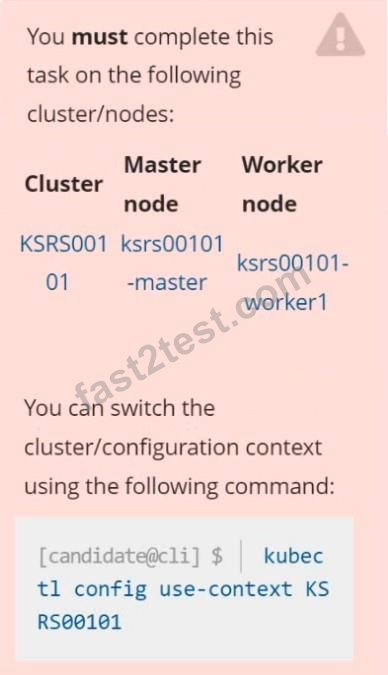

Two tools are pre-installed on the cluster's worker node:
Using the tool of your choice (including any non pre-installed tool), analyze the container's behavior for at least 30 seconds, using filters that detect newly spawning and executing processes.
Store an incident file at /opt/KSRS00101/alerts/details, containing the detected incidents, one per line, in the following format:
The following example shows a properly formatted incident file: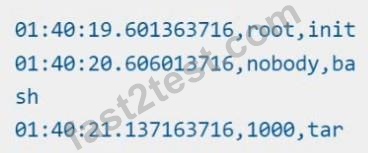


Correct Answer:
See explanation below
Explanation:


SIMULATION
You can switch the cluster/configuration context using the following command:
[desk@cli] $ kubectl config use-context qa
Context:
A pod fails to run because of an incorrectly specified ServiceAccount
Task:
Create a new service account named backend-qa in an existing namespace qa, which must not have access to any secret.
Edit the frontend pod yaml to use backend-qa service account
Note: You can find the frontend pod yaml at /home/cert_masters/frontend-pod.yaml
Correct Answer:
See the Explanation belowExplanation:
[desk@cli] $ k create sa backend-qa -n qa
sa/backend-qa created
[desk@cli] $ k get role,rolebinding -n qa
No resources found in qa namespace.
[desk@cli] $ k create role backend -n qa --resource pods,namespaces,configmaps --verb list
# No access to secret
[desk@cli] $ k create rolebinding backend -n qa --role backend --serviceaccount qa:backend-qa
[desk@cli] $ vim /home/cert_masters/frontend-pod.yaml
apiVersion: v1
kind: Pod
metadata:
name: frontend
spec:
serviceAccountName: backend-qa # Add this
image: nginx
name: frontend
[desk@cli] $ k apply -f /home/cert_masters/frontend-pod.yaml
pod created
[desk@cli] $ k create sa backend-qa -n qa
serviceaccount/backend-qa created
[desk@cli] $ k get role,rolebinding -n qa
No resources found in qa namespace.
[desk@cli] $ k create role backend -n qa --resource pods,namespaces,configmaps --verb list role.rbac.authorization.k8s.io/backend created
[desk@cli] $ k create rolebinding backend -n qa --role backend --serviceaccount qa:backend-qa rolebinding.rbac.authorization.k8s.io/backend created
[desk@cli] $ vim /home/cert_masters/frontend-pod.yaml
apiVersion: v1
kind: Pod
metadata:
name: frontend
spec:
serviceAccountName: backend-qa # Add this
image: nginx
name: frontend
[desk@cli] $ k apply -f /home/cert_masters/frontend-pod.yaml
pod/frontend created
https://kubernetes.io/docs/tasks/configure-pod-container/configure-service-account/
Viewing page 1 out of 14 pages.
Viewing questions 1-5 out of 66 questions.
1334 Customer ReviewsCustomers Feedback (* Some similar or old comments have been hidden.)
These CKS exam dumps are updated and valid. I passed my certification exam.

Roberta

This is super great that Fast2test offers valid and helpful CKS exam braindump. I have passed the CKS exam after studying for three days with it.

Lawrence
Fast2test dumps seem a blessing especially for exam candidates like me who have not a thorough background and hands on practice of the certification syllabus. They provide you the easiest and Lucky to Pass CKS Exam!

Ira
This time not only i passed, but also i also passed with high scores in my examination. Good guides!

Roxanne
There were free demo for CKS exam training materials for me to have a try before buying, and it was the free demo that made me decide to buy the CKS exam dumps, since I was satisfied with the demo.

Katherine
Trust me if you remember all questions and answers from the CKS exam braindumps, you will pass it with high score.

Esther

Keep on your great work.Luckily to find your site.

Kevin
It's a good CKS exam dumps, I passed the exams of CKS with 87 % marks, I am really glad for such remarkable performance.

Ralap
I just pass my CKS exam yesterday and score high.

Harry
I took the Linux Foundation CKS exam yesterday and passed with 91%.

Aldrich
Thank you!
I have got your CKS update yesterday.

Mark
Your CKS exam braindumps helped me get the CKS certification without difficulty. Thank you,Fast2test!

Stacey
There is nothing more exciting than to know that i have passed the CKS exam. Thanks! I will introduce Fast2test to all my friends.

Berger
I'm really happy I choose the CKS dumps to prepare my exam, I have passed my exam today.

Marlon
I haved attended to my CKS exam last week and passed. Guys this CKS exam study material is really amazing and second to none for providing results.

Celeste
The after-service of Fast2test is very perfect I got my Linux Foundation CKS certificate several days ago, now I want to express my thanks to Fast2test. If you are worried about your IT certification examination, I suggest that you can use the exam dumps on Fast2test.

Sam
a lot of the same questions but there are some differences. Still valid. Tested out today in U.S. and was extremely prepared, did not even come close to failing.

Tyrone
I guess any guy who buy this CKS practice engine can pass the exam, it is so excellent. I got full marks with it. It is really amazing! Thank you so much!

Nigel
I thought that the CKS exam is difficult, but with CKS, i found it is not difficult as i imagined before. I passed it easily!

Brook
Just returned from exam center with passing score. Guys this CKS exam pdf is still valid but there were few new questions added to exam but shouldn't be a problem for an experienced guy...Cheers !

Benson
Related Exams
Related Posts
Instant Download CKS
After Payment, our system will send you the products you purchase in mailbox in a minute after payment. If not received within 2 hours, please contact us.
365 Days Free Updates
Free update is available within 365 days after your purchase. After 365 days, you will get 50% discounts for updating.

Money Back Guarantee
Full refund if you fail the corresponding exam in 60 days after purchasing. And Free get any another product.
Security & Privacy
We respect customer privacy. We use McAfee's security service to provide you with utmost security for your personal information & peace of mind.
Contact Us
If you have any question please leave me your email address, we will reply and send email to you in 12 hours.
Our Working Time: ( GMT 0:00-15:00 ) From Monday to Saturday
Support: Contact now