

Based on Official Syllabus Topics of Actual SAP C-ABAPD-2507 Exam
Free C-ABAPD-2507 Dumps are Available for Instant Access
NEW QUESTION # 25
Given the following code,
DATA gv_text1 TYPE string. "#EC_NEEDED
DATA gv_text2 TYPE string ##NEEDED.
What are valid statements? Note: There are 2 correct answers to this question.
- A. ##NEEDED is checked by the syntax checker.
- B. The pragma is not checked by the syntax checker.
- C. #EC_NEEDED is not checke d by the syntax checker.
- D. The pseudo-comment is checked by the syntax checker.
Answer: A,C
NEW QUESTION # 26
When defining a METHOD, which parameter type can only have 1 value?
- A. CHANGING
- B. IMPORTING
- C. RETURNING
- D. EXPORTING
Answer: C
Explanation:
Comprehensive and Detailed Explanation from Exact Extract:
In ABAP Object-Oriented Programming within ABAP Cloud, methods can define multiple parameters of type IMPORTING, EXPORTING, or CHANGING. However, for RETURNING parameters, only one value is permitted per method.
This restriction ensures that RAP BOs and ABAP Cloud classes expose methods with clear, unambiguous outputs, aligning with best practices of encapsulation and functional programming design.
* IMPORTING # multiple allowed
* EXPORTING # multiple allowed
* CHANGING # multiple allowed
* RETURNING # exactly one allowed
Verified Study Guide Reference: ABAP Objects Programming Guide (Methods), ABAP Cloud Back-End Developer Documentation - Method Signature Rules.
NEW QUESTION # 27
Which internal table type allows unique and non-unique keys?
- A. Hashed
- B. Standard
- C. Sorted
Answer: C
Explanation:
Comprehensive and Detailed Explanation from Exact Extract:
* Sorted tables can be declared with unique keys (ensuring no duplicates) or with non-unique keys (allowing duplicates).
* Hashed tables only allow unique keys.
* Standard tables allow non-unique keys only.
Thus, sorted internal tables are the only type that can be configured with both unique and non-unique keys.
Verified Study Guide Reference: ABAP Dictionary and ABAP Cloud Programming Guide - Internal Table Types.
NEW QUESTION # 28
How do you make class sub1 a subclass of class super1?
- A. In sub1 use clause "INHERITING FROM super1" in the IMPLEMENTATION part.
- B. In super1 use clause "sub1 REDEFINITION" in the DEFINITION part.
- C. In sub1 use clause "INHERITING FROM super1" in the DEFINITION part.
- D. In super1 use clause "sub1 REDEFINITION" in the IMPLEMENTATION part.
Answer: C
Explanation:
Comprehensive and Detailed Explanation From Exact Extract:
In ABAP, inheritance is declared in the class DEFINITION using the keyword INHERITING FROM. The RAP documentation shows this exact syntax in multiple class definitions, for example:
* "CLASS lcl_local_event_consumption DEFINITION INHERITING FROM
cl_abap_behavior_event_handler." This proves the inheritance clause belongs to the DEFINITION section, not the IMPLEMENTATION, and uses the form INHERITING FROM <superclass>.(Back- End Developer - ABAP Cloud study areas: RAP handler/event classes use standard ABAP OO rules; architecture shows inheritance declared in DEFINITION with INHERITING FROM.)
NEW QUESTION # 29
Which of the following ABAP SQL statements are valid? Note: There are 2 correct answers to this question.
- A. SELECT FROM /dmo/connection FIELDS V D MAX(distance) AS dist_max
MIN(distance) AS dist_min INTO TABLE @DATA(It_hits). - B. SELECT FROM /dmo/connection FIELDS r-i carrid, airpfrom u GROUP BY carrid, connid INTO TABLE @DATA(It_hits).
- C. SELECT FROM /dmo/connection FIELDS carrid O airpfrom,
MAX(distance) AS dist_max, MIN( distance) AS dist_min GROUP BY carrid, airpfrom INTO TABLE @DATA(It_hits) - D. SELECT FROM /dmo/connection FIELDS \/ O carrid, airpfrom,
MAX( distance) AS dist_max, MIN(distance) AS dist_min INTO TABLE @DATA(It_hits)
Answer: C,D
Explanation:
The following are the explanations for each ABAP SQL statement:
A: This statement is valid. It selects the fields carrid, airpfrom, and the aggregate functions MAX(distance) and MIN(distance) from the table /dmo/connection, and groups the results by carrid and airpfrom. The aggregate functions are aliased as dist_max and dist_min. The results are stored in an internal table named It_hits, which is created using the inline declaration operator @DATA.
B: This statement is valid. It is similar to statement A, except that it does not specify the GROUP BY clause. This means that the aggregate functions are applied to the entire table, and the results are stored in an internal table named It_hits, which is created using the inline declaration operator @DATA.
C: This statement is invalid. It selects the aggregate functions MAX(distance) and MIN(distance) from the table /dmo/connection, but it does not specify any grouping or non-aggregate fields. This is not allowed in ABAP SQL, as the SELECT list must contain at least one non-aggregate field or a GROUP BY clause. The statement will cause a syntax error.
D: This statement is invalid. It selects the fields carrid and airpfrom from the table /dmo/connection, and groups the results by carrid and connid. However, the field connid is not included in the SELECT list, which is not allowed in ABAP SQL, as the GROUP BY clause must contain only fields that are also in the SELECT list. The statement will cause a syntax error.
NEW QUESTION # 30
Which of the following are features of Core Data Services? Note: There are 3 correct answers to this question.
- A. Annotations
- B. Delegation
- C. Inheritance
- D. Associations
- E. Structured Query Language (SQL)
Answer: A,D,E
NEW QUESTION # 31
While debugging an ABAP program, you want the program to stop whenever the value of a variable changes.
Which of the following do you use?
- A. Watchpoint
- B. Conditional breakpoint
- C. Exception breakpoint
Answer: A
Explanation:
Comprehensive and Detailed Explanation from Exact Extract:
* A watchpoint halts program execution when the content of a specified variable changes.
* Exception breakpoints # Trigger when exceptions are raised.
* Conditional breakpoints # Stop only if a Boolean condition is true at that line.
Thus, watchpoint is the correct tool for variable-change monitoring.
Study Guide Reference: ABAP Debugging Guide - Breakpoints and Watchpoints.
NEW QUESTION # 32
When you join two database tables, which of the following rules applies to the database fields you use in the join?
- A. They must always have an alias name.
- B. They must have the same name, e.g. col1 = col1.
- C. They must be compared with an ON condition.
- D. They must be the same position in their table, for example left_table-col1 = rigght_table-col1.
Answer: C
NEW QUESTION # 33
Given the following code excerpt that defines an SAP HANA database table: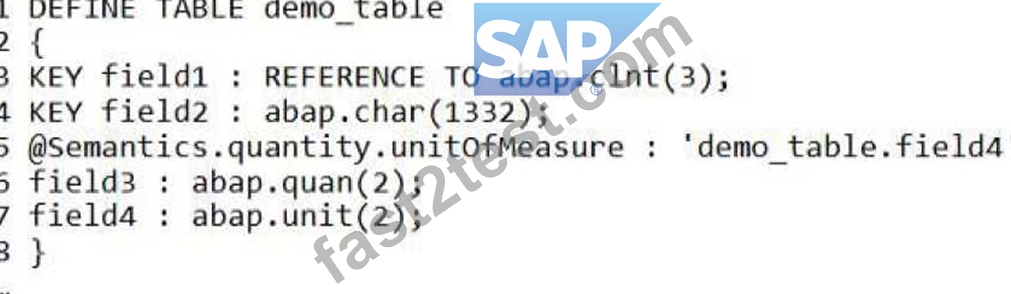
Which field is defined incorrectly?
- A. field4
- B. field3
- C. field1
- D. field2
Answer: C
NEW QUESTION # 34
In the assignment, data (gv_result) = 1/8. what will be the data type of gv_result?
- A. TYPE DEFLOAT 16
- B. OTYPE I
- C. TYPE P DECIMALS 3
- D. TYPE P DECIMALS 2
Answer: A
Explanation:
The data type of gv_result in the assignment data (gv_result) = 1/8 will be TYPE DECFLOAT 16. This is because the assignment operator (=) in ABAP performs an implicit type conversion from the source type to the target type, according to the following rules12:
If the target type is specified explicitly, the source value is converted to the target type.
If the target type is not specified explicitly, the source type is used as the target type, unless the source type is a literal or an expression, in which case the target type is determined by the following priority order: DECFLOAT34, DECFLOAT16, P, F, I, C, N, X, STRING, XSTRING.
In this case, the target type is not specified explicitly, and the source type is an expression (1/8). Therefore, the target type is determined by the priority order, and the first matching type is DECFLOAT16, which is a decimal floating point type with 16 digits of precision12.
NEW QUESTION # 35
What can you do in SAP S/4HANA Cloud, public edition? (2 correct)
- A. Use ABAP Development Tools in Eclipse (ADT)
- B. Modify SAP objects
- C. Use Web Dynpros
- D. Use SAP-released extension points
Answer: A,D
Explanation:
Comprehensive and Detailed Explanation From Exact Extract:
* Use ABAP Development Tools (ADT) in Eclipse: For ABAP Cloud development, ADT must be used
, and modern object types such as CDS View Entities and Behavior Definitions can only be edited in ADT. This confirms option B.
* Use SAP-released/predefined extension points: RAP extensibility is opt-in; every possible extension point must be defined explicitly in the original BO artifacts. Extensions are performed only at these predefined points to ensure lifecycle stability-this is exactly the "use SAP-released extension points" rule. This confirms option A.
* In contrast, directly modifying SAP objects is not part of the clean-core, upgrade-stable model for public cloud; extensions must adhere to released APIs and predefined points (therefore C is not correct).
The classic Web Dynpro UI technology is not the target for ABAP Cloud development in S/4HANA Cloud public edition (therefore D is not correct). (Context anchored by the extensibility/clean-core guidance above.) Study-Guide anchors: ABAP Cloud development with ADT only; RAP opt-in extensibility and predefined extension points for cloud-ready, upgrade-safe extensions.
NEW QUESTION # 36
When you join two database tables, which of the following rules applies to the database fields you use in the join?
- A. They must always have an alias name.
- B. They must be at the same position in their table, for example left_table-col1 = right_table-col1.
- C. They must have the same name, e.g. col1 = col1.
- D. They must be compared with an ON condition.
Answer: D
Explanation:
Comprehensive and Detailed Explanation From Exact Extract:
When performing a JOIN in ABAP SQL or CDS:
* The key requirement is to specify the ON condition, which compares fields from the two tables, typically via equality (e.g., ON a.field = b.field). Hence, Option D is correct.
* The fields do not need to have the same name (Option C is incorrect).
* The position in the table structure is irrelevant (Option A is incorrect).
* An alias name is optional, not mandatory (Option B is incorrect).
Reference: SAP Help 3, page 3 - When defining CDS views with joins, the ON condition defines the semantic relationship between entities.
NEW QUESTION # 37
In a subclass sub1, you want to redefine a component of a superclass super1.
How do you achieve this?
Note: There are 2 correct answers to this question.
- A. You add the clause REDEFINITION to the component in sub1.
- B. You add the clause REDEFINITION to the component in super1.
- C. You implement the redefined component for a second time in super1.
- D. You implement the redefined component in sub1.
Answer: A,D
Explanation:
Comprehensive and Detailed Explanation From Exact Extract:
To redefine a component in a subclass:
* The component (method) in the superclass must be defined with the FOR REDEFINITION addition.
* In the subclass, you use the REDEFINITION clause in the method declaration and implement the method in the subclass to override the superclass behavior.
Thus:
* Option A is correct because the method declaration in sub1 must include the REDEFINITION addition.
* Option D is correct because the actual redefined method implementation must be provided in the subclass sub1.
* Option B is incorrect because the component is not re-implemented in the superclass.
* Option C is incorrect because REDEFINITION is not added in the superclass, but FOR REDEFINITION is.
Reference: SAP Help 2, section on object-oriented ABAP programming with class-based components and redefinitions in inheritance structures.
NEW QUESTION # 38
Which of the following Core Data Services built-in functions returns a result of type INT4?
(Select 2 correct answers)
- A. dats_is_valid
- B. dats_add_months
- C. dats_days_between
- D. dats_add_days
Answer: C,D
Explanation:
Comprehensive and Detailed Explanation from Exact Extract:
* dats_add_days # # Returns the number of days added/subtracted to a given date # INT4.
* dats_days_between # # Returns the number of days between two dates # INT4.
* dats_add_months # # Returns a DATE, not INT4.
* dats_is_valid # # Returns a BOOLEAN (flag), not INT4.
In CDS, these date functions are used for calculations in queries, supporting business logic pushdown.
Verified Study Guide Reference: ABAP CDS Functions Reference - Date and Time Functions.
NEW QUESTION # 39
After you created a database table in the RESTful Application Programming model, what do you create next?
- A. A metadata extension
- B. A data model view
- C. A projection view
- D. A service definition
Answer: B
NEW QUESTION # 40
How can you control data access of a business user?
Note: There are 3 correct answers to this question.
- A. To control the "Create, Update, and Delete access" implicitly via an Access Control object (define role).
- B. To control the general access implicitly via an Access Control object (define role).
- C. To control the "Read access" via explicit check using AUTHORITY-CHECK.
- D. To control the "Read access" implicitly via an Access Control object (define role).
- E. To control the "Create, Update, and Delete access" via explicit check using AUTTHORITY-
Answer: B,C,E
NEW QUESTION # 41
What would be the correct expression to change a given string value 'mr joe doe' into 'JOE' in an ABAP SQL field list?
- A. SELECT FROM TABLE dbtabl FIELDS
Of1,
substring(lower(upper( 'mr joe doe' ) ), 4, 3) AS f2_sub_lo_up, f3, - B. SELECT FROM TABLE dbtabl FIELDS
Of1,
substring(upper('mr joe doe'), 4, 3) AS f2_sub_up, f3,... - C. SELECT FROM TABLE dbtabl FIELDS
Of1,
left(lower(substring( 'mr joe doe', 4, 3)), 3) AS f2_left_lo_sub, f3, - D. SELECT FROM TABLE dbtabl FIELDS
Of1,
upper(left( 'mr joe doe', 6)) AS f2_up_left, f3,
Answer: B
Explanation:
The correct expression to change a given string value 'mr joe doe' into 'JOE' in an ABAP SQL field list is C. SELECT FROM TABLE dbtabl FIELDS Of1, substring(upper('mr joe doe'), 4, 3) AS f2_sub_up, f3,... This expression uses the following SQL functions for strings12:
upper: This function converts all lowercase characters in a string to uppercase. For example, upper('mr joe doe') returns 'MR JOE DOE'.
substring: This function returns a substring of a given string starting from a specified position and with a specified length. For example, substring('MR JOE DOE', 4, 3) returns 'JOE'.
AS: This keyword assigns an alias or a temporary name to a field or an expression in the field list. For example, AS f2_sub_up assigns the name f2_sub_up to the expression substring(upper('mr joe doe'), 4, 3).
You cannot do any of the following:
A . SELECT FROM TABLE dbtabl FIELDS Of1, upper(left( 'mr joe doe', 6)) AS f2_up_left, f3,...: This expression uses the wrong SQL function for strings to get the desired result. The left function returns the leftmost characters of a string with a specified length, ignoring the trailing blanks. For example, left( 'mr joe doe', 6) returns 'mr joe'. Applying the upper function to this result returns 'MR JOE', which is not the same as 'JOE'.
B . SELECT FROM TABLE dbtabl FIELDS Of1, left(lower(substring( 'mr joe doe', 4, 3)), 3) AS f2_left_lo_sub, f3,...: This expression uses unnecessary and incorrect SQL functions for strings to get the desired result. The lower function converts all uppercase characters in a string to lowercase. For example, lower(substring( 'mr joe doe', 4, 3)) returns 'joe'. Applying the left function to this result with the same length returns 'joe' again, which is not the same as 'JOE'.
D . SELECT FROM TABLE dbtabl FIELDS Of1, substring(lower(upper( 'mr joe doe' ) ), 4, 3) AS f2_sub_lo_up, f3,...: This expression uses unnecessary and incorrect SQL functions for strings to get the desired result. The lower function converts all uppercase characters in a string to lowercase, and the upper function converts all lowercase characters in a string to uppercase. Applying both functions to the same string cancels out the effect of each other and returns the original string. For example, lower(upper( 'mr joe doe' ) ) returns 'mr joe doe'. Applying the substring function to this result returns 'joe', which is not the same as 'JOE'.
NEW QUESTION # 42
Which of the following are valid sort operations for internal tables? Note: There are 3 correct answers to this question.
- A. SORT itab BY fieldl ASCENDING field2 DESCENDING.
Sort a standard table using - B. SORT itab DESCENDING.
- C. SORT itab BY field1 field2.
Sort a standard table using - D. SORT itab.
Sort a sorted table using - E. Sort a standard table using
SORT itab ASCENDING.
Sort a sorted table using
Answer: C,D,E
NEW QUESTION # 43
What are some features of the current ABAP programming language? (Select 2)
- A. The code is expression-based.
- B. Keywords are case-sensitive.
- C. It has built-in database access.
- D. A data object's type can change at runtime.
Answer: A,C
Explanation:
Comprehensive and Detailed Explanation From Exact Extract:
* ABAP for Cloud Development emphasizes expression-oriented, typed programming with strong static checks (e.g., constructor/operators, REDUCE, COND, etc.), which is the modern ABAP style used in RAP.
* ABAP integrates built-in database access tightly via CDS and Open SQL; CDS entities are the building blocks and govern data access that the runtime executes via the SQL view.
* (A) is false (ABAP is statically typed). (B) is false (ABAP keywords are not case-sensitive).
NEW QUESTION # 44
......
SAP C-ABAPD-2507 Exam Syllabus Topics:
| Topic | Details |
|---|---|
| Topic 1 |
|
| Topic 2 |
|
| Topic 3 |
|
| Topic 4 |
|
| Topic 5 |
|
The Most In-Demand C-ABAPD-2507 Pass Guaranteed Quiz : https://www.fast2test.com/C-ABAPD-2507-premium-file.html
View All C-ABAPD-2507 Actual Exam Questions Answers and Explanations for Free: https://drive.google.com/open?id=1aZ8W-cpsTC5szvsVE7PsGFdq6-l0QEbS