

Download L4M7 Dumps (2025) - Free PDF Exam Demo
Enhance your career with L4M7 PDF Dumps - True CIPS Exam Questions
CIPS L4M7 exam is a highly specialized qualification that focuses on Whole Life Asset Management. It is designed for professionals who are looking to enhance their skills in the field of asset management and develop a deep understanding of the entire lifecycle of an asset. L4M7 exam is recognized globally and is highly respected in the industry. It covers a range of topics and requires a high level of dedication and commitment from candidates. L4M7 exam is an excellent opportunity for asset management professionals to demonstrate their expertise and advance their careers.
CIPS L4M7 certification exam is ideal for individuals who are involved in asset management roles within their organization, such as facilities managers, maintenance managers, and procurement professionals. It is also suitable for those who are looking to enhance their skills and knowledge in asset management to pursue a career in this field. By obtaining this certification, professionals will be able to demonstrate their expertise in asset management principles and practices, which can help them to advance their careers and improve their job prospects.
NEW QUESTION # 13
Staff at DIY Products Inc (DPI) have been experiencing issues with the identification of stock items. The current labelling system is outdated and unreliable. DPI has therefore invested in a machine-readable approach. Each item has a unique number that is attached visibly to the packaging. This number can be deciphered by a scanner to aid identification. This approach is known as which of the following?
- A. Product tagging
- B. Standard certification
- C. Order tracking
- D. Bar coding
Answer: D
NEW QUESTION # 14
A manufacturer is making a plan for strategic safety stock. To do so, they must analyse the proba-bility of a stock out occurring and the cost impacts if it does. Which of the following are typical costs the manufacturer may incur in 'out of stock' event? Select TWO that apply.
- A. Extra costs for urgent transportation
- B. Costs for qualifying suppliers
- C. Costs of approving the requisition
- D. Cost of equipment downtime
- E. Costs of handling inventory
Answer: A,D
Explanation:
The costs of stockouts - the costs of being out of inventory - include:
- Loss of production output
- Costs of idle time and of fixed overheads spread over a reduced level of output
- Costs of any action taken to deal with the stockout, such as buying from another stockist at an enhanced price, switching production, obtaining substitute materials
- Loss of customer goodwill due to the inability to supply or late delivery.
(Procurement and Supply Chain management - 9th Edition, K. Lysons and B. Farrington, 2016) LO 2, AC 2.2
NEW QUESTION # 15
Which of the following are examples of associated costs resulting from running out of inventory? SelectTWO that apply.
- A. The costs associated with the IT ordering platform
- B. The costs associated with receipting the goods
- C. The costs associated with urgent delivery of raw materials
- D. The costs associated with product deterioration
- E. The costs associated with production machine downtime
Answer: C,E
NEW QUESTION # 16
Which of the following is NOT an improvement available in ERP II in compare with ERP?
- A. ERP II systems are closed and silo-working
- B. ERP II enables the organisation to collaborate with trading partners across the supply chain
- C. ERP II offers better integration with other proprietary software
- D. ERP II crosses all sectors and segments of business, including service, government and asset-based industries
Answer: A
Explanation:
The main improvements from ERP to ERP II are the following:
- ERP II is web enabled as compared to Conventional ERP Which is not.
- ERP is restricted to provide selected exhaustive or rigorous or wide-spread coverage in its mod-ules. But as compared to ERP, ERP II provides the true and accurate blend of the macro and the micro and affords customers with curative actions/measures after identifying the slip-up/error or fault;
- ERP was embattled more headed for manufacturing or industrialization and the dilemma or difficulty is conquer in ERP II by endowing clarification for all kind of industries and sectors.
- ERP is not in the position or could not possibly integrate/incorporate diverse functions from di-verse departments/divisions but ERP II could possibly do so as well as from different industries as compared to conventional ERP.
- For WEB and WAP connectivity ERP II grip CRM and SCM Functionalities.
- ERP II be obliged the function and purpose to an external/outdoor one and smooth the progress of better networks than remaining as internal/interior application.
NEW QUESTION # 17
In just in time production system, when is an upstream production triggered?
- A. After the management team forecasts the future demands
- B. When downstream operations summon the upstream production
- C. When the inventory level reaches the reorder point
- D. When the production workers are idle
Answer: B
Explanation:
Along with Jidoka, Just-in-time (JIT) production is one of the pillars of the two Toyota Production System. It is a production method that fundamentally changed the way large-scale production oc-curred in the 20th century, and is the basis for Lean Manufacturing (Lean for short), which is the school of thought many modern companies have modeled themselves after.
JIT production is often called a pull system because instead of using traditional push production where scheduling is done based on historical data and demand forecasting, production is scheduled based on actual customer orders. Rather than predicting demands from customers, the JIT method requires that actual customer demand exists. Production doesn't begin before an order triggers it. This system not only reduces the amount of extra inventory, but also reduces the amount of work in progress at one time.
Reference:
- Just-in-Time Production
- CIPS study guide page 122-127
LO 2, AC 2.3
NEW QUESTION # 18
When deciding on the storage facilities and locations, an organisation needs to assess the current situation comprehensively and forecast the future demands. Quantitative analysis is the best method for these activities. Is this statement true?
- A. No, some intangible information is difficult to collect and measure
- B. Yes, quantitative analysis provides a reality based on numerical values
- C. No, subjective judgements are the best as they compensate for weaknesses of quantita-tive analysis
- D. Yes, quantitative analysis is easy to implement as it is based on 'hard' facts
Answer: A
Explanation:
Decisions regarding stores and warehouse locations involve a complex range of issues that are unique to each business. Most storage facilities and location decisions are based on a combination of qualitative and quantitative analysis.
Qualitative analysis uses subjective judgment to analyze a situation based on non-quantifiable in-formation, such as potential markets for new products, forecast on possible risks that may happen, etc.
Quantitative analysis (QA) is a technique that uses mathematical and statistical modeling, meas-urement, and research to understand behavior. Quantitative analysts represent a given reality in terms of a numerical value. This may include the following:
- Cost analysis for the current premises and future predictions based on current premises
- Cost analysis for routine operations
- Current inventory performance measures: lead times, service levels, rate of stock turn, stock-outs in a given period and stock cover To get a big picture of current situation and future demands, organisation should combine both qualitative and quantitative methods so that useful information is achieved and well-informed decisions are made.
Reference:
LO 1, AC 1.1
NEW QUESTION # 19
Which of the following are most likely to be the purposes of packing and packaging?
1. To bring the product cost down
2. To protect the product
3. To improve the product recognition
4. To test the product durability
- A. 2 and 3 only
- B. 1 and 2 only
- C. 3 and 4 only
- D. 1 and 4 only
Answer: A
Explanation:
It would be really convenient if we could just hand our products directly to the customers, but that's not possible. Packaging needs to be done for several reasons. Here are some of the most prominent ones:
1. Safety: Packaging is used to keep your product safe from external factors. It also prevents human tampering. If you want to sell fruit juice, you just can't hand it over to customers. It should be packaged in something, like a stand up pouch.
2. Brand visibility: You provide the best product in your category and you want your customers to remember that. How else will you do that without using the right kind of creative food packaging?
3. Bundling it together: If you want to sell an ounce of something, you need to create a packet so that the right amount is bundled together.
4. Theft prevention: If you sell your product loose, there are chances that the retailer doesn't give the right amount to the customer and saves some part for himself. There are other cases too where theft can be done in the absence of packaging.
Apart from these four, there are many other reasons why you should package your products.
Reference:
- What Is the Purpose of Packaging?
- CIPS study guide page 62
LO 1, AC 1.3
NEW QUESTION # 20
Which of the following is the formula for calculating the re-order level?
- A. Average usage in a lead-time / Required level of safety stock
- B. Required level of safety stock x Average usage in a lead-time.
- C. Required level of safety stock - Average usage in a lead-time
- D. Average usage in a lead-time + Required level of safety stock
Answer: D
Explanation:
In management accounting, reorder level (or reorder point) is the inventory level at which a com-pany would place a new order or start a new manufacturing run.
Reorder level depends on a company's work-order lead time and its demand during that time and whether the company maintain a safety stock.
If a company maintains a safety stock, reorder level calculation changes are follows:
Reorder Level = Average Demand × Lead Time + Safety Stock
NEW QUESTION # 21
MRP software is a powerful tool for managing material requirements of manufacturing processes. To keep the software function well, an organisation must have appropriate input data. Which of the following are the inputs of MRP software? Select THREE that apply.
- A. Payrolls information
- B. Facilities management
- C. Capacity requirement plan
- D. Inventory records
- E. Bill of materials
- F. Master production schedule
Answer: D,E,F
Explanation:
A powerful benefit of MRP system is the capacity to produce exception reports, which show deviations from normal planning and performance. These enable anomalies to be investigated with a view to improve future forecasting.
Material requirement planning is an electronic system for combining the following:
- Known demand
- Forecast demand. Known demand and forecasted demand are shown in master production schedule.
- Bill of materials for the final product
- Inventory records
NEW QUESTION # 22
What term describes the method used to account for inventory, where the most recently produced items are recorded as sold first?
- A. Last in, last out
- B. First in, first out
- C. First in, last out
- D. Last in, first out
Answer: D
Explanation:
Last In, First Out (LIFO) is an inventory valuation method where the latest items added to inventory are considered sold first. This method is often used in situations where prices are rising, as it reflects the current cost of goods sold. In whole-life asset management, LIFO can affect the reported value of inventory and, consequently, tax implications, as newer, costlier items are sold off first.
NEW QUESTION # 23
XYZ Ltd is looking for new office space overseas. To keep the overhead expense minimal, it chooses leasing rather than purchasing new office. In leasing contract, which of the following costs are most likely to be attributable to the lessee?
1. Disposal costs
2. Rentals
3. Operating costs
4. Vendor selection costs
- A. 1, 3 and 4
- B. 1, 2 and 3
- C. 2, 3 and 4
- D. 1, 2 and 4
Answer: C
Explanation:
A lease is a contractual arrangement calling for the lessee (user) to pay the lessor (owner) for use of an asset.
Property, buildings and vehicles are common assets that are leased. Industrial or business equipment is also leased. Since the lessee does not own the asset, it is not responsible for disposing the assets, and therefore, disposal costs are not attributable to the lessee. The lessee usually incurs rentals and operating costs. Finally, a company should treat the lease the same as other contracts, which they must qualify the supplier.
NEW QUESTION # 24
An organization might find it more beneficial to lease and use an asset over a predetermined period. After this period, the lessee has the right to secure outright ownership of the asset by paying an agreed amount; otherwise, the asset would be repossessed by the lessor. Which of the following is an advantage of leasing?
- A. The total cost of ownership is not applicable as the asset is leased
- B. The usage of the asset is usually capped
- C. Costs are known and agreed in advance
- D. Long-term commitment to pay installments even if not using the asset
Answer: C
Explanation:
Leasing allows an organization to predict costs accurately, as installment payments are pre-agreed. This makes financial planning simpler, which is especially beneficial in whole-life asset management where minimizing upfront capital expenditure is often a priority. Leasing also reduces the risk associated with asset obsolescence.
NEW QUESTION # 25
Which of the following are essential aspects that are required for the successful implementation of Just-In- Time (JIT)? SelectTWOthat apply.
- A. Parts must arrive where they are needed, when they are needed, and in the exact quantity needed
- B. All parts arriving must be of a quality standard which is usable and free from defects
- C. The cost of carrying increased parts inventory to meet customer demand is transferred to the customer
- D. The purchasing of parts in bulk at lower prices covers the costs of delivery and storage required for JIT
- E. Suppliers must hold a buffer stock of components to ensure that they are able to meet JIT demand
Answer: A,B
NEW QUESTION # 26
Which of the following code systems is commonly used by governments as a basis for their Cus-toms tariffs and for the collection of international trade statistics?
- A. Global Trade Item Number
- B. Global Location Number
- C. The International Mobile Equipment Identity
- D. The Harmonized Commodity Description and Coding System
Answer: D
Explanation:
The Harmonized Commodity Description and Coding System, also known as the Harmonized System (HS) of tariff nomenclature is an internationally standardized system of names and numbers to classify traded products. It came into effect in 1988 and has since been developed and maintained by the World Customs Organization (WCO) (formerly the Customs Co-operation Council), an independent intergovernmental organization based in Brussels, Belgium, with over 200 member countries.
The Global Trade Item Number (GTIN) is an identifier for trade items, developed by GS1. Such identifiers are used to look up product information in a database (often by entering the number through a barcode scanner pointed at an actual product) which may belong to a retailer, manufacturer, collector, researcher, or other entity.
The Global Location Number can be used by companies to identify their locations, giving them complete flexibility to identify any type or level of location required.
The International Mobile Equipment Identity (IMEI) is a number, usually unique, to identify 3GPP and iDEN mobile phones, as well as some satellite phones.
NEW QUESTION # 27
Sidel Corp is a major food processor. It invested heavily on manufacturing facilities and processing machineries. Sidel's expenses on maintenance are exceptionally high. To minimise the total cost of maintenance, what should Sidel Corp do?
- A. Replace every machineries at breakdowns
- B. Balance between proactive maintenance and reactive maintenance
- C. Outsource corrective maintenance but in-source preventative maintenance.
- D. Only conduct preventative maintenance
Answer: B
Explanation:
Maintenance can represent a significant portion of the cost in asset intensive organisations (such as Sidel - a food processor), as breakdowns have an impact on the capacity, quality and cost of operation. However, the formulation of a maintenance strategy depends on a number of factors, including the cost of down time, reliability characteristics and redundancy of assets. Consequently, the balance between preventive maintenance (PM) and corrective maintenance (CM) for minimising costs varies between organisations and assets. Nevertheless, there are some rules of thumb on the balance between PM and CM, such as the 80/20 rule.
Preventive maintenance is a type of proactive maintenance, while corrective maintenance is an example of reactive maintenance. Therefore, the answer should be "Balance between proactive maintenance and reactive maintenance".
NEW QUESTION # 28
In inventory management, the cost of insurance and taxes are included in which group?
- A. Acquisition costs
- B. Set up costs
- C. Costs of shortage
- D. Inventory carrying cost
Answer: D
Explanation:
Direct and indirect costs of holding inventory include the following:
1. Acquisition costs
2. Holding costs (carrying costs) are the costs associated with the storage and handling of physical stock. There are two different types of holding costs:
a. Costs related to the value of the goods: financial costs (i.e. the interest on the working capital tied up in inventory, which may be the bank borrowing rate or the company's target for return on capital); cost of insurance; losses due to product deterioration; losses due to obsolescence and redundancy of inventory; losses due to theft, accidental damage etc.
b. Costs related to the physical characteristics of the inventory include the following: storage space; power, heat and lighting of the store; movement equipment; labour costs; administration costs.
3. Costs of stockouts
Reference:
LO 2, AC 2.2
NEW QUESTION # 29
MRP software is applied to schedule which of the following?
- A. Tax accounting
- B. Executive meetings
- C. Human resource management
- D. Production processes
Answer: D
Explanation:
Material Requirements Planning (MRP) software manages material requirements for manufacturing processes.
LO 2, AC 2.3
NEW QUESTION # 30
Holding inventory is key to ensure that an organisation can maintain production and meet customer demands.
Which of the following are classes of inventory? SelectTHREEthat apply.
- A. Sub-assemblies
- B. Forklift trucks
- C. Raw material
- D. Finished products
- E. Scrap components
- F. Machines
Answer: A,C,D
NEW QUESTION # 31
Which of the following factors influence stock-holding policy for slow-moving items?
* Item cost
* Surplus cost
* Shortage cost
* Lead time
- A. 1, 2 and 4 only
- B. 2, 3 and 4 only
- C. 1, 3 and 4 only
- D. 1, 2 and 3 only
Answer: D
NEW QUESTION # 32
When accounting for the disposal of fixed assets, the gain or loss on disposal is equal to...?
- A. The difference between resale price and the cost of the asset less depreciation up to the beginning of the year in which disposal took place
- B. The difference between resale price and the cost of that asset
- C. The difference between resale price and the cost or valuation plus depreciation up to the beginning of the year in which disposal took place
- D. The difference between resale price and the cost or valuation less accumulated depre-ciation up to the date of disposal
Answer: A
Explanation:
Fixed assets may be sold anytime during their useful life. This gives rise to the need to derecognize the asset from balance sheet and recognize any resulting gain or loss in the income statement.
The accounting for disposal of fixed assets can be summarized as follows:
- Record cash receive or the receivable created from the sale:
Debit Cash/Receivable
- Remove the asset from the balance sheet
Credit Fixed Asset (Net Book Value)
- Recognize the resulting gain or loss
Debit/Credit Gain or Loss (Income Statement)
Example
ABC LTD purchased a machine for $2000 on 1st January 2001 which had a useful life of 5 years and an estimated residual value of $500. The machine was being depreciated on straight line basis. However, ABC LTD decided to sell the asset on1 January 2003 for $1500 in order to raise cash for the purchase of a new machine.
The disposal of the fixed asset will be recorded as follows:
Record cash received or the receivable arising from the sale:
Debit Cash $1,500
Remove the asset from the balance sheet
As a fixed asset is recognized in the balance sheet at the Net Book Value (i.e. Cost less Accumulated Depreciation), the machine will be removed from the accounts of ABC LTD in two parts:
First, the Machine Cost must be removed by crediting the ledger:
Credit Machine Cost $2,500
Second, the Accumulated Depreciation in respect of the machine must be removed by debiting the ledger:
Debit Accumalated Depreciation $600*
*Accumulated Depreciation: (2000 - 500)/5 x 2 Years
The combined effect of the above two transactions would be to remove the machine's net book value of $1400 (2000 - 600) from the balance sheet.
Recognize the resulting gain or loss on the sale of machine
ABC LTD received $1500 for an asset with a balance sheet worth of $1400. It therefore earned a gain of
$100. The gain will be recorded as follows:
Credit Gain on Disposal $100
NEW QUESTION # 33
Which of the following can replace pallets as bases for unit loads but they require push pull acces-sories to retrieve or discharge unit load?
- A. Post pallets
- B. Shrink wraps
- C. Skids
- D. Slip sheets
Answer: D
Explanation:
The system of slip sheet load handling involves the use of a thin sheet of material, the slip sheet, as a base on which items are assembled as a unit load for handling, storage, and transport. The slip sheet is used in conjunction with a pallet, if desired, at certain stages in the distribution cycle. If all lift trucks in the cycle are equipped with the proper attachment, an appropriate slip sheet is the only material handling base required.
Slip sheet requires special push pull accessories and usually use thin and wide forks.
A picture containing text Description automatically generated
Skids are generally described as single-deck pallets and do not have bottom flatted layer which makes them less bulky and cheaper than conventional pallets but also less universal in their use.
A picture containing building material Description automatically generated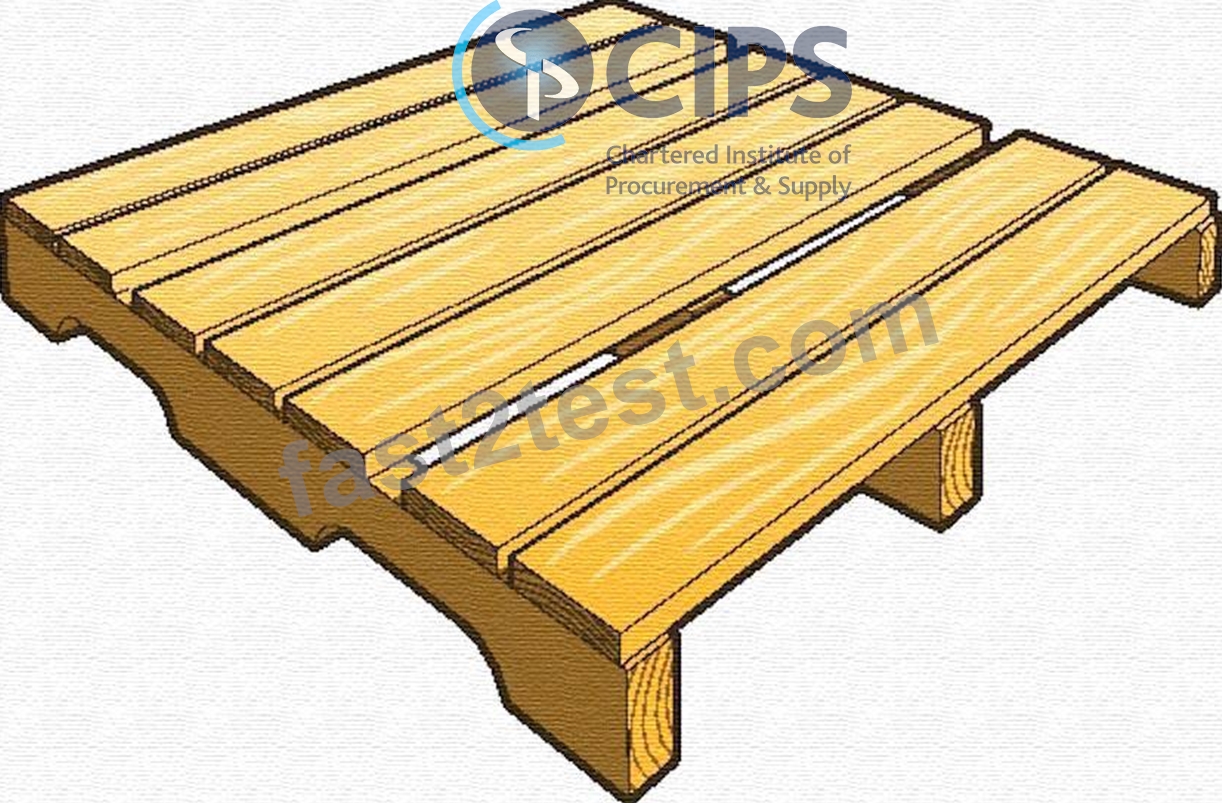
Shrink wrap, also referred to as shrink film or shrink wrap, is a versatile polymer material used for the packaging of finished goods. Heat is applied to the film - by either a conveyor heat tunnel or an electric or gas heat gun - which catalyzes the film to shrink tightly around the item placed within. This process results in a clear, durable barrier of protection around the product.
Post pallets have a simple metal structure with four uprights and substantial feat to take the load. These may be free standing, but many are designed for the feet to interlock with the posts of another post pallet so that the stack can be created.
NEW QUESTION # 34
A company has obsolete inventories and it must write off these inventories. How does writing off inventories impact on the company's financial statements?
1. Stock increases
2. Stock decreases
3. Profit increases
4. Profit decreases
- A. 2 and 4 only
- B. 1 and 3 only
- C. 2 and 3 only
- D. 1 and 4 only
Answer: A
Explanation:
An inventory write-off is a process of removing from the general ledger any inventory that has no value.
Using the direct write-off method, a business will record a credit to the inventory asset account and a debit to the expense account. For example, say a company with $100,000 worth of inventory decides to write off $10,000 in inventory at the end of the year. First, the firm will credit the inventory account with the value of the write-off to reduce the balance. The value of the gross inventory will be reduced as such: $100,000 - $10,000 = $90,000. Next, the inventory write-off expense account will be increased with a debit to reflect the loss.
The expense account is reflected in the income statement, reducing the firm's net income and thus its retained earnings. A decrease in retained earnings translates into a corresponding decrease in the shareholders' equity section of the balance sheet.
If the inventory write-off is immaterial, a business will often charge the inventory write-off to the cost of goods sold (COGS) account. The problem with charging the amount to the COGS account is that it distorts the gross margin of the business, as there is no corresponding revenue entered for the sale of the product. Most inventory write-offs are small, annual expenses. A large inventory write-off (such as one caused by a warehouse fire) may be categorized as a non-recurring loss.
Reference:
- CIPS study guide page 86-90
- Inventory Write-Off
LO 2, AC 2.1
NEW QUESTION # 35
Which of the following costs can be classified as 'acquisition costs'?
* Invitation to tender and order processing costs
* Invoice processing and supplier selection costs
* Goods inspection and total ownership cost
* Total input costs and invoice processing cost
- A. 2 and 4 only
- B. 2 and 5 only
- C. 1 and 2 only
- D. 1 and 4 only
Answer: C
NEW QUESTION # 36
Resevoir Inc runs several oil refineries across the country. These refineries require heavy invest-ment, particularly in maintenance, repair and operating (MRO) inventory. But the inventory turno-ver rate of these MRO items are low, while some items have expired date, which increases the risks of obsolescence. Which of the following methods can address the issues of these MRO items?
- A. Vendor-owned stock
- B. Forrester effect
- C. Larger safety stock
- D. Just in case
Answer: A
Explanation:
Where stock turn (inventory turnover) is low and there are potential risks of redundancy or obsolescence, the buying organisation may adopt vendor owned stock. In this system, a supplier (vendor) maintains a stock of items ready to be used at the point of customer consumption. The supplier owns the stock until it is used by the purchaser; only then is the purchaser invoiced for it.
Just in case and larger safety stock would significantly increase the stock level, which may cause redundancy or obsolescence.
Forrester effect (or Bullwhip effect) is a distribution channel phenomenon in which forecasts yield supply chain inefficiencies. It refers to increasing swings in inventory in response to shifts in customer demand as one moves further up the supply chain.
Reference:
LO 2, AC 2.2
NEW QUESTION # 37
In the Appendix A of a long-term supply contract of Bulk Drug Substance, both parties agree that "The reference price for Bulk Product at the specification, per gram, shall be US$10. The unit price for Bulk Product for a specific Purchase Order shall be computed by multiplying the above- specified reference price by two corrective factors, namely inflation correction factor and exchange rate correction factor". This pricing appendix is an example of...?
- A. Discounted pricing
- B. Adjustable pricing
- C. Fixed pricing
- D. Volume-based pricing
Answer: B
Explanation:
Price setting mechanisms fall into two main categories: fixed and variable. A fixed price mecha-nism is a straightforward concept which typically results in a relatively stable budget that can be forecast. Variable mechanisms have an element of variable pricing per unit bought.
Setting a fixed price mechanism is in theory a relatively simple and straightforward concept, where the collector and the buyer agree on a fixed price for a specific material or mix of materials, for a certain length of time.
All other pricing mechanisms that are not fixed have an element of variable pricing per unit bought.
The most common variable pricing mechanisms can be divided into two groups:
1. Where the benefit accruing to the buyer from acquiring the material is used to calculate what the payment to the seller should be; or Approaches to Materials Sales: A guide for local authorities
2. Where the price paid is indexed to a published source of market price information. The above scenario demonstrates variable pricing mechanism using published sources on inflation rate and exchange rate. CIPS also refers this mechanism as adjustable prices.
NEW QUESTION # 38
......
The CIPS Whole Life Asset Management certification process for the CIPS L4M7 exam involves passing a rigorous assessment, which includes a written exam and a practical assessment. Students who pass the assessment are awarded the CIPS Level 4 Certificate in Procurement and Supply. CIPS Whole Life Asset Management certification is recognized internationally and is highly valued by employers looking for procurement professionals with this level of expertise.
100% Free L4M7 Files For passing the exam Quickly: https://www.fast2test.com/L4M7-premium-file.html
New Download free L4M7 PDF for CIPS Practice Tests: https://drive.google.com/open?id=1-qwGrEku3f_6SusxApfZ06Q-MevwYXOk