

[Mar-2026] New-Jersey-Real-Estate-Salesperson Exam Questions and Valid New-Jersey-Real-Estate-Salesperson Dumps PDF
New-Jersey-Real-Estate-Salesperson Brain Dump: A Study Guide with Tips & Tricks for passing Exam
NEW QUESTION # 42
A licensee faxes a list of available properties to prospective buyers. Which of the following is true?
- A. The licensee's company's name does not need to be listed.
- B. The licensee must mail an identical list to all parties.
- C. The licensee must include only a phone number to reply.
- D. The fax must contain an opt-out provision for future communications.
Answer: D
Explanation:
Under the federal Telephone Consumer Protection Act (TCPA) and Junk Fax Prevention Act:
Any unsolicited fax must include a clear opt-out provision allowing the recipient to request no further communications.
The fax must also identify the sender, including company name.
There is no requirement to mail identical lists.
Correct answer = A.
Reference: Telephone Consumer Protection Act (TCPA); Junk Fax Prevention Act; NJ Real Estate Salesperson Study Guide, Chapter on Advertising Rules.
NEW QUESTION # 43
A buyer and broker enter into a 3-month exclusive buyer agency agreement. With regard to the broker's right to be compensated and to work with other clients, this means that during the term of this agreement, the broker
- A. must be compensated by the seller.
- B. is only due compensation if the buyer purchases one of the broker's listings.
- C. is entitled to compensation even if the buyer purchases a property that they locate.
- D. may not show a property to other buyers until the buyer decides if they want to make an offer.
Answer: C
Explanation:
Under an Exclusive Buyer Agency Agreement, the buyer agrees that the broker is their exclusive representative during the term. This creates a contractual right for the broker to be compensated regardless of who finds the property. If the buyer purchases any property during the agreement period (even one they personally locate or one listed by another brokerage), the broker is still entitled to commission as agreed.
The broker is not restricted from showing properties to other buyers at the same time, as fiduciary obligations run individually to each client.
Reference: New Jersey Real Estate Salesperson Pre-Licensure Course Study Guide, Chapter on Agency Relationships; NJREC Buyer Representation Agreements.
NEW QUESTION # 44
A licensed broker may establish a commission rate at a predetermined amount that reflects the broker's general office policy provided the broker:
- A. advises the New Jersey Consumer Affairs Division that the broker will not negotiate this commission rate
- B. advertises the commission rate at least once per month
- C. has the percentage or fixed amount printed on all listing agreement forms
- D. negotiates all commissions with sellers
Answer: D
Explanation:
Under New Jersey Real Estate Commission rules and antitrust law, commissions are always negotiable between the broker and the client. A broker may set a general office policy or customary rate, but legally the rate cannot be mandatory or fixed without negotiation. It must be negotiated in each listing agreement.
* Options A, B, and C would constitute unlawful practices or misleading advertising.
* Only D is correct: all commissions must be negotiated with sellers.
(Reference: NJ Real Estate Salesperson Pre-Licensure Course Study Guide, Commission Rates & Antitrust; NJAC 11:5 on advertising and business conduct.)
NEW QUESTION # 45
Which of the following items would be prorated at closing with the credit going to the seller?
- A. earnest money
- B. prepaid property taxes
- C. accrued interest on an assumed mortgage
- D. unearned rent collected in advance
Answer: B
Explanation:
Prepaid items (like property taxes already paid by seller) are prorated at closing, with the buyer reimbursing the seller for the period after closing. The credit therefore goes to the seller.
Accrued interest is typically credited to the buyer (since the seller owes it).
Earnest money is applied to buyer's costs, not prorated.
Unearned rent collected in advance is credited to the buyer, since the seller must pass future rent benefit to the buyer.
Correct answer = B.
Reference: NJ Real Estate Salesperson Study Guide, Chapter on Closings and Prorations.
NEW QUESTION # 46
A public utility company is installing power lines across several counties. Will the utility company be more likely to be granted an easement appurtenant or an easement in gross?
- A. easement appurtenant because it cannot run with the land
- B. easement in gross because it allows the holder of the easement to eventually gain title to the encumbered property
- C. easement appurtenant because it cannot be extinguished by merger of the dominant and servient tenements
- D. easement in gross because it does not require ownership of real property adjacent to the property that is subject to the easement
Answer: D
Explanation:
An easement in gross benefits a person or entity, rather than another parcel of land. Unlike an easement appurtenant, which requires a dominant and servient estate (two adjoining parcels), an easement in gross does not require ownership of adjacent property.
Utility companies (electric, gas, water, sewer, cable) typically hold easements in gross, allowing them to install and maintain lines across multiple properties. The easement is granted to the utility company, not to a neighboring landowner.
Therefore, the correct answer is C.
Reference: NJ Real Estate Salesperson Pre-Licensure Course Guide, Chapter on Interests in Real Estate (Easements); NJ Property Law principles on easements.
NEW QUESTION # 47
In surveying, monuments are used to establish:
- A. real estate boundaries
- B. a common address
- C. flood elevation
- D. historical sites
Answer: A
Explanation:
Monuments are fixed physical objects (iron pins, concrete markers, trees, rocks) used by surveyors to establish property boundaries in the metes-and-bounds system.
They do not establish addresses, flood elevations, or historical sites.
Correct answer = B.
Reference: NJ Real Estate Salesperson Study Guide, Chapter on Legal Descriptions and Surveys.
NEW QUESTION # 48
When buyers move into their new house, they see that the ceiling fan in the dining room is gone. The ceiling fan was not mentioned in the offer to purchase. Did the sellers have the right to take the ceiling fan?
- A. Yes, because it was the sellers' personal property.
- B. No, because it was a fixture in the house.
- C. No, because it was chattel.
- D. Yes, because it was not referenced in the contract.
Answer: B
Explanation:
A fixture is personal property that has become real property by being permanently attached (e.g., ceiling fans, light fixtures).
Fixtures are considered part of the real estate and transfer with the property unless specifically excluded in the contract.
Chattel refers to movable personal property, which a ceiling fan is not once installed.
Correct answer = C.
Reference: NJ Real Estate Salesperson Study Guide, Chapter on Property Ownership and Fixtures.
NEW QUESTION # 49
Which of the following is a permitted free offering?
- A. A complimentary home warranty with every listing
- B. Free use of a local moving van for all listings
- C. A free dinner for attendees at a homebuyers' evening seminar
- D. A coupon for discounted commission on listing services
Answer: C
Explanation:
According to NJREC rules on inducements (N.J.A.C. 11:5-6.4):
Free offers to the general public (e.g., a dinner seminar or educational event) are permissible because they are not conditioned upon listing or buying.
Inducements like "home warranty with every listing," "discounted commissions," or "moving vans for clients only" are contingent on brokerage activity and are prohibited.
Thus, the permitted free offering is C.
Reference: NJREC Rules and Regulations, N.J.A.C. 11:5-6.4; NJ Real Estate Salesperson Study Guide, Chapter on Advertising and Inducements.
NEW QUESTION # 50
According to the New Jersey Law Against Discrimination, which of the following descriptions may be used in advertising properties in a townhome development?
- A. Close to synagogues and churches
- B. Senior housing
- C. Ethnic neighborhood
- D. Singles only
Answer: B
Explanation:
Under the New Jersey Law Against Discrimination (LAD) and HUD advertising guidelines:
Ads cannot reference religion, ethnicity, or familial status (e.g., "singles only" or "close to synagogues").
However, housing for older persons (senior housing) is a permitted exception under the Housing for Older Persons Act (HOPA).
Correct answer = D. Senior housing.
Reference: NJ Law Against Discrimination (N.J.S.A. 10:5-1 et seq.); HUD Fair Housing Advertising Guidelines.
NEW QUESTION # 51
A national company desires a parcel of land which must be 4 times the size of its proposed building. If the building design includes 20,000 square feet, then which of the following minimum sized lots should be purchased?
- A. 1 acre
- B. 4 acres
- C. 8 acres
- D. 2 acres
Answer: C
Explanation: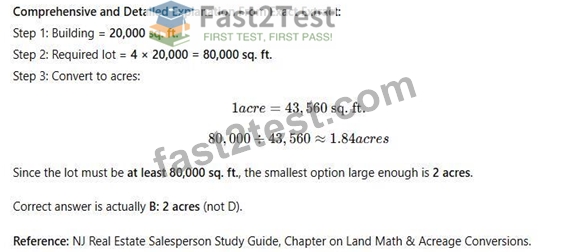
NEW QUESTION # 52
A low loan-to-value ratio indicates a:
- A. higher equity in the property.
- B. greater risk of foreclosure.
- C. greater use of leverage.
- D. lower equity in the property.
Answer: A
Explanation:
The loan-to-value (LTV) ratio compares the loan amount to the property's value or purchase price.
A low LTV means the borrower made a large down payment.
This results in higher equity in the property and lower risk for the lender.
Conversely, a high LTV means lower equity and higher lender risk.
Correct answer = C: higher equity in the property.
Reference: NJ Real Estate Salesperson Study Guide, Chapter on Financing and Loan Concepts.
NEW QUESTION # 53
A licensee must provide a Consumer Information Statement in all of the following transactions EXCEPT the:
- A. sublease of a studio apartment for two months
- B. lease of a three-bedroom apartment for one year
- C. sale of a vacant one-family lot
- D. sale of a three-family house in a mixed-use zone
Answer: A
Explanation:
The Consumer Information Statement (CIS) must be used in all sales of 1-4 family residential properties and all residential lease transactions of 1-4 units that are for terms longer than 125 days.
A short-term rental or sublease (two months) does not require a CIS.
Correct answer = C.
Reference: N.J.A.C. 11:5-6.9; NJ Real Estate Salesperson Study Guide, Chapter on Consumer Information Statement.
NEW QUESTION # 54
If a salesperson or broker-salesperson maintains a webpage that is not linked to the webpage of their broker, the licensee's webpage must display the name of the broker as well as the
- A. address of the broker's main office.
- B. address of the branch office from which the licensee operates.
- C. broker's telephone number.
- D. broker's email address.
Answer: A
Explanation:
Under NJREC advertising rules (N.J.A.C. 11:5-6.1), any licensee maintaining an independent website (not directly linked to the broker's official site) must clearly and prominently display:
The name of their employing broker, and
The main office address of the broker.
This ensures the public understands the licensee works under a supervising broker, and prevents misleading advertising. It is not sufficient to only list a branch office or email.
Therefore, the correct answer is C.
Reference: NJREC Rules and Regulations, N.J.A.C. 11:5-6.1 (Advertising Requirements).
NEW QUESTION # 55
Which of the following differentiates a bilateral contract from a unilateral contract?
- A. number of parties involved
- B. type of property specified in the contract
- C. performance obligations of the parties
- D. relative value of the object of the contract
Answer: C
Explanation:
A bilateral contract involves mutual promises where both parties are obligated to perform (e.g., a sales contract: buyer promises to pay, seller promises to transfer title).
A unilateral contract involves only one party making a promise contingent on the performance of the other (e.
g., an option contract).
Thus, the key difference is performance obligations of the parties.
Correct answer = B.
Reference: NJ Real Estate Salesperson Study Guide, Chapter on Contracts.
NEW QUESTION # 56
A small broker committee in the local county has set up a new marketing idea. They will give every seller the same commission rate and it will not be negotiable. This will allow the consumers to know exactly what it will cost to list a property. This marketing plan is an example of:
- A. consumer protection
- B. price-fixing
- C. apostille
- D. market allocation
Answer: B
Explanation:
Price-fixing occurs when competitors agree to set commission rates or fees rather than allowing them to be independently negotiated.
This practice is a violation of the Sherman Antitrust Act and NJREC regulations.
Market allocation refers to dividing territories or clients.
"Apostille" is irrelevant.
Calling it "consumer protection" is misleading.
Thus, this is an example of price-fixing.
Reference: Sherman Antitrust Act; NJ Real Estate Salesperson Study Guide, Chapter on Antitrust Laws and Commission Practices.
NEW QUESTION # 57
A client is considering listing an industrially zoned 10-acre site. It has been vacant for several years, and was formerly used as an automobile junkyard. What would a responsible real estate licensee recommend the seller consider obtaining prior to putting the property on the market?
- A. a radon measurement analysis
- B. an air quality report from the Environmental Protection Agency
- C. an environmental site assessment
- D. an electromagnetic field determination
Answer: C
Explanation:
A property formerly used as an automobile junkyard may have soil or groundwater contamination.
The recommended due diligence is an Environmental Site Assessment (ESA), usually a Phase I ESA, to evaluate potential contamination and liability under environmental laws (such as CERCLA).
Radon, EMF, or air quality reports may be relevant in other contexts, but here the correct and standard recommendation is an ESA.
Correct answer = B.
Reference: NJ Real Estate Salesperson Study Guide, Chapter on Environmental Issues; CERCLA and Phase I ESA guidelines.
NEW QUESTION # 58
Standard title insurance would protect a buyer:
- A. in a purchase where the buyer had knowledge of a shed violating setback requirements.
- B. when the seller has forged an ex-partner's signature on the deed.
- C. if after closing, the HOA placed a lien on the property for the previous owners' unpaid dues.
- D. for the purchase of a property bought sight unseen where the buyer discovers a tenant living at the property.
Answer: B
Explanation:
Standard title insurance protects against defects in title that existed before closing, such as forged documents, undisclosed heirs, or improperly executed deeds.
It does not cover issues arising after closing (like new HOA liens).
It does not protect against defects the buyer already knew about.
It also does not insure physical possession or condition of property.
Thus, the correct answer is A.
Reference: NJ Real Estate Salesperson Study Guide, Chapter on Title and Title Insurance.
NEW QUESTION # 59
Rules for Truth in Lending and RESPA call for disclosure documents to borrowers. How can a managing broker best prepare associated licensees to manage these disclosures?
- A. Because the lender has primary responsibility to provide these forms, the broker and licensees should be aware of the items required for the lender to comply.
- B. The managing broker should train licensees to advise borrowers to accept the Loan Estimate right away.
- C. The buyer's broker can provide samples so that when the licensee and the borrower prepare the forms they are following a good example.
- D. Because the listing broker will be primarily responsible for completing the Loan Estimate to send to the lender, the broker should train associated licensees to collect all the necessary information in a timely fashion.
Answer: A
Explanation:
Under TILA-RESPA Integrated Disclosure (TRID) rules, the lender is primarily responsible for preparing and delivering the Loan Estimate and Closing Disclosure.
Brokers and licensees do not prepare these forms.
However, licensees must be knowledgeable about the disclosures so they can help clients understand the process and provide necessary information for lender compliance.
Thus, the best practice is B: brokers should ensure licensees are aware of what the lender requires.
Reference: Truth in Lending Act (Regulation Z); RESPA (Regulation X); NJ Real Estate Salesperson Study Guide, Chapter on Federal Lending Laws.
NEW QUESTION # 60
Under New Jersey Real Estate Commission rules, a licensee's obligations to the public include all of the following responsibilities EXCEPT:
- A. dealing honestly with all parties
- B. accepting any reasonable commission offered by a seller in the course of negotiating a listing agreement
- C. disclosing material defects in a property to a prospective purchaser
- D. protecting and promoting the interests of the licensee's principal when acting as an agent
Answer: B
Explanation:
According to NJREC Rules (N.J.A.C. 11:5-6.3 and 11:5-6.4), obligations to the public include:
Dealing honestly and fairly with all parties.
Disclosing material defects known to the licensee.
Protecting and promoting the interests of the principal when acting as agent.
There is no requirement that a licensee must accept "any reasonable commission" offered. Commission rates are always negotiable and must be agreed upon voluntarily.
Correct answer = A.
Reference: NJREC Rules and Regulations; NJ Real Estate Salesperson Study Guide, Chapter on Fiduciary Duties.
NEW QUESTION # 61
The best way to research the previous owners of the property would be to research the:
- A. chain of title
- B. grantor
- C. abstract
- D. lien records
Answer: A
Explanation:
The chain of title is the recorded history of property ownership from one owner to the next. It is the most reliable way to determine prior ownership.
Lien records show financial claims but not ownership sequence.
An abstract of title summarizes the chain of title and liens but is not the original source.
Grantor indexes are tools used in researching title but do not themselves provide the full sequence.
Thus, the best method is the chain of title.
Reference: NJ Real Estate Salesperson Study Guide, Chapter on Title Records and Transfer of Ownership.
NEW QUESTION # 62
The common area of a condominium development is owned by:
- A. any individuals who pay a prorated share of the taxes and maintenance.
- B. all owners as tenants in common.
- C. its duly elected Board of Directors.
- D. those owners who were original owners of the units.
Answer: B
Explanation:
In a condominium, each unit owner owns their unit in fee simple.
All common areas (hallways, grounds, recreational areas) are owned by all unit owners collectively as tenants in common, with each owner's interest proportional to their ownership share.
The Board of Directors manages, but does not own, the common areas.
Correct answer = D.
Reference: NJ Condominium Act, N.J.S.A. 46:8B-1 et seq.; NJ Real Estate Salesperson Study Guide, Chapter on Common Interest Properties.
NEW QUESTION # 63
Under the New Jersey Real Estate Sales Full Disclosure Act, the Act does NOT apply to a development project:
- A. extending over a 5 year period only.
- B. where the purchaser's total financial obligation is less than $5,000.
- C. consisting of 10 units.
- D. already approved by the Department of Commerce.
Answer: B
Explanation:
The NJ Real Estate Sales Full Disclosure Act (RESFDA) regulates sales or leases of subdivided land and certain developments to protect consumers.
Exemptions exist for small-scale projects or when the total financial obligation to the purchaser is less than
$5,000.
Developments with 100+ lots typically require registration and a Public Offering Statement.
Thus, the Act does not apply where the financial obligation is under $5,000.
Reference: NJ Real Estate Sales Full Disclosure Act, N.J.S.A. 45:15-16.27; NJ Real Estate Salesperson Study Guide, Chapter on Land Sales.
NEW QUESTION # 64
Which of the following statements would most likely be considered mere "puffing"?
- A. This area is expected to increase in value by 25% within the next year.
- B. Children from this neighborhood have the highest SAT scores.
- C. The utility costs in this home are lower than in any other home in the neighborhood.
- D. This lot has the most beautiful view of the lake.
Answer: D
Explanation:
Puffing = exaggeration or subjective opinion that no reasonable person would take as fact (e.g., "most beautiful view").
Statements of fact (e.g., predicted appreciation %, test scores, or utility costs) could be misrepresentation if untrue.
Thus, "This lot has the most beautiful view of the lake" = puffing.
Correct answer = B.
Reference: NJ Real Estate Salesperson Study Guide, Chapter on Ethics and Misrepresentation.
NEW QUESTION # 65
Which of the following statements correctly describes a standard feature of a buyer-agency agreement?
- A. It establishes a fiduciary relationship with the buyer.
- B. A buyer-agency agreement is an option rather than an employment contract.
- C. The source of compensation determines the agency relationship.
- D. A retainer fee is normally paid at the time the agreement is signed.
Answer: A
Explanation:
Under the New Jersey Real Estate Commission rules on agency disclosure and the Salesperson Study Guide (Chapter on Buyer Agency):
A buyer-agency agreement is a form of employment contract creating a fiduciary relationship between the buyer and the broker.
A is incorrect because it is not just an option; it's a binding agreement.
B may or may not be true - a retainer fee is not required in NJ.
C is false because the source of compensation does not determine agency; agency is determined by the agreement and consent of the parties.
D is correct: a buyer-agency agreement creates fiduciary duties such as loyalty, disclosure, confidentiality, and obedience to the buyer.
Reference: NJ Real Estate Salesperson Pre-Licensure Course Study Guide, Agency & Fiduciary Duties section; NJREC Agency Disclosure Rules.
NEW QUESTION # 66
A buyer made an offer to purchase a home using a VA loan, but the property's appraised value was determined to be less than the contract price. If the buyer really wants the property, which of the following choices is the buyer's best option?
- A. Make up the difference between the contract price and appraised value in cash.
- B. Hire an appraiser and see if a second appraisal yields a higher appraised value.
- C. Seek an FHA lender who will automatically make up the difference between the contract price and the appraised value.
- D. Do nothing, because the seller must sell the property at the appraised value.
Answer: A
Explanation:
VA loans include an escape clause: buyers cannot be forced to purchase a home for more than its appraised value. However, if the buyer still wants the property, they can:
Pay the contract price, but must cover any amount above the VA appraised value in cash, since the VA will only guarantee the appraised portion.
Sellers are not forced to lower their price to the appraisal amount.
An FHA loan will not automatically cover the shortfall.
Thus, the best option is B.
Reference: U.S. Department of Veterans Affairs Loan Guaranty Program; NJ Real Estate Salesperson Study Guide, Chapter on VA and FHA Financing.
NEW QUESTION # 67
......
New-Jersey-Real-Estate-Salesperson Exam Questions: Free PDF Download Recently Updated Questions: https://www.fast2test.com/New-Jersey-Real-Estate-Salesperson-premium-file.html
New-Jersey-Real-Estate-Salesperson Certification Exam Dumps with 122 Practice Test Questions: https://drive.google.com/open?id=1Uo-qd85Y0Kn8ytm7qp8LZmJl3hUeslNC