

Free Sample Questions to Practice H12-831_V1.0-ENU Certification Test Engine [Nov-2025]
2025 Valid H12-831_V1.0-ENU Real Exam Questions, practice HCIP-Datacom
Huawei H12-831_V1.0 (HCIP-Datacom-Advanced Routing & Switching Technology V1.0) Exam is a professional certification exam designed for individuals who wish to validate their knowledge and skills in advanced routing and switching technologies. H12-831_V1.0-ENU exam is designed to test the candidate's ability to plan, design, implement, operate, and troubleshoot complex enterprise-level networks using Huawei's routing and switching technologies. H12-831_V1.0-ENU exam covers a wide range of topics, including advanced routing protocols, switching technologies, MPLS, VPNs, network security, and network optimization.
NEW QUESTION # 88
On the network shown in the figure, EBGP peer relationships are established between ASs through directly connected interfaces.
* OSPF is deployed in AS 65456 (with OSPF disabled on interconnected interfaces between ASs).
* R4 and R5 use Loopback0 to establish iBGP peer relationships with R6.
* The IP address of Loopback0 on each router is 10.0.X.X/32, and the router ID is 10.0.X.X, where X is the number of the router.
* R1, R2, and R3 import the external route 192.168.1.0/24 into BGP through the import-route command.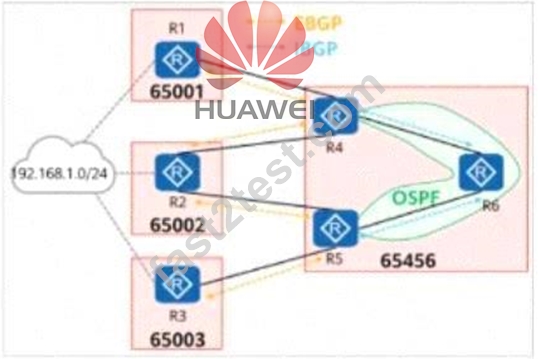
Which of the following statements are true?
- A. For 192.168.1.0/24, R5 preferentially selects the route received from R2.
- B. For 192.168.1.0/24, R6 preferentially selects the route received from R4.
- C. For 192.168.1.0/24, if the default local-preference 150 command is configured on R3, R5 preferentially selects the route received from R3.
- D. For 192.168.1.0/24, R4 preferentially selects the route received from R1.
Answer: A,C
Explanation:
Comprehensive and Detailed In-Depth Explanation:
Understanding the BGP and OSPF Network Topology in the Question:
* External Route Importation
* R1, R2, and R3 import 192.168.1.0/24 into BGP from an external source.
* This means R1, R2, and R3 will advertise this route to their EBGP and iBGP peers.
* BGP Route Selection Criteria
* BGP follows specific rules to determine the best path for a route. The most relevant factors here are:
* Highest Local Preference (LOCAL_PREF) # Preferred
* Shortest AS Path # Preferred
* Lowest Origin Type (IGP < EGP < Incomplete) # Preferred
* Lowest MED (Multi-Exit Discriminator) # Preferred
* Oldest eBGP route (if paths are equal) # Preferred
Route Selection Analysis for Each Statement:
A: For 192.168.1.0/24, R5 preferentially selects the route received from R2. # (Correct)
* R5 is in AS 65456 and peers with R6 using iBGP.
* Since R2 is a central router with direct connectivity to R5, it is the most preferred path compared to indirect paths from R1 or R3.
* By default, R5 will prefer the path from R2 over others unless explicitly influenced by BGP attributes.
# Statement A is correct.
B: For 192.168.1.0/24, R4 preferentially selects the route received from R1. # (Incorrect)
* R4 and R5 use Loopback0 to establish iBGP with R6, meaning they receive BGP routes from multiple sources.
* BGP prefers the shortest AS path, and there is no specific information indicating that R1's path is the shortest for R4.
* R4 may actually prefer another router's advertisement (e.g., R2 or R3) depending on AS path length and other attributes.
# Statement B is incorrect.
C: For 192.168.1.0/24, if the default local-preference 150 command is configured on R3, R5 preferentially selects the route received from R3. # (Correct)
* By default, BGP assigns a local-preference of 100.
* If R3 sets local-preference to 150, it is higher than other routes (R1, R2).
* BGP prefers the highest local-preference value, so R5 will prefer the route received from R3 if this attribute is set.
# Statement C is correct.
D: For 192.168.1.0/24, R6 preferentially selects the route received from R4. # (Incorrect)
* R6 is an iBGP peer of both R4 and R5.
* BGP best-path selection depends on attributes like local-preference, AS-path, and MED.
* There is no explicit information suggesting that R4's advertisement is preferred over R5's.
* R6 may prefer R5's route depending on attributes.
# Statement D is incorrect.
Final Conclusion:
# A. R5 preferentially selects the route received from R2.# B. R4 does not necessarily prefer R1's route.
# C. If R3 sets local-preference 150, R5 will prefer the route from R3.# D. R6 does not necessarily prefer R4's route.
Thus, the correct answers are: A, C.
NEW QUESTION # 89
The figure shows the LSP information of R1 and R3 on an MPLS network. An administrator runs the ping -a 1.1.1.1 3.3.3.3 command on R1. Given this, which of the following statements is true?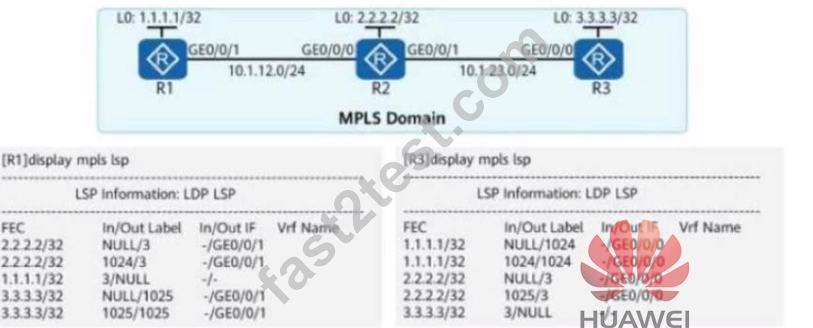
- A. Both the Echo Request and Echo Reply packets received by R2 do not carry any label.
- B. The Echo Request packet received by R2 does not carry any label, and the Echo Reply packet received by R2 carries label 1024.
- C. The Echo Request packet received by R2 carries label 1025, and the Echo Reply packet received by R2 carries label 1024.
- D. The Echo Request packet received by R2 carries label 1025, and the Echo Reply packet received by R2 does not carry any label.
Answer: D
NEW QUESTION # 90
As shown in the figure, an engineer uses 4 routers to test branch network interoperability. Among them, R1, R2, and R3 in branch 1 deploy OSPF to implement network interoperability. R2, R3, and R4 in branch 2 deploy IS-S to implement network interoperability. Now the engineer wants to implement R1 to access the loopback interface address of R4. Which of the following operations can meet this requirement?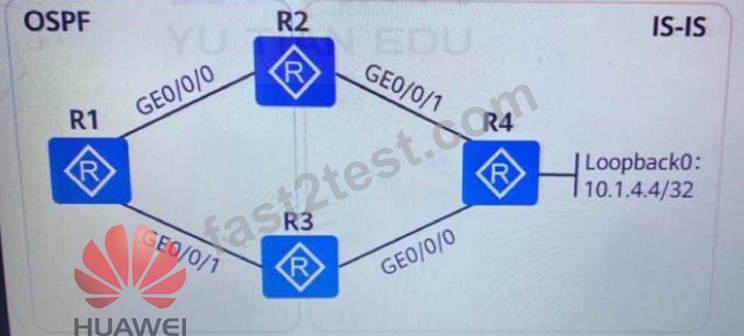
- A. No configuration required
- B. only atR2ofOSPFDuring the process, the default route is advertised
- C. existR2ofOSFFprocess neutralizationIS-ISDuring the process, the default route is advertised separately
- D. only atR2ofIS-ISDuring the process, the default route is advertised
Answer: C
NEW QUESTION # 91
The rollback operation of the project cutover can be determined temporarily according to the situation during the cutover, and no advance planning is required.
- A. FALSE
- B. TRUE
Answer: A
NEW QUESTION # 92
On the network shown in the figure, the DHCP server function is enabled on GE0/0/0 of R2, and the address pool is an interface address pool.
When GE0/0/0 and GE0/0/1 of R1 function as DHCP clients, only one interface can obtain an IP address by default.
Options:
- A. TRUE
- B. FALSE
Answer: A
Explanation:
Comprehensive and Detailed In-Depth Explanation:
Understanding the DHCP Process in This Scenario:
* DHCP Server on R2:
* The DHCP server is configured on interface GE0/0/0 of R2.
* The address pool is an interface address pool, meaning that IP addresses are allocated from the subnet of GE0/0/0 (i.e., 10.0.12.0/24).
* DHCP Clients on R1:
* Both interfaces (GE0/0/0 and GE0/0/1) on R1 are set as DHCP clients, meaning they will send DHCP DISCOVER messages to obtain an IP address dynamically.
* Why Only One Interface Gets an IP Address?
* Interface address pools in Huawei devices assign only one IP address per MAC address (which is typically the router's MAC).
* Since both interfaces belong to R1, they share the same MAC address when making a DHCP request.
* As a result, the DHCP server on R2 only assigns one IP address to the first requesting interface.
* The second request is ignored or denied by the DHCP server due to the duplicate MAC address issue.
Key Takeaways:
* Huawei routers using an interface-based DHCP address pool assign only one IP per MAC address.
* Since both interfaces on R1 have the same MAC, only one gets an IP.
* This behavior is expected in Huawei's HCIP-Datacom-certified DHCP configurations.
HCIP-Datacom-Advanced Routing & Switching Technology References:
* Huawei HCIP-Datacom Official Certification Guide, Chapter on DHCP Server and Client Configurations.
* Huawei Datacom Configuration Guide, Section on Interface Address Pools and Address Assignment Limitations.
* Huawei Enterprise Networking Training Materials, DHCP Relay and DHCP Server Behavior.
NEW QUESTION # 93
OSPFv3 runs on R1 and R2, and the IPv6 addresses configured for the interfaces are marked in the figure.
The router IDs of R1 and R2 are 10.0.1.1 and 10.0.2.2, respectively.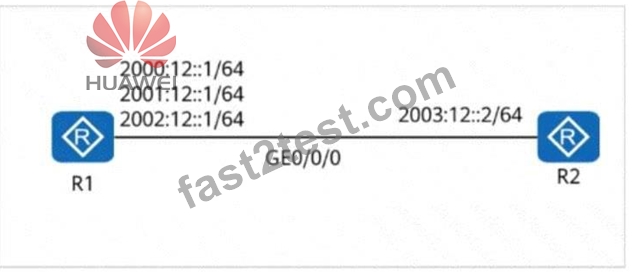
Which of the following statements is true?
- A. The Intra-Area-Prefix-LSA generated by R1 describes three prefixes.
- B. The Intra-Area-Prefix-LSA generated by R2 describes three prefixes.
- C. The Intra-Area-Prefix-LSA generated by R2 describes four prefixes.
- D. The Intra-Area-Prefix-LSA generated by R1 describes four prefixes.
Answer: D
Explanation:
Comprehensive and Detailed In-Depth Explanation:
Understanding Intra-Area-Prefix-LSA (Type 9) in OSPFv3
* OSPFv3 uses the Intra-Area-Prefix-LSA (Type 9) to advertise IPv6 prefixes associated with either:
* A Router-LSA (Type 1) # Describes links and interfaces.
* A Network-LSA (Type 2) # Advertises multi-access networks (if a Designated Router exists).
* Each router generates one Intra-Area-Prefix-LSA to advertise its own IPv6 prefixes.
Prefix Analysis for Each Router
R1's IPv6 Prefixes:
* 2000:12::1/64
* 2001:12::1/64
* 2002:12::1/64
* 2003:12::/64 (Shared link with R2)
* Total Prefixes in R1's Intra-Area-Prefix-LSA = 4
# R1 advertises four prefixes in its Intra-Area-Prefix-LSA.
R2's IPv6 Prefixes:
* 2003:12::2/64 (Shared link with R1)
* Total Prefixes in R2's Intra-Area-Prefix-LSA = 1
# R2 advertises only one prefix in its Intra-Area-Prefix-LSA.
Checking Each Option:
# A. The Intra-Area-Prefix-LSA generated by R2 describes three prefixes. (# False, R2 only has one prefix).
# B. The Intra-Area-Prefix-LSA generated by R1 describes four prefixes. (# True, R1 has four prefixes).
# C. The Intra-Area-Prefix-LSA generated by R2 describes four prefixes. (# False, R2 only has one prefix).
# D. The Intra-Area-Prefix-LSA generated by R1 describes three prefixes. (# False, R1 has four prefixes).
Final Conclusion:
# B. The Intra-Area-Prefix-LSA generated by R1 describes four prefixes.
Thus, the correct answer is: B. The Intra-Area-Prefix-LSA generated by R1 describes four prefixes.
NEW QUESTION # 94
On the network shown in the figure, single-hop BFD is configured on R1 and R2.
A network engineer finds that the BFD session goes down. To locate the fault, the network engineer queries the BFD configurations on R1 and R2.
According to the configuration information marked in the figure, it can be determined that mismatched time parameter settings on R1 and R2 cause the BFD session to go down.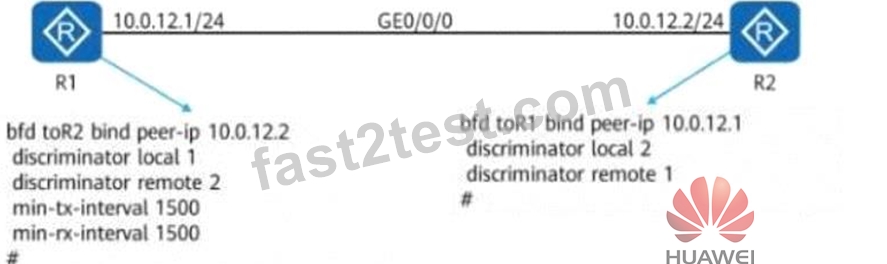
Is this statement TRUE or FALSE?
- A. FALSE
- B. TRUE
Answer: A
Explanation:
Comprehensive and Detailed In-Depth Explanation:
To verify the correct answer, we need to analyze Bidirectional Forwarding Detection (BFD) behavior and the provided configuration.
1. Understanding BFD Configuration Parameters
BFD (Bidirectional Forwarding Detection) is a protocol used for fast failure detection between directly connected devices.
Key Configuration Parameters in BFD:
* Peer IP (bind peer-ip)
* This specifies the destination router's IP address for the BFD session.
* # Correctly configured on both R1 and R2.
* Discriminator Local/Remote (discriminator local X / remote Y)
* These values must match between the two routers.
* # Correctly configured (R1: local 1, remote 2; R2: local 2, remote 1).
* Min-TX Interval (min-tx-interval)
* Defines the minimum transmit interval for BFD packets.
* # Missing from R2's configuration (could be a cause for mismatch).
* Min-RX Interval (min-rx-interval)
* Defines the minimum receive interval for BFD packets.
* # Missing from R2's configuration (could be a cause for mismatch).
2. Analyzing the Configuration on R1 and R2
# Configuration on R1 (Correct)
shell
CopyEdit
bfd tor2 bind peer-ip 10.0.12.2
discriminator local 1
discriminator remote 2
min-tx-interval 1500
min-rx-interval 1500
* This configuration is correct.
# Configuration on R2 (Incomplete)
shell
CopyEdit
bfd tor1 bind peer-ip 10.0.12.1
discriminator local 2
discriminator remote 1
* Missing min-tx-interval and min-rx-interval.
3. Why the Answer is FALSE?
* A BFD session does NOT go down due to mismatched timing parameters.
* BFD dynamically negotiates timing values, meaning even if R2 is missing min-tx/min-rx values, the session should still establish.
* However, the session will fail if the peer IP or discriminator values are incorrect (which they are NOT in this case).
* The actual cause of failure in this case is likely the missing min-tx and min-rx settings on R2, NOT a mismatch between R1 and R2.
NEW QUESTION # 95
According to this picture, we can judge?
<Huawei>display ospf Isdb router self-originate OSPF Process 1 with Router ID 10.0.12J Area: 0.0.0.0 Type:Router Lsid: 10.0.12 J Adv rtr: 10.0.12.1 Ls age: 312 Len: 36 Options : A, BR E
\seq#:80000013
1 chksum : 0xc61c
I Link count: 1
1 * Link ID: 10.0.12.2
I Data : 10.0.12.1
, Link Type: TransNet
. Metric : 1
- A. R1ofsystem IDYesee8c.a0c2.bafl
- B. R1existinglevel", andlevel-1-2Dimensional state information of
- C. R1onlylevel-2link state information
Answer: A
Explanation:
Ds level-2In the network, there are a total of8Tailu Electric
NEW QUESTION # 96
If the migration preparation is insufficient, which of the following problems may occur?
Options (Multiple Choice):
- A. A hardware fault occurs on a board, but no spare board is available.
- B. When an interface cannot go up but no network cable tester is available, it is difficult to determine whether the interface hardware or cable is faulty.
- C. The migration fails, and the configuration file is not backed up. As a result, the service rollback fails.
- D. Engineers cannot arrive at the migration site at the scheduled time.
Answer: A,B,C,D
Explanation:
Comprehensive and Detailed In-Depth Explanation:
* Network migration requires detailed planning to prevent service disruptions and rollback failures.
* Potential issues due to poor preparation:# A. No network cable tester available # Hard to diagnose whether the issue is hardware or cable-related.# B. No backup of configuration files # If migration fails, services cannot be restored quickly.# C. No spare hardware available # Hardware failures may cause long service downtimes.# D. Engineers arriving late # Delays may lead to extended service downtime or missed migration windows.
# Reference: HCIP-Datacom Advanced Routing & Switching Technology - Migration Best Practices
NEW QUESTION # 97
There is a concept of forwarding equivalence class (FEC-Fowarding Equivalence Class) in MPLS, so FEC does not Can the allocation be made based on which of the following criteria?
- A. Service type(Class of Service)
- B. target address(Destination Addess)
- C. Application protocol(Application Protocol)
- D. Fragment offset (Fragment office)
Answer: D
NEW QUESTION # 98
When OSPFv2 evolves to OSPFv3, the format and function of LSA are exactly the same, except that the network layer address in LSA changes from IPv4 to IPv6.
- A. FALSE
- B. TRUE
Answer: A
NEW QUESTION # 99
Which of the following options is incorrect:
- A. LSPstaticLSPand dynamicLSPtwo kinds. staticLSPManual configuration by administrator, dynamicLSPthen use Dynamic establishment of label protocol
- B. dynamicLSPDynamically established through the label publishing protocol, such asMP-BGP, RSVP-TE, LDP
- C. The principle to be followed when manually assigning labels is: the value of the outgoing label of the upstream node is the value of the incoming label of the downstream node
- D. Created by assigning labels staticallyLSPIt can also be dynamically adjusted according to changes in network topology, without administrator intervention.
pre
Answer: A
NEW QUESTION # 100
[According to this picture, Peimen can judge?
cR3>display ipv6 routing-table protocol isis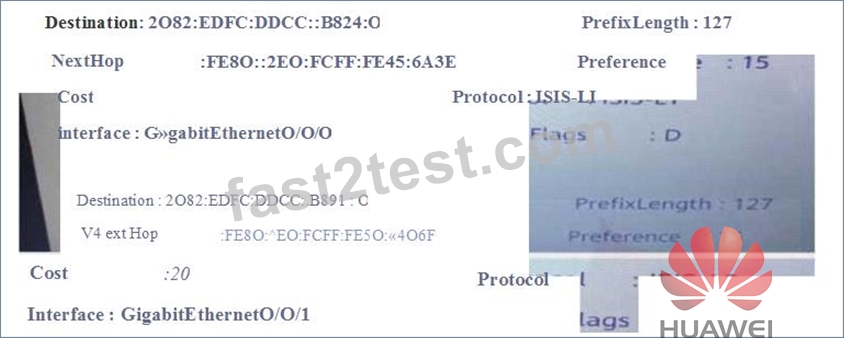
- A. unable to judgeR3type of device
- B. R3The device type must beLevel-1
- C. R3The device type must beLevel-2
- D. R3The device type must beLevel-1-2
Answer: D
NEW QUESTION # 101
SFFv2 is an IGP running on an IPv4 network: 0SPFV3 is an IGP running on an IPv6 network. Compared with 0SPFV2, SPFV3 has a similar LSA type, but has slightly different functions. Which of the following is not included in the LSA type of 0SPFV3?
- A. Network-LSA
- B. ASBR-Summary-LSA
- C. AS-External-LSA
- D. Router-LSA
Answer: B
NEW QUESTION # 102
Regarding the BGPI MPLS IPVPN network architecture, which of the following descriptions is wrong?
- A. Under normal circumstances, CE equipment does not perceive the existence of VPN, and CE equipment does not need to support MPLS, MP-BGP, etc.
- B. The P device only needs to have basic MPLS forwarding capabilities and does not maintain VPN related information
- C. Sites can visit each other through VPN, and a site can only belong to 1 VPN
- D. The BGP/MPLS IP VPN network architecture consists of three parts: CE (Customer Edge), PE (ProviderEdge), and P (Provider). PE and P are operator equipment, and CE is BGP/MPLS IPVPN user equipment.
Answer: C
NEW QUESTION # 103
What is the value of the linkage between OSPF and BFD?
- A. Detected at the millisecond levelBFD. associationOSPFstate, fulfilledOSPFThe purpose of quickly sensing the status of the tank
- B. OSPFofhelloThe sending interval is in seconds, more thanBFDInduction link status is fast
- C. BFDAny change in state will not affectOSPFneighbor state
- D. BFDThe message sending interval can reach the millisecond level, which is less thanOSPFInduction link status is slow
Answer: A
NEW QUESTION # 104
In the preparation phase of a migration project, the software and hardware need to be checked. Match the operation objects in the preparation phase with the corresponding operation contents.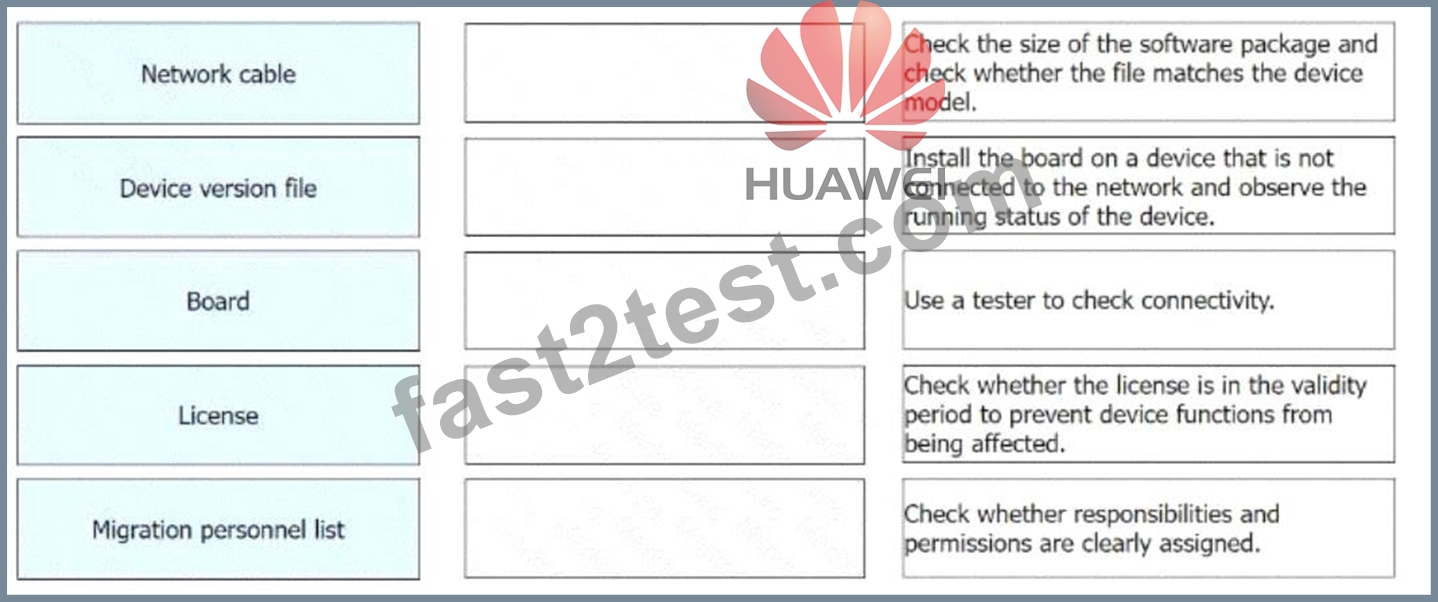
Answer:
Explanation: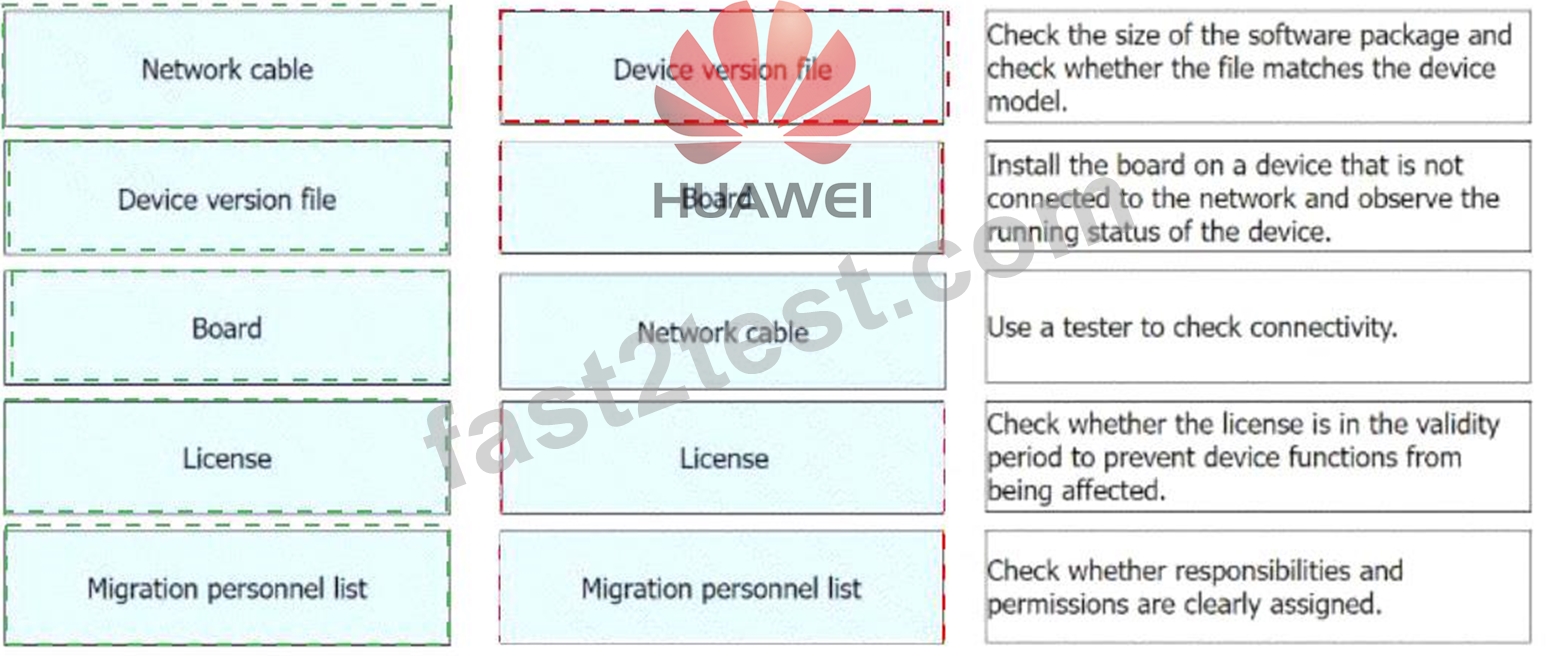
Explanation:
Network cable # Use a tester to check connectivity.
Device version file # Check the size of the software package and check whether the file matches the device model.
Board # Install the board on a device that is not connected to the network and observe the running status of the device.
License # Check whether the license is in the validity period to prevent device functions from being affected.
Migration personnel list # Check whether responsibilities and permissions are clearly assigned.
Comprehensive and Detailed In-Depth Explanation:
1. Network Cable - Connectivity Testing:
* Before starting a migration project, all network cables should be tested for physical connectivity issues.
* Network testers can be used to detect any breaks, shorts, or incorrect wiring.
* Ensuring proper connectivity avoids delays and troubleshooting issues during the migration.
2. Device Version File - Software Compatibility Check:
* Firmware and software versions must be verified before upgrading or migrating network devices.
* The device version file should match the model and hardware specifications to avoid compatibility issues.
* If incorrect software is used, the device may not function properly or could become inoperable.
3. Board - Installation and Hardware Verification:
* Before installing new hardware modules (boards, line cards, etc.) into a production environment, they should be tested in isolation.
* Testing ensures the board is operational and does not introduce faults into the system.
* If a board is faulty, it can cause device failure or unexpected behavior in the migration.
4. License - Validity and Activation Check:
* Some network devices require licenses for full functionality (e.g., advanced routing, security features).
* If a license is expired or missing, critical functions may be disabled after migration.
* Checking license status in advance prevents unexpected downtime or service disruptions.
5. Migration Personnel List - Roles and Responsibilities Assignment:
* Large network migrations require clear responsibility assignments for each team member.
* A migration personnel list ensures that everyone knows their role, tasks, and permissions.
* Proper coordination avoids miscommunication, errors, and project delays.
Key Takeaways:
# Network cables should be tested for connectivity.# Software versions should match the hardware model to prevent incompatibility.# Hardware boards should be tested before installing into production.
# Licenses should be verified to prevent service disruptions.# Migration personnel roles should be clearly defined for smooth execution.
HCIP-Datacom-Advanced Routing & Switching Technology References:
* Huawei HCIP-Datacom Official Certification Guide, Chapter on Network Migration Best Practices
.
* Huawei Enterprise Networking Whitepapers, Guidelines on Software & Hardware Pre-checks for Migration.
* Huawei Technical Documentation, License Management in Huawei Datacom Devices.
NEW QUESTION # 105
You have set IS-IS IPv6 enable under the interface, what is the meaning of this command?
- A. Activate on the interfaceIPv6 IS-ISprocess1
- B. activate on the interfaceIPv6 IS-ISprocess10
- C. Activate on the interfaceIPv6 IS-ISprocess3
- D. activate on the interfaceIPv6 IS-ISprocess2
Answer: A
NEW QUESTION # 106
. OSPFv2 is an IGP running on an IIPv4 network. OSPFV3 is an IGP running on an IPv6 network. Compared with OSPFv2, OSFv3 has similar LSA, but the function is slightly different. The following is the description of the LSA function of OSPFv3. Please drag the LSA to the correct LSA function column.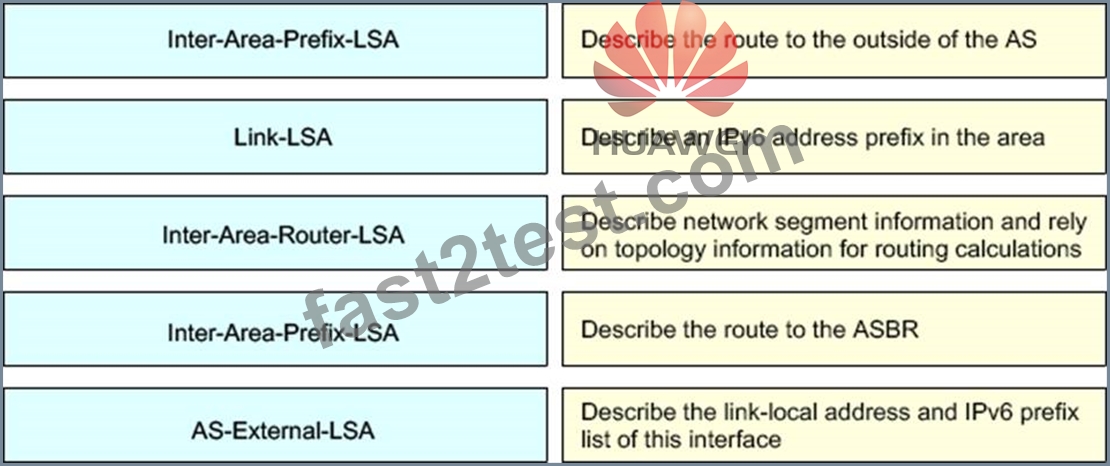
Answer:
Explanation: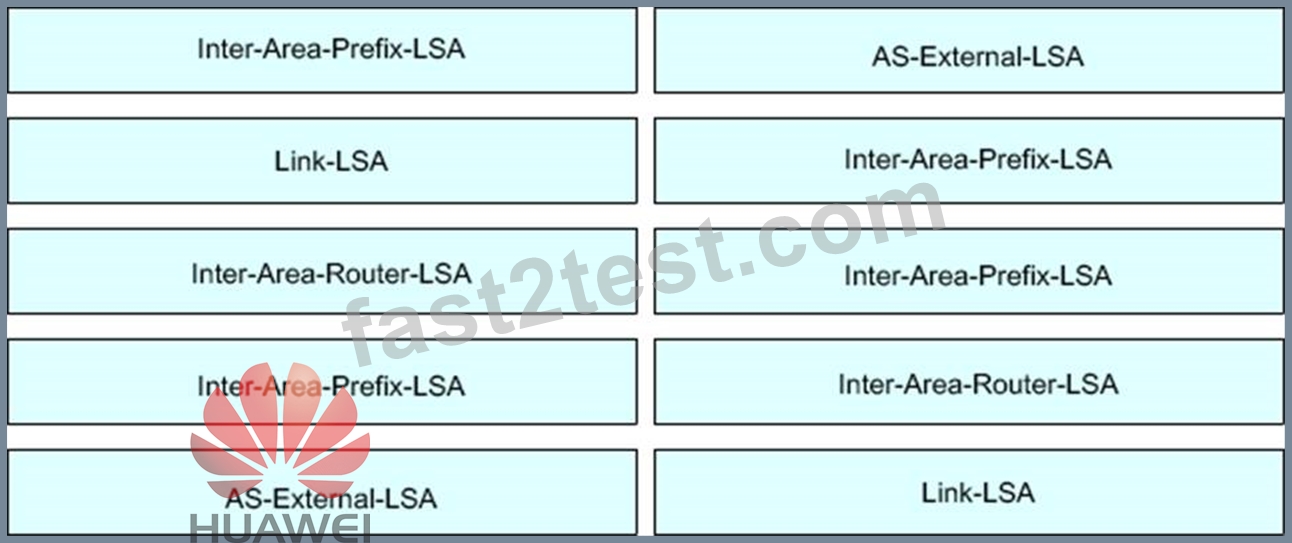
NEW QUESTION # 107
As shown in the figure, the carrier BGP/MPLS IP VPN backbone network constructs SP through DP. If you want to realize the intercommunication between the two sites of user X through the BGP/MPLS IPVPN network, the 32bit mask of Loopback interface address must be used between PE1 and PE2 to establish the MP-IBGP peer relationship.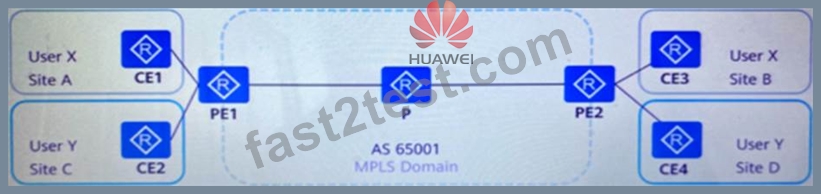
- A. TRUE
- B. FALSE
Answer: A
NEW QUESTION # 108
On the IS-IS network shown in the figure, R1 imports a default route using the default-route-advertise always level-1 command. Which of the following routers have the default route in their routing tables?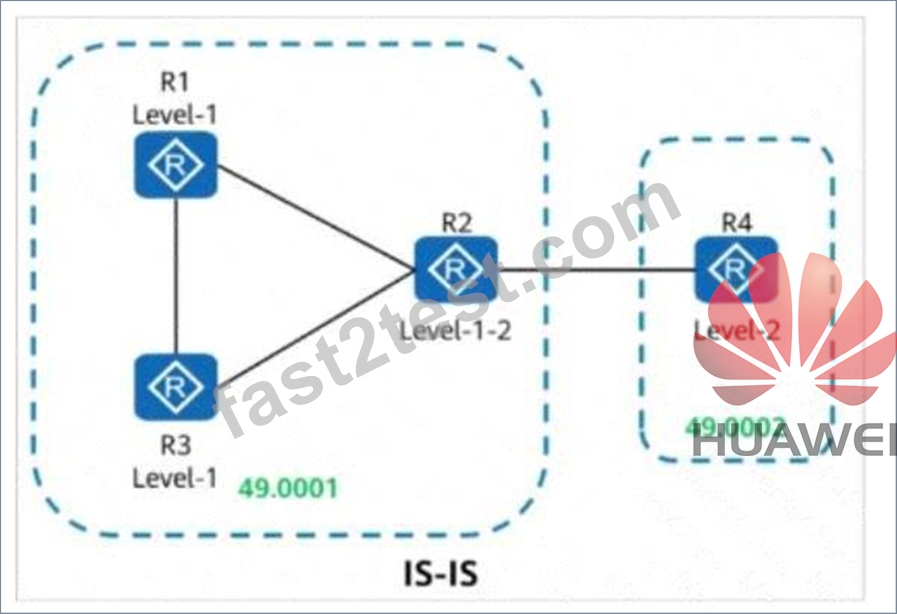
- A. R4
- B. R2
- C. R1
- D. R3
Answer: B,C,D
Explanation:
Comprehensive and Detailed In-Depth Explanation:
Understanding the IS-IS Network Structure in the Question:
* Router Roles & IS-IS Levels:
* R1 and R3: Level-1 routers.
* R2: Level-1-2 router (interconnects Level-1 and Level-2 areas).
* R4: Level-2 router.
* Key Command Used: default-route-advertise always level-1
* This command forces R1 to advertise a default route (0.0.0.0/0) to all Level-1 routers.
* In an IS-IS network:
* Level-1 routers do not see Level-2 routes unless a default route is provided.
* The default route is propagated only within the Level-1 area and does not affect Level-
2 routers unless explicitly redistributed.
Route Distribution Analysis:
* R1 (Level-1) imports the default route and advertises it to all Level-1 routers.# R1 has the default route.
* R3 (Level-1) is in the same Level-1 area as R1, so it receives the default route from R1.# R3 has the default route.
* R2 (Level-1-2) connects Level-1 and Level-2. Since it participates in Level-1, it also learns the default route from R1.# R2 has the default route.
* R4 (Level-2) is not in Level-1 and does not receive the default route unless it is explicitly redistributed from Level-1 to Level-2, which is not stated in the question.# R4 does NOT have the default route.
Final Conclusion:
* R1, R2, and R3 have the default route.
* R4 does not have the default route.
Thus, the correct answer is:# R1, R2, and R3 have the default route in their routing tables.
NEW QUESTION # 109
......
Genuine H12-831_V1.0-ENU Exam Dumps Free Demo Valid QA's: https://www.fast2test.com/H12-831_V1.0-ENU-premium-file.html
Latest Success Metrics For Actual H12-831_V1.0-ENU Exam (Updated 158 Questions): https://drive.google.com/open?id=1NGIXf6EbcxtWGnQ8jqpASxGC4vWoE_rR