

212-82 Practice Test Questions Updated 104 Questions
ECCouncil 212-82 Dumps - Secret To Pass in First Attempt
The Certified Cybersecurity Technician (212-82) Exam is an ideal certification for individuals looking to enter the cybersecurity field. It provides a solid foundation in the essential concepts and practices of cybersecurity, including incident response and risk management. Certified Cybersecurity Technician certification is also a stepping stone to more advanced cybersecurity certifications, such as the Certified Ethical Hacker (CEH) or the EC-Council Certified Security Analyst (ECSA).
NEW QUESTION # 61
Ayden works from home on his company's laptop. During working hours, he received an antivirus software update notification on his laptop. Ayden clicked on the update button; however, the system restricted the update and displayed a message stating that the update could only be performed by authorized personnel. Which of the following PCI-DSS requirements is demonstrated In this scenario?
- A. PCI-DSS requirement no 53
- B. PCI-DSS requirement no 1.3.2
- C. PCI-DSS requirement no 5.1
- D. PCI-DSS requirement no 1.3.1
Answer: A
Explanation:
PCI-DSS requirement no 5.3 is the PCI-DSS requirement that is demonstrated in this scenario. PCI-DSS (Payment Card Industry Data Security Standard) is a set of standards that applies to entities that store, process, or transmit payment card information, such as merchants, service providers, or payment processors. PCI-DSS requires them to protect cardholder data from unauthorized access, use, or disclosure. PCI-DSS consists of 12 requirements that are grouped into six categories: build and maintain a secure network and systems, protect cardholder data, maintain a vulnerability management program, implement strong access control measures, regularly monitor and test networks, and maintain an information security policy. PCI-DSS requirement no 5.3 is part of the category "maintain a vulnerability management program" and states that antivirus mechanisms must be actively running and cannot be disabled or altered by users, unless specifically authorized by management on a case-by-case basis for a limited time period. In the scenario, Ayden works from home on his company's laptop. During working hours, he received an antivirus software update notification on his laptop. Ayden clicked on the update button; however, the system restricted the update and displayed a message stating that the update could only be performed by authorized personnel. This means that his company's laptop has an antivirus mechanism that is actively running and cannot be disabled or altered by users, which demonstrates PCI-DSS requirement no 5.3.
NEW QUESTION # 62
Omar, an encryption specialist in an organization, was tasked with protecting low-complexity applications such as RFID tags, sensor-based applications, and other IbT-based applications. For this purpose, he employed an algorithm for all lower-powered devices that used less power and resources without compromising device security.
identify the algorithm employed by Omar in this scenario.
- A. Lightweight cryptography
- B. Homomorphic encryption
- C. Elliptic curve cryptography
- D. Quantum cryptography
Answer: A
Explanation:
Lightweight cryptography is an algorithm that is designed for low-complexity applications such as RFID tags, sensor-based applications, and other IoT-based applications. Lightweight cryptography uses less power and resources without compromising device security. Lightweight cryptography can be implemented using symmetric-key algorithms, asymmetric-key algorithms, or hash functions1.
NEW QUESTION # 63
As a cybersecurity technician, you were assigned to analyze the file system of a Linux image captured from a device that has been attacked recently. Study the forensic image 'Evidenced.img" in the Documents folder of the "Attacker Machine-1" and identify a user from the image file. (Practical Question)
- A. roger
- B. john
- C. smith
- D. attacker
Answer: D
Explanation:
The attacker is a user from the image file in the above scenario. A file system is a method or structure that organizes and stores files and data on a storage device, such as a hard disk, a flash drive, etc. A file system can have different types based on its format or features, such as FAT, NTFS, ext4, etc. A file system can be analyzed to extract various information, such as file names, sizes, dates, contents, etc. A Linux image is an image file that contains a copy or a snapshot of a Linux-based file system . A Linux image can be analyzed to extract various information about a Linux-based system or device . To analyze the file system of a Linux image captured from a device that has been attacked recently and identify a user from the image file, one has to follow these steps:
Navigate to Documents folder of Attacker Machine-1.
Right-click on Evidenced.img file and select Mount option.
Wait for the image file to be mounted and assigned a drive letter.
Open File Explorer and navigate to the mounted drive.
Open etc folder and open passwd file with a text editor.
Observe the user accounts listed in the file.
The user accounts listed in the file are:
root:x:0:0:root:/root:/bin/bash daemon:x:1:1:daemon:/usr/sbin:/usr/sbin/nologin bin:x:2:2:bin:/bin:/usr/sbin/nologin sys:x:3:3:sys:/dev:/usr/sbin/nologin sync:x:4:65534:sync:/bin:/bin/sync games:x:5:60:games:/usr/games:/usr/sbin/nologin man:x:6:12:man:/var/cache/man:/usr/sbin/nologin lp:x:7:7:lp:/var/spool/lpd:/usr/sbin/nologin mail:x:8:8:mail:/var/mail:/usr/sbin/nologin news:x:9:9:news:/var/spool/news:/usr/sbin/nologin uucp:x:10:10:uucp:/var/spool/uucp:/usr/sbin/nologin proxy:x:13:13:proxy:/bin:/usr/sbin/nologin www-data:x:33:33:www-data:/var/www:/usr/sbin/nologin backup:x:34:34:backup:/var/backups:/usr/sbin/nologin list:x:38:38:Mailing List Manager:/var/list:/usr/sbin/nologin irc:x:39:39:ircd:/var/run/ircd:/usr/sbin/nologin gnats:x:41:41:Gnats Bug-Reporting System (admin):/var/lib/gnats:/usr/sbin/nologin nobody:x:65534:65534:nobody:/nonexistent:/usr/sbin/nologin systemd-timesync:x:100: systemd-network:x: systemd-resolve:x: systemd-bus-proxy:x: syslog:x: _apt:x: messagebus:x: uuidd:x: lightdm:x: whoopsie:x: avahi-autoipd:x: avahi:x: dnsmasq:x: colord:x: speech-dispatcher:x: hplip:x: kernoops:x: saned:x: nm-openvpn:x: nm-openconnect:x: pulse:x: rtkit:x: sshd:x: attacker::1000 The user account that is not a system or service account is attacker, which is a user from the image file.
NEW QUESTION # 64
A pfSense firewall has been configured to block a web application www.abchacker.com. Perform an analysis on the rules set by the admin and select the protocol which has been used to apply the rule.
Hint: Firewall login credentials are given below:
Username: admin
Password: admin@l23
- A. ARP
- B. TCP/UDP
- C. POP3
- D. FTP
Answer: B
Explanation:
TCP/UDP is the protocol that has been used to apply the rule to block the web application www.abchacker.com in the above scenario. pfSense is a firewall and router software that can be installed on a computer or a device to protect a network from various threats and attacks. pfSense can be configured to block or allow traffic based on various criteria, such as source, destination, port, protocol, etc. pfSense rules are applied to traffic in the order they appear in the firewall configuration . To perform an analysis on the rules set by the admin, one has to follow these steps:
Open a web browser and type 20.20.10.26
Press Enter key to access the pfSense web interface.
Enter admin as username and admin@l23 as password.
Click on Login button.
Click on Firewall menu and select Rules option.
Click on LAN tab and observe the rules applied to LAN interface.
The rules applied to LAN interface are: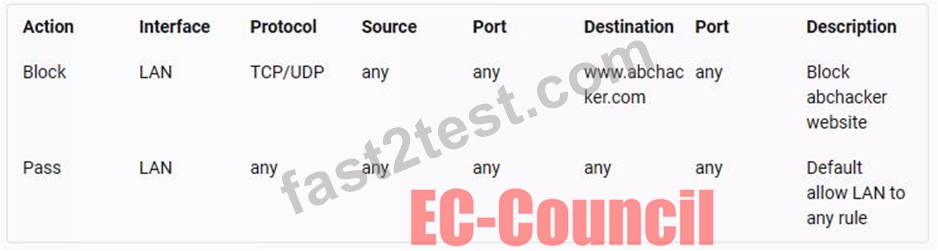
The first rule blocks any traffic from LAN interface to www.abchacker.com website using TCP/UDP protocol. The second rule allows any traffic from LAN interface to any destination using any protocol. Since the first rule appears before the second rule, it has higher priority and will be applied first. Therefore, TCP/UDP is the protocol that has been used to apply the rule to block the web application www.abchacker.com. POP3 (Post Office Protocol 3) is a protocol that allows downloading emails from a mail server to a client device. FTP (File Transfer Protocol) is a protocol that allows transferring files between a client and a server over a network. ARP (Address Resolution Protocol) is a protocol that resolves IP addresses to MAC (Media Access Control) addresses on a network.
NEW QUESTION # 65
Hayes, a security professional, was tasked with the implementation of security controls for an industrial network at the Purdue level 3.5 (IDMZ). Hayes verified all the possible attack vectors on the IDMZ level and deployed a security control that fortifies the IDMZ against cyber-attacks.
Identify the security control implemented by Hayes in the above scenario.
- A. Use of authorized RTU and PLC commands
- B. Point-to-po int communication
- C. MAC authentication
- D. Anti-DoS solution
Answer: A
Explanation:
The use of authorized RTU and PLC commands is the security control implemented by Hayes in the above scenario. RTU (Remote Terminal Unit) and PLC (Programmable Logic Controller) are devices that control and monitor industrial processes, such as power generation, water treatment, oil and gas production, etc. RTU and PLC commands are instructions that are sent from a master station to a slave station to perform certain actions or request certain data. The use of authorized RTU and PLC commands is a security control that fortifies the IDMZ (Industrial Demilitarized Zone) against cyber-attacks by ensuring that only valid and authenticated commands are executed by the RTU and PLC devices. Point-to-point communication is a communication method that establishes a direct connection between two endpoints. MAC authentication is an authentication method that verifies the MAC (Media Access Control) address of a device before granting access to a network. Anti-DoS solution is a security solution that protects a network from DoS (Denial-of-Service) attacks by filtering or blocking malicious traffic.
NEW QUESTION # 66
Karter, a security professional, deployed a honeypot on the organization's network for luring attackers who attempt to breach the network. For this purpose, he configured a type of honeypot that simulates a real OS as well as the applications and services of a target network. Furthermore, the honeypot deployed by Karter only responds to pre-configured commands.
Identify the type of Honeypot deployed by Karter in the above scenario.
- A. High-interaction honeypot
- B. Pure honeypot
- C. Low-interaction honeypot
- D. Medium-interaction honeypot
Answer: C
Explanation:
A low-interaction honeypot is a type of honeypot that simulates a real OS as well as the applications and services of a target network, but only responds to pre-configured commands. It is designed to capture basic information about the attacker, such as their IP address, tools, and techniques. A low-interaction honeypot is easier to deploy and maintain than a high-interaction honeypot, which fully emulates a real system and allows the attacker to interact with it. A pure honeypot is a real system that is intentionally vulnerable and exposed to attackers. A medium-interaction honeypot is a type of honeypot that offers more functionality and interactivity than a low-interaction honeypot, but less than a high-interaction honeypot.
NEW QUESTION # 67
An MNC hired Brandon, a network defender, to establish secured VPN communication between the company's remote offices. For this purpose, Brandon employed a VPN topology where all the remote offices communicate with the corporate office but communication between the remote offices is denied.
Identify the VPN topology employed by Brandon in the above scenario.
- A. Star topology
- B. Full-mesh VPN topology
- C. Point-to-Point VPN topology
- D. Hub-and-Spoke VPN topology
Answer: D
Explanation:
A hub-and-spoke VPN topology is a type of VPN topology where all the remote offices communicate with the corporate office, but communication between the remote offices is denied. The corporate office acts as the hub, and the remote offices act as the spokes. This topology reduces the number of VPN tunnels required and simplifies the management of VPN policies. A point-to-point VPN topology is a type of VPN topology where two endpoints establish a direct VPN connection. A star topology is a type of VPN topology where one endpoint acts as the central node and connects to multiple other endpoints. A full-mesh VPN topology is a type of VPN topology where every endpoint connects to every other endpoint.
NEW QUESTION # 68
Paul, a computer user, has shared information with his colleague using an online application. The online application used by Paul has been incorporated with the latest encryption mechanism. This mechanism encrypts data by using a sequence of photons that have a spinning trait while traveling from one end to another, and these photons keep changing their shapes during their course through filters: vertical, horizontal, forward slash, and backslash.
Identify the encryption mechanism demonstrated in the above scenario.
- A. Homomorphic encryption
- B. Elliptic curve cryptography
- C. Rivest Shamir Adleman encryption
- D. Quantum cryptography
Answer: D
Explanation:
Quantum cryptography is the encryption mechanism demonstrated in the above scenario. Quantum cryptography is a branch of cryptography that uses quantum physics to secure data transmission and communication. Quantum cryptography encrypts data by using a sequence of photons that have a spinning trait, called polarization, while traveling from one end to another. These photons keep changing their shapes, called states, during their course through filters: vertical, horizontal, forward slash, and backslash. Quantum cryptography ensures that any attempt to intercept or tamper with the data will alter the quantum states of the photons and be detected by the sender and receiver . Homomorphic encryption is a type of encryption that allows computations to be performed on encrypted data without decrypting it first. Rivest Shamir Adleman (RSA) encryption is a type of asymmetric encryption that uses two keys, public and private, to encrypt and decrypt data. Elliptic curve cryptography (ECC) is a type of asymmetric encryption that uses mathematical curves to generate keys and perform encryption and decryption.
NEW QUESTION # 69
Miguel, a professional hacker, targeted an organization to gain illegitimate access to its critical information. He identified a flaw in the end-point communication that can disclose the target application's data.
Which of the following secure application design principles was not met by the application in the above scenario?
- A. Secure the weakest link
- B. Exception handling
- C. Fault tolerance
- D. Do not trust user input
Answer: B
Explanation:
Exception handling is a secure application design principle that states that the application should handle errors and exceptions gracefully and securely, without exposing sensitive information or compromising the system's functionality. Exception handling can help prevent attackers from exploiting errors or exceptions to gain access to data or resources or cause denial-of-service attacks. In the scenario, Miguel identified a flaw in the end-point communication that can disclose the target application's data, which means that the application did not meet the exception handling principle.
NEW QUESTION # 70
Tristan, a professional penetration tester, was recruited by an organization to test its network infrastructure. The organization wanted to understand its current security posture and its strength in defending against external threats. For this purpose, the organization did not provide any information about their IT infrastructure to Tristan. Thus, Tristan initiated zero-knowledge attacks, with no information or assistance from the organization.
Which of the following types of penetration testing has Tristan initiated in the above scenario?
- A. Gray-box testing
- B. Translucent-box testing
- C. White-box testing
- D. Black-box testing
Answer: D
NEW QUESTION # 71
Kaison. a forensic officer, was investigating a compromised system used for various online attacks. Kaison initiated the data acquisition process and extracted the data from the systems DVD-ROM. Which of the following types of data did Kaison acquire in the above scenario?
- A. Archival media
- B. ARP cache
- C. Kernel statistics
- D. Processor cache
Answer: A
Explanation:
Archival media is the type of data that Kaison acquired in the above scenario. Archival media is a type of data that is stored on removable media such as DVD-ROMs, CD-ROMs, tapes, or flash drives. Archival media can be used to backup or transfer data from one system to another. Archival media can be acquired using forensic tools that can read and copy the data from the media4. Reference: Archival Media
NEW QUESTION # 72
Kayden successfully cracked the final round of interview at an organization. After few days, he received his offer letter through an official company email address. The email stated that the selected candidate should respond within a specified time. Kayden accepted the opportunity and provided e-signature on the offer letter, then replied to the same email address. The company validated the e-signature and added his details to their database. Here, Kayden could not deny company's message, and company could not deny Kayden's signature.
Which of the following information security elements was described in the above scenario?
- A. Availability
- B. Integrity
- C. Non-repudiation
- D. Confidentiality
Answer: C
NEW QUESTION # 73
An organization hired a network operations center (NOC) team to protect its IT infrastructure from external attacks. The organization utilized a type of threat intelligence to protect its resources from evolving threats. The threat intelligence helped the NOC team understand how attackers are expected to perform an attack on the organization, identify the information leakage, and determine the attack goals as well as attack vectors.
Identify the type of threat intelligence consumed by the organization in the above scenario.
- A. Technical threat intelligence
- B. Strategic threat intelligence
- C. Operational threat intelligence
- D. Tactical threat intelligence
Answer: A
NEW QUESTION # 74
Myles, a security professional at an organization, provided laptops for all the employees to carry out the business processes from remote locations. While installing necessary applications required for the business, Myles has also installed antivirus software on each laptop following the company's policy to detect and protect the machines from external malicious events over the Internet.
Identify the PCI-DSS requirement followed by Myles in the above scenario.
- A. PCI-DSS requirement no 5.1
- B. PCI-DSS requirement no 1.3.5
- C. PCI-DSS requirement no 1.3.2
- D. PCI-DSS requirement no 1.3.1
Answer: A
NEW QUESTION # 75
Tenda, a network specialist at an organization, was examining logged data using Windows Event Viewer to identify attempted or successful unauthorized activities. The logs analyzed by Tenda include events related to Windows security; specifically, log-on/log-off activities, resource access, and also information based on Windows system's audit policies.
Identify the type of event logs analyzed by Tenda in the above scenario.
- A. Setup event log
- B. Application event log
- C. System event log
- D. Security event log
Answer: D
NEW QUESTION # 76
Lorenzo, a security professional in an MNC, was instructed to establish centralized authentication, authorization, and accounting for remote-access servers. For this purpose, he implemented a protocol that is based on the client-server model and works at the transport layer of the OSI model.
Identify the remote authentication protocol employed by Lorenzo in the above scenario.
- A. IMAPS
- B. RADIUS
- C. SNMPv3
- D. POP3S
Answer: B
NEW QUESTION # 77
An MNC hired Brandon, a network defender, to establish secured VPN communication between the company's remote offices. For this purpose, Brandon employed a VPN topology where all the remote offices communicate with the corporate office but communication between the remote offices is denied.
Identify the VPN topology employed by Brandon in the above scenario.
- A. Star topology
- B. Full-mesh VPN topology
- C. Point-to-Point VPN topology
- D. Hub-and-Spoke VPN topology
Answer: D
NEW QUESTION # 78
Tenda, a network specialist at an organization, was examining logged data using Windows Event Viewer to identify attempted or successful unauthorized activities. The logs analyzed by Tenda include events related to Windows security; specifically, log-on/log-off activities, resource access, and also information based on Windows system's audit policies.
Identify the type of event logs analyzed by Tenda in the above scenario.
- A. Setup event log
- B. Application event log
- C. System event log
- D. Security event log
Answer: D
Explanation:
Security event log is the type of event log analyzed by Tenda in the above scenario. Windows Event Viewer is a tool that displays logged data about various events that occur on a Windows system or network. Windows Event Viewer categorizes event logs into different types based on their source and purpose. Security event log is the type of event log that records events related to Windows security; specifically, log-on/log-off activities, resource access, and also information based on Windows system's audit policies . Security event log can help identify attempted or successful unauthorized activities on a Windows system or network. Application event log is the type of event log that records events related to applications running on a Windows system, such as errors, warnings, or information messages. Setup event log is the type of event log that records events related to the installation or removal of software or hardware components on a Windows system. System event log is the type of event log that records events related to the operation of a Windows system or its components, such as drivers, services, processes, etc.
NEW QUESTION # 79
Rickson, a security professional at an organization, was instructed to establish short-range communication between devices within a range of 10 cm. For this purpose, he used a mobile connection method that employs electromagnetic induction to enable communication between devices. The mobile connection method selected by Rickson can also read RFID tags and establish Bluetooth connections with nearby devices to exchange information such as images and contact lists.
Which of the following mobile connection methods has Rickson used in above scenario?
- A. Satcom
- B. Cellular communication
- C. NFC
- D. ANT
Answer: C
NEW QUESTION # 80
In an organization, all the servers and database systems are guarded in a sealed room with a single-entry point. The entrance is protected with a physical lock system that requires typing a sequence of numbers and letters by using a rotating dial that intermingles with several other rotating discs.
Which of the following types of physical locks is used by the organization in the above scenario?
- A. Combination locks
- B. Mechanical locks
- C. Digital locks
- D. Electromagnetic locks
Answer: A
Explanation:
It identifies the type of physical lock used by the organization in the above scenario. A physical lock is a device that prevents unauthorized access to a door, gate, cabinet, or other enclosure by using a mechanism that requires a key, code, or biometric factor to open or close it. There are different types of physical locks, such as:
Combination lock: This type of lock requires typing a sequence of numbers and letters by using a rotating dial that intermingles with several other rotating discs. This type of lock is suitable for securing safes, lockers, or cabinets that store valuable items or documents.
Digital lock: This type of lock requires entering a numeric or alphanumeric code by using a keypad or touchscreen. This type of lock is suitable for securing doors or gates that require frequent access or multiple users.
Mechanical lock: This type of lock requires inserting and turning a metal key that matches the shape and size of the lock. This type of lock is suitable for securing doors or gates that require simple and reliable access or single users.
Electromagnetic lock: This type of lock requires applying an electric current to a magnet that attracts a metal plate attached to the door or gate. This type of lock is suitable for securing doors or gates that require remote control or integration with other security systems.
In the above scenario, the organization used a combination lock that requires typing a sequence of numbers and letters by using a rotating dial that intermingles with several other rotating discs. Option A is incorrect, as it does not identify the type of physical lock used by the organization in the above scenario. A digital lock requires entering a numeric or alphanumeric code by using a keypad or touchscreen. In the above scenario, the organization did not use a digital lock, but a combination lock. Option C is incorrect, as it does not identify the type of physical lock used by the organization in the above scenario. A mechanical lock requires inserting and turning a metal key that matches the shape and size of the lock. In the above scenario, the organization did not use a mechanical lock, but a combination lock. Option D is incorrect, as it does not identify the type of physical lock used by the organization in the above scenario. An electromagnetic lock requires applying an electric current to a magnet that attracts a metal plate attached to the door or gate. In the above scenario, the organization did not use an electromagnetic lock, but a combination lock. Reference: , Section 7.2
NEW QUESTION # 81
Henry Is a cyber security specialist hired by BlackEye - Cyber security solutions. He was tasked with discovering the operating system (OS) of a host. He used the Unkornscan tool to discover the OS of the target system. As a result, he obtained a TTL value, which Indicates that the target system is running a Windows OS. Identify the TTL value Henry obtained, which indicates that the target OS is Windows.
- A. 0
- B. 1
- C. 2
- D. 3
Answer: D
NEW QUESTION # 82
You are a penetration tester working to test the user awareness of the employees of the client xyz. You harvested two employees' emails from some public sources and are creating a client-side backdoor to send it to the employees via email. Which stage of the cyber kill chain are you at?
- A. Weaponization
- B. Exploitation
- C. Command and control
- D. Reconnaissance
Answer: A
NEW QUESTION # 83
Bob was recently hired by a medical company after it experienced a major cyber security breach. Many patients are complaining that their personal medical records are fully exposed on the Internet and someone can find them with a simple Google search. Bob's boss is very worried because of regulations that protect those dat a. Which of the following regulations is mostly violated?
- A. PCIDSS
- B. HIPPA/PHl
- C. Pll
- D. ISO 2002
Answer: B
NEW QUESTION # 84
......
ECCouncil 212-82 exam is a challenging and comprehensive exam that requires candidates to have a deep understanding of cybersecurity concepts and technologies. 212-82 exam is designed to test both the theoretical knowledge and practical skills of candidates, ensuring that they are well-equipped to handle real-world cybersecurity challenges. 212-82 exam is also updated regularly to reflect the latest developments in the field, ensuring that certified professionals are up-to-date with the latest cybersecurity trends and technologies.
ECCouncil 212-82 Exam Dumps [2023] Practice Valid Exam Dumps Question: https://www.fast2test.com/212-82-premium-file.html
212-82 Dumps - Grab Out For [NEW-2023] ECCouncil Exam: https://drive.google.com/open?id=1m-5X7ykxkustidiv5UsDXUB8PzZSwQ0l