

Get Ready with JN0-363 Exam Dumps (2026)
Realistic JN0-363 Dumps are Available for Instant Access
NEW QUESTION # 48
Click the Exhibit.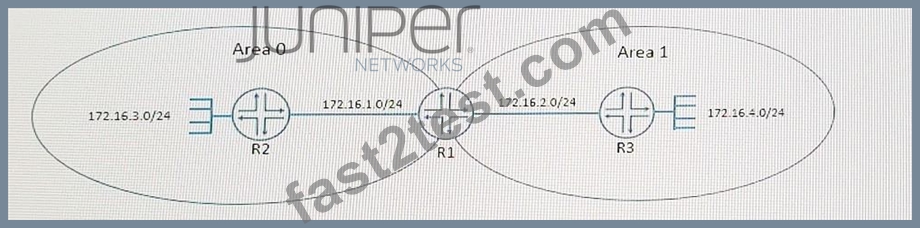

You are using OSPF as your IGP in your network. You have applied the OSPF configuration shown in the exhibit to router R1.
Which statement is true in this scenario?
- A. Router R2 will not have a route to subnet 172.16.4.0/24.
- B. Router R1 must be configured as a stub area for Area 0.0.0.0.
- C. Router R1 will send a default route to router R2.
- D. Router R3 will not have a route to subnet 172.16.3.0/24.
Answer: D
NEW QUESTION # 49
What are tree types of interfaces that can be used in an MX Series device when implementing a virtual switch routing instance? (Choose three.)
- A. Access interface
- B. Trunk interface
- C. Layer 2 logical interface
- D. Logical tunnel interface
- E. GRE tunnel interface
Answer: A,B,C
NEW QUESTION # 50
Referring to the exhibit, which firewall filter action(s) will be applied to incoming frames to ge-1/0/3?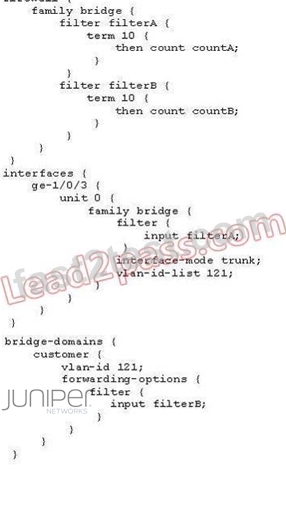
- A. Frames will be counted initially by filterA and then counted by filterB.
- B. Frames will be counted by filterA only.
- C. Frames will be counted by filterB only.
- D. Frames will be counted initially by filterB and then counted by filterA.
Answer: A
NEW QUESTION # 51
Referring to the exhibit, which two additional steps should you lake to fully configure NSR? (Choose two.)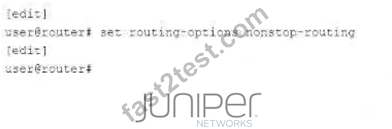
- A. You should configure the max period for NSR precision timers.
- B. You must configure GRES.
- C. You must configure graceful restart.
- D. You should configure commit synchronization.
Answer: A,B
NEW QUESTION # 52
Click the exhibit.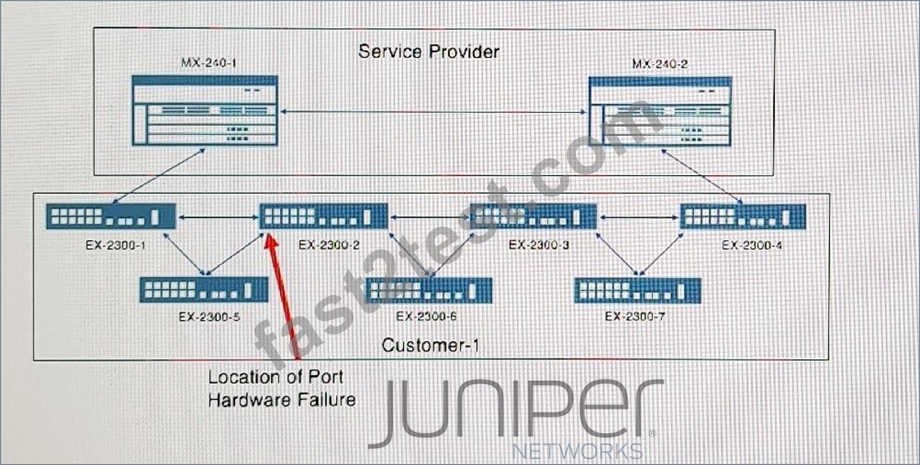
Customer 1 has experienced some hardware failures that erroneously transitioned some links into a forwarding state, as shown in the exhibit.
In this scenario, which STP feature set would solve this problem?
- A. Root protection
- B. Loop protection
- C. BPDU protection
- D. MAC movement protection
Answer: B
NEW QUESTION # 53
Click the Exhibit button.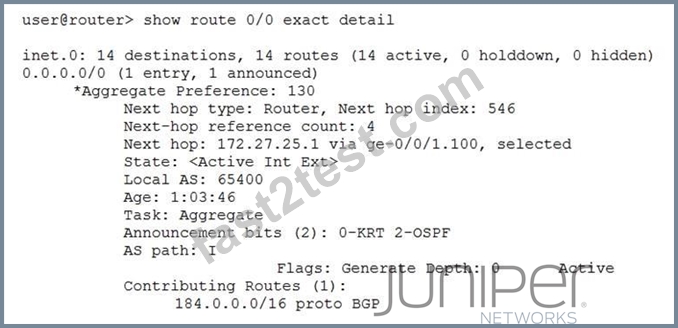
Which type of route is shown in the exhibit?
- A. kernel
- B. static
- C. generate
- D. aggregate
Answer: C
NEW QUESTION # 54
Click the Exhibit.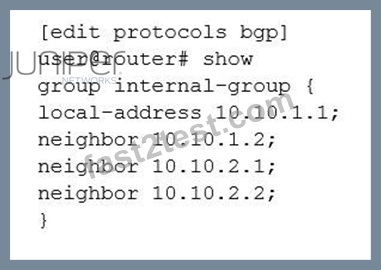
You have configured the IBGP group shown in the exhibit. However, committing your configuration fails.
Which parameter should you add to the IBGP group configuration to correct the problem?
- A. Type internal
- B. Type external
- C. As -override
- D. Export <policy name>
Answer: A
NEW QUESTION # 55
What are three types of MPLS routers? (Choose three.)
- A. egress routers
- B. transit routers
- C. peering routers
- D. aggregation routers
- E. ingress routers
Answer: A,B,E
NEW QUESTION # 56
Exhibit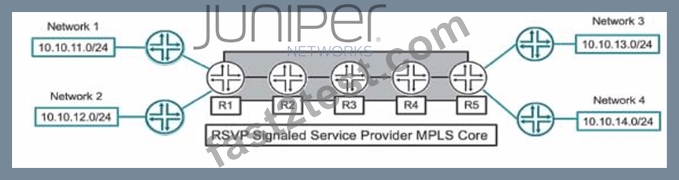
Referring to the exhibit, what is the minimum number of LSPs required to support alt four networks?
- A. 0
- B. 1
- C. 2
- D. 3
Answer: B
Explanation:
Network 1 to Network 3
Network 1 to Network 4
Network 2 to Network 3
Network 2 to Network 4
and vice-versa
NEW QUESTION # 57
Click the Exhibit button.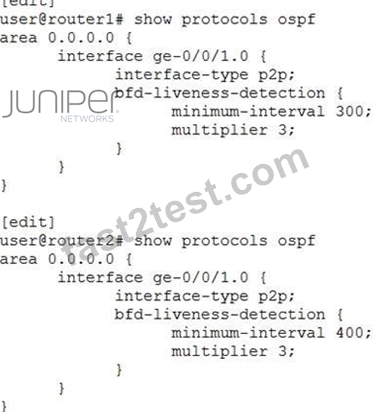
Referring to the exhibit, if there is a connection failure between router1 and router2, how much time will pass before the devices declare the BFD session dead?
- A. 900 ms
- B. 300 ms
- C. 600 ms
- D. 1200 ms
Answer: A
NEW QUESTION # 58
You want the R1 and R3 routers to forward traffic destined to the 203.0.113.0/24 network through R2. Which BGP attribute would you modify to satisfy this requirement?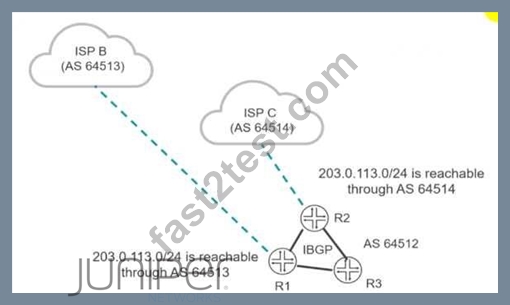
- A. community
- B. origin
- C. MED
- D. local preference
Answer: C
NEW QUESTION # 59
Exhibit.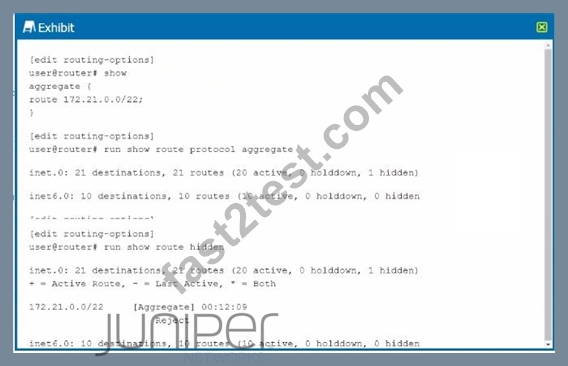
Referring to the exhibit, you have configured an aggregate route that represents the 172.21.0.0/24, 172.21.1.0/24, and 172.21.2.0/24 networks. However, when you view the routing table, your new route hidden.
Which action would you perform to determine the problem?
- A. Verify that you have defined a metric value for the aggregate route.
- B. Verify that you have set the preference to a lower default value.
- C. Verify that you have active contributing routes on the device.
- D. Verify that you have configured a policy on the device to accept aggregate routes.
Answer: B
NEW QUESTION # 60
Exhibit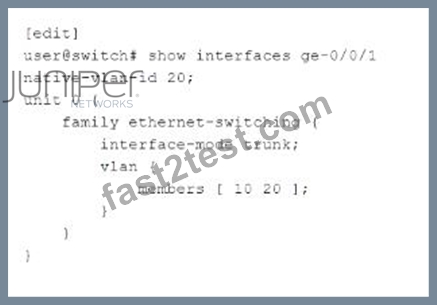
Referring to the exhibit, what will happen to untagged frames?
- A. The untagged frames are dropped.
- B. The untagged frames are associated with VLAN 10.
- C. The untagged frames are load balanced between VLAN 10 and VLAN 20.
- D. The untagged frames are associated with VLAN 20.
Answer: A
NEW QUESTION # 61
Click the Exhibit button.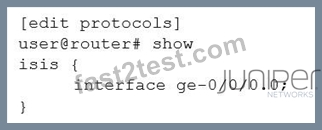
Referring to the exhibit, which statement about the IS-IS interface is true?
- A. The ge-0/0/0.0 interface will not be assigned to a level
- B. The ge-0/0/0.0 interface will act as an L2 interface only
- C. The ge-0/0/0.0 interface will act as an L1/L2 interface
- D. The ge-0/0/0.0 interface will act as an L1 interface only
Answer: C
NEW QUESTION # 62
Which statement is true about an OSPF broadcast link?
- A. All routers form an adjacency with both the DR and BDR
- B. All routers form an adjacency only with the DR
- C. All routers form an adjacency only with the BDR
- D. All routers form an adjacency with all other routers
Answer: A
Explanation:
https://sites.google.com/site/amitsciscozone/home/juniper-junos/junos--ospf-designated-router
NEW QUESTION # 63
Which OSPF database packet determines which router is in charge of the database synchronization and the transferring of LSA headers between the two systems?
- A. link-state update
- B. link-state request
- C. hello
- D. database description
Answer: D
Explanation:
the Database Description (DD) packets serve two main purposes:
1. determinining which router is in charge of the database synchronization
2. tansferring the LSA headers between the two systems
The Database Description (DBD) OSPF packet is used during the adjacency formation process to describe the contents of the topological database between routers. The routers exchange DBD packets to determine the master and slave relationship, which dictates the router in charge of the database synchronization.
Reference::
OSPF Design Guide, Juniper Networks Documentation
OSPF Database Description Packets, Juniper Networks Documentation
NEW QUESTION # 64
Click the Exhibit button. What does IS-IS/18 mean in the output displayed in the exhibit?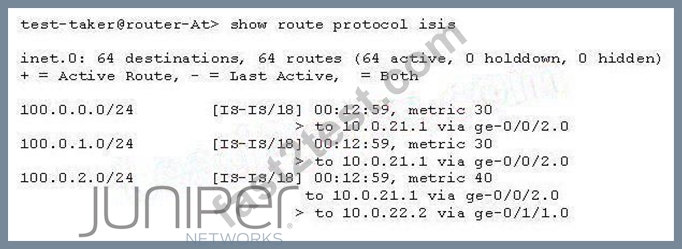
- A. These routes are external Level 1 routes.
- B. These routes are internal Level 2 routes.
- C. These routes are internal Level 1 routes.
- D. These routes are external Level 2 routes.
Answer: B
NEW QUESTION # 65
Exhibit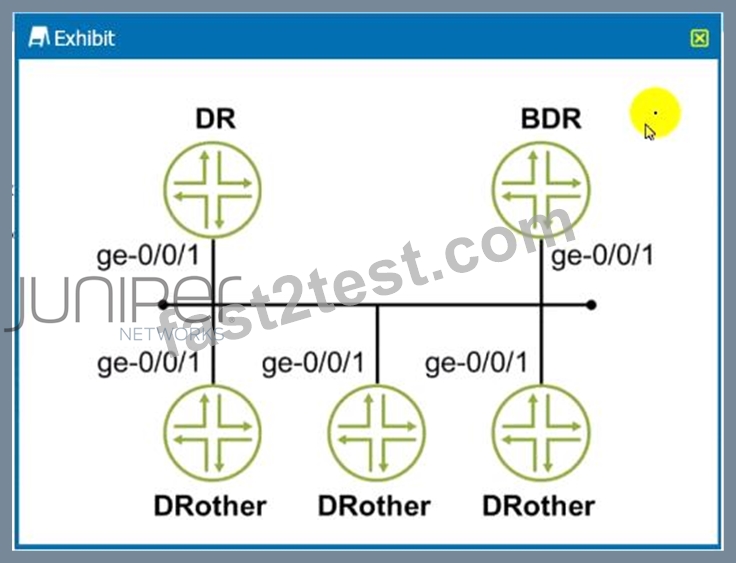
You are asked to configure the OSPF environment to prevent the DRother routers from participating in DR/BDR election.
Referring to the exhibit, which command will accomplish this task?
- A. set protocols ospf area 0.0.0.0 interface ge-0/0/1 interface-type nbma
- B. set protocols ospf area 0.0.0.0 interface ge-0/0/l priority 255
- C. set protocols ospf area 0.0.0.0 interface ge-0/0/1 interface-type p2p
- D. set protocols ospf area 0.0.0.0 interface ge-0/0/1 priority 0
Answer: B
NEW QUESTION # 66
Which two statements are true about IP and GRE tunnels? (Choose two.)
- A. Tunnel endpoints need a valid route to the remote endpoint
- B. The protocol field is changed in the inner IP packet header
- C. Tunnel traffic is encrypted
- D. The TTL field is changed in the inner IP packet header
Answer: A,D
NEW QUESTION # 67
Which type of load balancing is shown in the exhibit?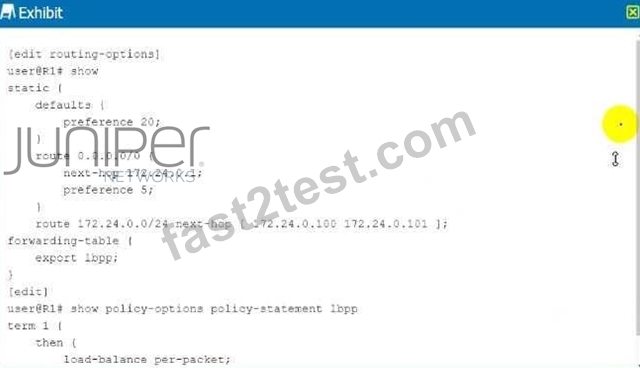
- A. network load balancing
- B. per-flow load balancing
- C. elastic load balancing
- D. per-packet load balancing
Answer: A
NEW QUESTION # 68
You are asked to configure filter-based forwarding on a Junos device.
Which two statements are correct in this scenario? (Choose two.)
- A. You must create a routing instance.
- B. You must create and apply a match filter.
- C. You must create a routing policy.
- D. You must create a route target.
Answer: A,B
Explanation:
To configure filter-based forwarding, perform the following tasks: Create a match filter on the ingress device. To specify a match filter, include the filter filter-name statement at the [edit firewall] hierarchy level. A packet that passes through the filter is compared against a set of rules to classify it and to determine its membership in a set. Once classified, the packet is forwarded to a routing table specified in the accept action in the filter description language. The routing table then forwards the packet to the next hop that corresponds to the destination address entry in the table. Create routing instances that specify the routing table(s) to which a packet is forwarded, and the destination to which the packet is forwarded at the [edit routing-instances] hierarchy level.
NEW QUESTION # 69
Click the Exhibit.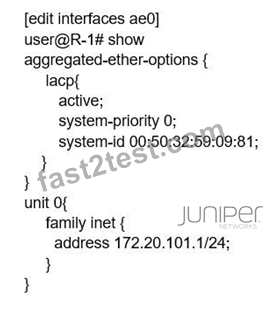
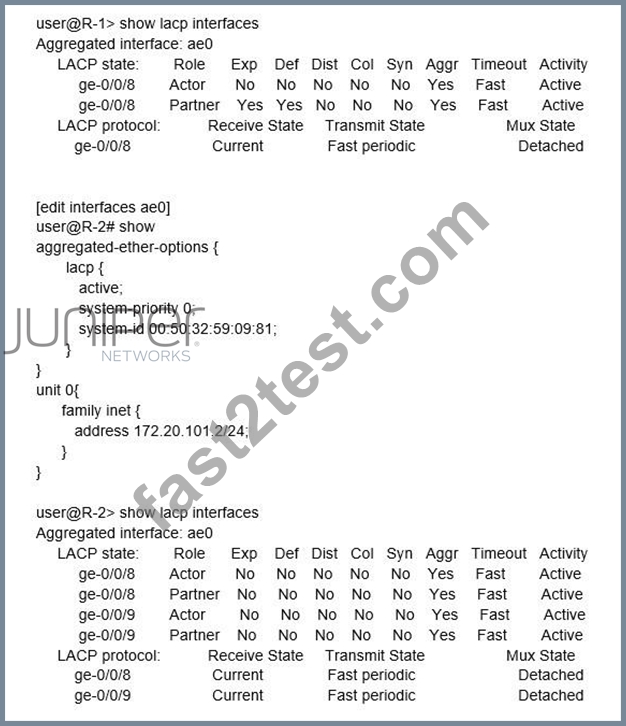
Referring to the exhibit, R-1 and R-2 are connected with a LAG on the ae0 interface.
However, the LAG is not operational.
Which action will solve this problem?
- A. Set the LACP system priority to a non-zero value on both devices.
- B. Change one device to use LACP passive mode.
- C. Change the system ID on one device.
- D. Set the LACP system priority to a non-zero value on one device.
Answer: C
NEW QUESTION # 70
Which two statements are correct when using LDP? (Choose two.)
- A. The lnet.3 table will contain only the paths explicitly defined.
- B. LDP label-switched paths are created by configuring LDP on at least one physical router interface.
- C. The inet.3 table will contain a full mesh of label-switched paths to other LDP-enabled routers.
- D. LDP label-switched paths are created by configuring LDP on the loopbacK Interface.
Answer: B,C
NEW QUESTION # 71
What are two valid next-hop types that would be configured for a static route? (Choose two.)
- A. An IP address
- B. An egress interface name
- C. An igress interface name
- D. A MAC address
Answer: A,B
NEW QUESTION # 72
Which two interface types are used as tunnel endpoints? (Choose two.)
- A. gr
- B. ae
- C. ip
- D. ge
Answer: C,D
NEW QUESTION # 73
......
Download Exam JN0-363 Practice Test Questions with 100% Verified Answers: https://www.fast2test.com/JN0-363-premium-file.html
Share Latest JN0-363Test Practice Test Questions, Exam Dumps: https://drive.google.com/open?id=1XdbfFPwGQmlra8AkjuIlj39d5kElN1cI