

Valid NSE4_FGT-7.2 Practice Test Dumps with 100% Passing Guarantee [Jun-2024]
NSE4_FGT-7.2 PDF Dumps Are Helpful To produce Your Dreams Correct QA's
Fortinet NSE4_FGT-7.2 exam is an intermediate-level certification exam that is suitable for network administrators, security architects, and IT professionals who are responsible for managing and securing enterprise networks. NSE4_FGT-7.2 exam consists of 60 multiple-choice questions that must be completed within 90 minutes. To pass the exam, candidates must score at least 70%.
Fortinet NSE4_FGT-7.2 exam is a vendor-neutral certification, meaning that it is not tied to any specific hardware or software platform. This makes it an excellent certification for networking professionals who want to demonstrate their expertise in network security, regardless of the tools and technologies they use. Fortinet NSE 4 - FortiOS 7.2 certification is also recognized globally, making it an excellent choice for professionals who work with multinational organizations.
NEW QUESTION # 10
Refer to the exhibits.
The exhibits show a network diagram and firewall configurations.
An administrator created a Deny policy with default settings to deny Webserver access for Remote-User2.
Remote-User1 must be able to access the Webserver. Remote-User2 must not be able to access the Webserver.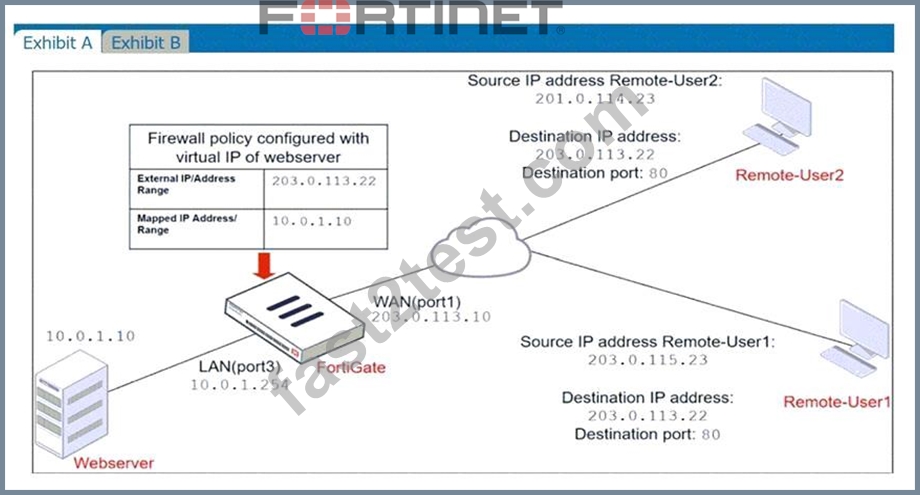

In this scenario, which two changes can the administrator make to deny Webserver access for Remote-User2?
(Choose two.)
- A. Set the Destination address as Web_server in the Deny policy.
- B. Disable match-vip in the Deny policy.
- C. Enable match vip in the Deny policy.
- D. Set the Destination address as Deny_IP in the Allow-access policy.
Answer: A,C
Explanation:
Explanation
https://community.fortinet.com/t5/FortiGate/Technical-Tip-Firewall-does-not-block-incoming-WAN-to-LAN/ta-
NEW QUESTION # 11
What are two functions of ZTNA? (Choose two.)
- A. ZTNA provides role-based access.
- B. ZTNA provides a security posture check.
- C. ZTNA manages access through the client only.
- D. ZTNA manages access for remote users only.
Answer: A,B
NEW QUESTION # 12
A network administrator has enabled SSL certificate inspection and antivirus on FortiGate. When downloading an EICAR test file through HTTP, FortiGate detects the virus and blocks the file. When downloading the same file through HTTPS, FortiGate does not detect the virus and the file can be downloaded.
What is the reason for the failed virus detection by FortiGate?
- A. The website is exempted from SSL inspection.
- B. The EICAR test file exceeds the protocol options oversize limit.
- C. The browser does not trust the FortiGate self-signed CA certificate.
- D. The selected SSL inspection profile has certificate inspection enabled.
Answer: A,C
Explanation:
Explanation
https traffic requires SSL decryption. Check the ssh inspection profile
NEW QUESTION # 13
Refer to exhibit.
An administrator configured the web filtering profile shown in the exhibit to block access to all social networking sites except Twitter. However, when users try to access twitter.com, they are redirected to a FortiGuard web filtering block page.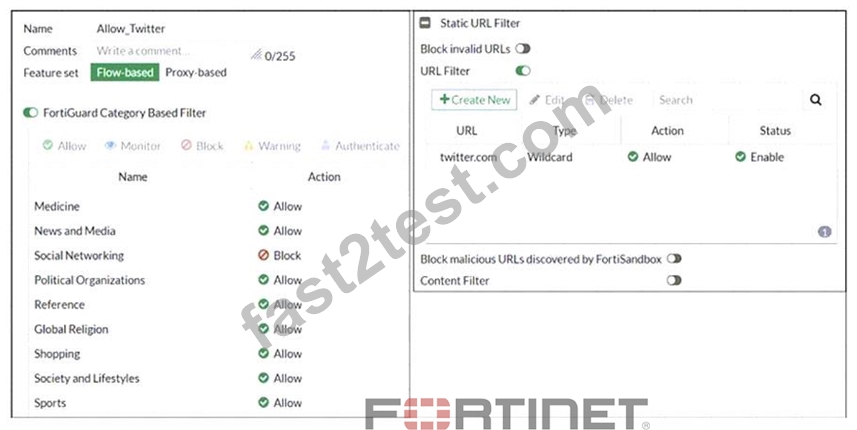
Based on the exhibit, which configuration change can the administrator make to allow Twitter while blocking all other social networking sites?
- A. On the FortiGuard Category Based Filter Action to Warning for Social Networking
- B. On the Static URL Filter configuration, set Action to Monitor.
- C. On the Static URL Filter configuration, set Type to Simple
- D. On the Static URL Filter configuration, set Action to Exempt.
Answer: D
NEW QUESTION # 14
Refer to the exhibit.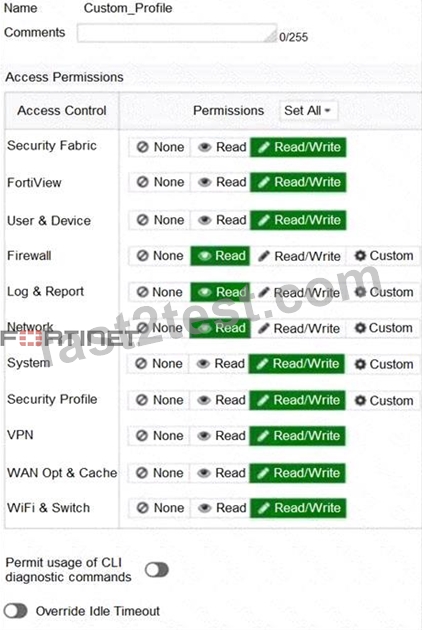
Based on the administrator profile settings, what permissions must the administrator set to run the diagnose firewall auth list CLI command on FortiGate?
- A. Read/Write permission for Firewall
- B. Read/Write permission for Log & Report
- C. Custom permission for Network
- D. CLI diagnostics commands permission
Answer: D
Explanation:
Explanation
https://kb.fortinet.com/kb/documentLink.do?externalID=FD50220
NEW QUESTION # 15
View the exhibit.
Which of the following statements are correct? (Choose two.)
- A. The TunnelB route is the primary route for reaching the remote site. The TunnelA route is used only if the TunnelB VPN is down.
- B. Dead peer detection must be disabled to support this type of IPsec setup.
- C. This is a redundant IPsec setup.
- D. This setup requires at least two firewall policies with the action set to IPsec.
Answer: A,C
Explanation:
https://docs.fortinet.com/document/fortigate/6.2.4/cookbook/632796/ospf-with-ipsec-vpn-for-network-redundancy
NEW QUESTION # 16
Refer to the exhibit.
The exhibit shows a diagram of a FortiGate device connected to the network, the firewall policy and VIP configuration on the FortiGate device, and the routing table on the ISP router.
When the administrator tries to access the web server public address (203.0.113.2) from the internet, the connection times out. At the same time, the administrator runs a sniffer on FortiGate to capture incoming web traffic to the server and does not see any output.
Based on the information shown in the exhibit, what configuration change must the administrator make to fix the connectivity issue?
- A. Configure a loopback interface with address 203.0.113.2/32.
- B. In the VIP configuration, enable arp-reply.
- C. In the firewall policy configuration, enable match-vip.
- D. Enable port forwarding on the server to map the external service port to the internal service port.
Answer: C
NEW QUESTION # 17
Which statement correctly describes the use of reliable logging on FortiGate?
- A. Reliable logging can be configured only using the CLI.
- B. Reliable logging prevents the loss of logs when the local disk is full.
- C. Reliable logging is enabled by default in all configuration scenarios.
- D. Reliable logging is required to encrypt the transmission of logs.
Answer: B
NEW QUESTION # 18
Which two statements about FortiGate FSSO agentless polling mode are true? (Choose two.)
- A. FortiGate uses the SMB protocol to read the event viewer logs from the DCs.
- B. FortiGate does not support workstation check .
- C. FortiGate uses the AD server as the collector agent.
- D. FortiGate directs the collector agent to use a remote LDAP server.
Answer: A,B
Explanation:
You can deploy FSSO w/o installing an agent. FG polls the DCs directly, instead of receiving logon info indirectly from a collector agent.
Because FG collects all of the data itself, agentless polling mode requires greater system resources, and it doesn't scale as easily.
Agentless polling mode operates in a similar way to WinSecLog, but with only two event IDs: 4768 and 4769. Because there's no collector agent, FG uses the SMB protocol to read the event viewer logs from the DCs.
FG acts as a collector. It 's responsible for polling on top of its normal FSSO tasks but does not have all the extra features, such as workstation checks, that are available with the external collector agent.
Reference:
https://community.fortinet.com/t5/FortiGate/Troubleshooting-Tip-How-to-troubleshoot-FSSO-agentless-polling/ta-p/214349
NEW QUESTION # 19
Which CLI command will display sessions both from client to the proxy and from the proxy to the servers?
- A. diagnose wad session list | grep hook-pre&&hook-out
- B. diagnose wad session list
- C. diagnose wad session list | grep hook=pre&&hook=out
- D. diagnose wad session list | grep "hook=pre"&"hook=out"
Answer: B
NEW QUESTION # 20
Refer to the exhibit.
Examine the intrusion prevention system (IPS) diagnostic command.
Which statement is correct If option 5 was used with the IPS diagnostic command and the outcome was a decrease in the CPU usage?
- A. The IPS engine will continue to run in a normal state.
- B. The IPS engine was blocking all traffic.
- C. The IPS engine was inspecting high volume of traffic.
- D. The IPS engine was unable to prevent an intrusion attack .
Answer: C
NEW QUESTION # 21
What are two characteristics of FortiGate HA cluster virtual IP addresses? (Choose two.)
- A. Virtual IP addresses are used to distinguish between cluster members.
- B. A change in the virtual IP address happens when a FortiGate device joins or leaves the cluster.
- C. Heartbeat interfaces have virtual IP addresses that are manually assigned.
- D. The primary device in the cluster is always assigned IP address 169.254.0.1.
Answer: A,B
Explanation:
Fortigate Infrastructure 7.2 Study Guide page 301
FortiGate Infrastructure 7.2 Study Guide (p.301):
"FGCP automatically assigns the heartbeat IP addresses based on the serial number of each device. The IP address 169.254.0.1 is assigned to the device with the highest serial number."
"A change in the heartbeat IP addresses may happen when a FortiGate device joins or leaves the cluster."
"The HA cluster uses the heartbeat IP addresses to distinguish the cluster members and synchronize data."
https://networkinterview.com/fortigate-ha-high-availability/
NEW QUESTION # 22
Refer to the exhibits.
The exhibits show a network diagram and firewall configurations.
An administrator created a Deny policy with default settings to deny Webserver access for Remote-User2. Remote-User1 must be able to access the Webserver. Remote-User2 must not be able to access the Webserver.

In this scenario, which two changes can the administrator make to deny Webserver access for Remote-User2? (Choose two.)
- A. Disable match-vip in the Deny policy.
- B. Set the Destination address as Deny_IP in the Allow-access policy.
- C. Enable match vip in the Deny policy.
- D. Set the Destination address as Web_server in the Deny policy.
Answer: B,C
Explanation:
https://community.fortinet.com/t5/FortiGate/Technical-Tip-Firewall-does-not-block-incoming-WAN-to-LAN/ta-p/189641 The exhibits show a network diagram and firewall configurations for a FortiGate unit that has two policies: Allow_access and Deny. The Allow_access policy allows traffic from the WAN (port1) interface to the LAN (port3) interface with the destination address of VIP and the service of HTTPS. The VIP object maps the external IP address 10.200.1.10 and port 10443 to the internal IP address 10.0.1.10 and port 443 of the Webserver. The Deny policy denies traffic from the WAN (port1) interface to the LAN (port3) interface with the source address of Deny_IP and the destination address of All.
In this scenario, the administrator wants to deny Webserver access for Remote-User2, who has the IP address 10.200.3.2, which is included in the Deny_IP address object. Remote-User1, who has the IP address 10.200.3.1, must be able to access the Webserver.
To achieve this goal, the administrator can make two changes to deny Webserver access for Remote-User2:
Set the Destination address as Webserver in the Deny policy. This will make the Deny policy more specific and match only the traffic that is destined for the Webserver's internal IP address, instead of any destination address.
Enable match-vip in the Deny policy. This will make the Deny policy apply to traffic that matches a VIP object, instead of ignoring it1. This way, the Deny policy will block Remote-User2's traffic that uses the VIP object's external IP address and port.
NEW QUESTION # 23
A network administrator has enabled SSL certificate inspection and antivirus on FortiGate. When downloading an EICAR test file through HTTP, FortiGate detects the virus and blocks the file. When downloading the same file through HTTPS, FortiGate does not detect the virus and the file can be downloaded.
What is the reason for the failed virus detection by FortiGate?
- A. The website is exempted from SSL inspection.
- B. The EICAR test file exceeds the protocol options oversize limit.
- C. The browser does not trust the FortiGate self-signed CA certificate.
- D. The selected SSL inspection profile has certificate inspection enabled.
Answer: A,C
Explanation:
https traffic requires SSL decryption. Check the ssh inspection profile
NEW QUESTION # 24
Refer to the exhibits.
Exhibit A shows a network diagram. Exhibit B shows the firewall policy configuration and a VIP object configuration.
The WAN (port1) interface has the IP address 10.200.1.1/24.
The LAN (port3) interface has the IP address 10.0.1.254/24.
The administrator disabled the WebServer firewall policy.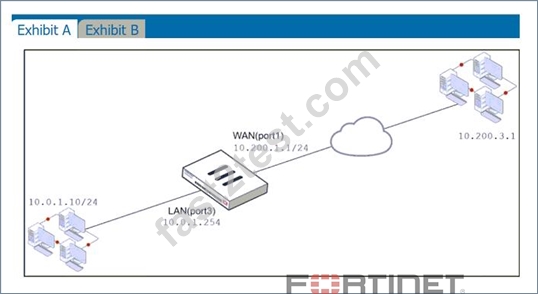
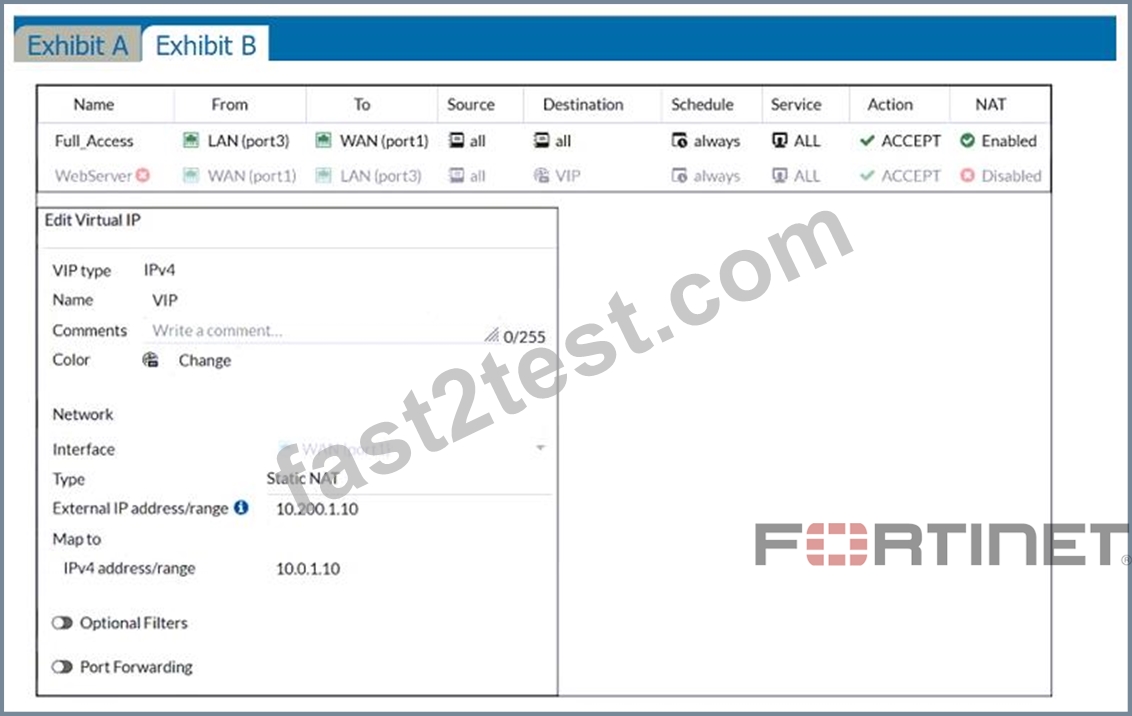
Which IP address will be used to source NAT the traffic, if a user with address 10.0.1.10 connects over SSH to the host with address 10.200.3.1?
- A. 10.0.1.254
- B. 10.200.1.10
- C. 10.200.3.1
- D. 10.200.1.1
Answer: D
Explanation:
Traffic is coming from LAN to WAN, matches policy Full_Access which has NAT enable, so traffic uses source IP address of outgoing interface. Simple SNAT.
NEW QUESTION # 25
Refer to the exhibit.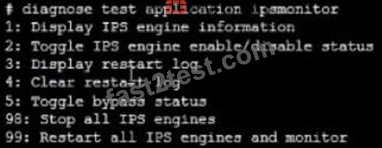
Examine the intrusion prevention system (IPS) diagnostic command.
Which statement is correct If option 5 was used with the IPS diagnostic command and the outcome was a decrease in the CPU usage?
- A. The IPS engine will continue to run in a normal state.
- B. The IPS engine was blocking all traffic.
- C. The IPS engine was inspecting high volume of traffic.
- D. The IPS engine was unable to prevent an intrusion attack .
Answer: C
Explanation:
Reference:
https://docs.fortinet.com/document/fortigate/6.2.3/cookbook/232929/troubleshooting-high-cpu-usage
NEW QUESTION # 26
Refer to the exhibit.

The exhibit contains the configuration for an SD-WAN Performance SLA, as well as the output of diagnose sys virtual-wan-link health-check . Which interface will be selected as an outgoing interface?
- A. port4
- B. port2
- C. port1
- D. port3
Answer: C
Explanation:
Port 1 shows the lowest latency.
NEW QUESTION # 27
......
Cover NSE4_FGT-7.2 Exam Questions Make Sure You 100% Pass: https://www.fast2test.com/NSE4_FGT-7.2-premium-file.html
New NSE4_FGT-7.2 exam Free Sample Questions to Practice: https://drive.google.com/open?id=1bOphIOksh4UhqjRwFdDruvdJa0DyNe1n