

The New AD0-E718 2023 Updated Verified Study Guides & Best Courses
Authentic AD0-E718 Exam Dumps PDF - 2023 Updated
NEW QUESTION # 18
Due to a marketing campaign, a website is experiencing a very large number of simultaneously placed orders, which is affecting checkout performance. The website is in the production deploy mode.
Which two website settings can an Architect optimize to decrease the impact on checkout performance? (Choose two.)
- A. Asynchronous email notifications admin panel Setting (stores > Settings > Configuration > Sales > Sales Emails > General Settings > Asynchronous) can be enabled
- B. Multithreaded checkout processing admin panel setting (stores > s ettmgs > Configuration > Sales > Checkout > General Settings > Asynchronous) can be set to a higher value representing the number of PHP threads used exclusively for checkout
- C. Asynchronous indexing admin panel Setting (Stores > Settings > Ccr.f iguraticr. > Advanced > developer > Grid Settings > Asynchronous indexing) can be enabled by executing the following CLI command: tm/magento config:set dev/grid/async_ini*xmg 1
- D. The website deploy mode can be set to si-g- by executing the following CLI command: bin/magento deploy:mode:set siege. Provided that it will be changed back to production as soon as the number of simultaneously placed orders decreases to acceptable levels
- E. A new database can be created and the Split Database feature can be automatically configured with the following command: bin/Magento setup:db-schema:split-sales-sales --host=''<checkout db host or ip>" -dbname="<name>" -username""<checkout db username>'' -password=" <password>"
Answer: C,E
Explanation:
Asynchronous indexing allows Magento to process indexers in the background without affecting the storefront performance. Splitting the database allows Magento to use a separate database for checkout-related tables, which reduces the load on the main database and improves checkout performance. Reference: https://devdocs.magento.com/guides/v2.4/extension-dev-guide/indexing.html#asynchronous-indexing https://devdocs.magento.com/guides/v2.4/config-guide/multi-master/multi-master.html
NEW QUESTION # 19
An Adobe Commerce Architect is asked by a merchant using B2B features to help with a configuration issue.
The Architect creates a test Company Account and wants to create Approval Rules for orders. The Approval Rules tab does not appear in the Company section in the Customer Account Menu when the Architect logs in using the Company Administrator account.
Which two steps must be taken to fix this issue? (Choose two.)
- A. Set 'Enable Purchase Orders' in the B2B Admin to TRUE
- B. Set 'Enable B2B Quote" in the B2B Admin to TRUE
- C. Set Enable Purchase Orders' on the Company Record to TRUE
- D. Merchant needs to log out of frontend and then log back in to load new permissions
- E. Make sure that the 'Purchase Order' payment method is active
Answer: A,C
Explanation:
Explanation
Enabling Purchase Orders at both the B2B Admin and the Company Record levels is necessary for Approval Rules to appear in the Company section of the Customer Account Menu. When 'Enable Purchase Orders' is set to TRUE, the system assumes that the company will be making purchases using purchase orders, and the Approval Rules tab becomes visible.
NEW QUESTION # 20
An Architect needs to review a custom product feed export module that a developer created for a merchant.
During final testing before the solution is deployed, the product feed output is verified as correct. All unit and integration tests for code pass.
However, once the solution is deployed to production, the product price values in the feed are incorrect for several products. The products with incorrect data are all currently part of a content staging campaign where their prices have been reduced.
What did the developer do incorrectly that caused the feed output to be incorrect for products in the content staging campaign?
- A. The developer retrieved product data directly from the database using the entity_id column rather than a collection or repository.
- B. The developer did not check for an active content staging campaign and emulates the campaign state when retrieving product data.
- C. The developer forgot to use the getContentStagingValue() method to retrieve the active campaign value of the product data
Answer: C
Explanation:
Explanation
According to the Adobe Commerce documentation, when retrieving product data, developers must use the getContentStagingValue() method to ensure that the active campaign value for theproduct is retrieved. This method takes into account any content staging campaigns that might be active, and returns the appropriate value from the content staging campaign rather than the default value from the database. Failing to use this method can result in incorrect data being returned in the product feed.
NEW QUESTION # 21
An Adobe Commerce system is configured to run in a multi-tier architecture that includes:
* A cache server with Varnish installed
* A backend web server with Adobe Commerce installed
* A database server with MySQL installed
When an Adobe Commerce Architect tries to clean the cache from the Store Admin by using the "Flush Magento Cache" in Cache Management, the Full Page Cache does not clear.
Which two steps should the Architect take to make the Full Page Cache work properly? (Choose two.)
- A. Set the cache type to "Varnish Caching" in the Store Admin.
Stores > Configuration > Advanced > System > Full Page Cache > Caching Application - B. Use "Flush Cache Storage" instead of "Flush Magento Cache"
- C. Set the cache destination host using magento CLIbin/magento setup:config:set
--http-cache-hosts<cache_server>:<varrnish port> - D. Set the backend destination host to the frontend server's address in the Store Admin Stores > Configuration > Advanced > System > Full Page Cache > Varnish Configuration > Backend Host
- E. Set the backend port destination to the frontend server's Varnish port in the Store Admin Stores > Configuration > Advanced > System > Full Page Cache > Varnish Configuration > Backend Port
Answer: D,E
NEW QUESTION # 22
An external system integrates functionality of a product catalog search using Adobe Commerce GraphQL API. The Architect creates a new attribute my_attribute in the admin panel with frontend type select.
Later, the Architect sees that Productinterface already has the field my_atcribute, but returns an mc value. The Architect wants this field to be a new type that contains both option id and label.
To meet this requirement, an Adobe Commerce Architect creates a new module and file etc/schema.graphqls that declares as follows:
After calling command setup:upgrade, the introspection of Productlnterface field xy_attribute remains int. What prevented the value type of field my_attribute from changing?
- A. The Magento.CatalogGraphQI module occurs later in sequence than the Magento.GraphQI module and merging output of dynamic attributes schema reader overrides types declared in schema.graphqls
- B. The fields of Productlnterface are checked during processing schema.graphqls files. If they have a corresponding attribute, then the backendjype of product attribute is set for field type.
- C. The interface Productlnterface is already declared in Magento.CatalogGraphQI module. Extending requires use of the keyword -xceni before a new declaration of Productlnterface.
Answer: A
Explanation:
products query is a GraphQL query that returns information about products that match specified search criteria. It also shows how to use ProductInterface fields to retrieve product data.
https://devdocs.magento.com/guides/v2.3/graphql/queries/products.html
The Magento.CatalogGraphQI module occurs later in sequence than the Magento.GraphQI module and merging output of dynamic attributes schema reader overrides types declared in schema.graphqls. The dynamic attributes schema reader is responsible for adding product attributes to the Productinterface based on the backend type of the attribute. Since the attribute my_attribute has a backend type of int, the field my_attribute in the Productinterface will also have a type of int, regardless of the custom type declared in the schema.graphqls file. To avoid this, the Architect should either change the backend type of the attribute to match the custom type, or use a different name for the field that does not conflict with the attribute name. Reference: https://devdocs.magento.com/guides/v2.4/graphql/develop/create-graphqls-file.html
NEW QUESTION # 23
An Architect is working to implement Adobe Commerce into a pre-built ecosystem in a company.
Communication between different company domains uses event-driven design and is driven via AMQP protocol with using RabbitMQ.
The Architect needs to establish the data flow between the ERP system and Adobe Commerce.
The ERP system stores only customer data excluding customer addresses.
The role of Adobe Commerce is to provide Customer Address data to the enterprise ecosystem.
Primary Customer data should not be changed from Adobe Commerce side; it should only be updated by messages data from ERP.
Which three AMQP configurations should be considered to meet these requirements? (Choose three.)
- A. Create a queue_topology.xml configuration file for Customer Address messages
- B. Create a queue_consumer.xml and communction.xml configuration files for Customer data messages
- C. Create a queue_customer.xml and communication.xml configuration files for Customer Address messages
- D. Create a queue_publisher.xml configuration file for Customer data messages
- E. Create a nueue_publisher.xml configuration file for Customer Address messages
- F. Create a queue_topology.xml configuration file for Customer data messages
Answer: B,E,F
Explanation:
To establish the data flow between the ERP system and Adobe Commerce using AMQP protocol with RabbitMQ, you need to consider the following AMQP configurations:
Create a queue_consumer.xml and communication.xml configuration files for Customer data messages. These files will define the topics, handlers, and consumers that will receive and process the messages from the ERP system. The communication.xml file will also specify the schema for the Customer data messages.
Create a queue_publisher.xml configuration file for Customer Address messages. This file will define the exchange where the Customer Address messages will be published to. The exchange will route the messages to the appropriate queues based on the binding rules.
Create a queue_topology.xml configuration file for Customer Address messages. This file will define the message routing rules and declare the queues and exchanges for the Customer Address messages. The queue_topology.xml file will also specify the connection name and type for RabbitMQ.
Reference:
1: https://devdocs.magento.com/guides/v2.3/extension-dev-guide/message-queues/config-mq.html
NEW QUESTION # 24
An Adobe Commerce Architect is supporting deployment and building tools for on-premises Adobe Commerce projects. The tool is executing build scripts on a centralized server and using an SSH connection to deploy to project servers.
A client reports that users cannot work with Admin Panel because the site breaks every time they change interface locale.
Considering maintainability, which solution should the Architect implement?
- A. Adjust the tool's build script and specify required locales during 'setup:static-content:deploy' command
- B. Edit project env.php file, configure 'admin_locales_for.build' value, and specify all required locales
- C. Modify project config.php file, configure 'admin_locales_for_deploy' value, and specify all required locales
Answer: A
Explanation:
The 'setup:static-content:deploy' command allows you to generate static view files for specific locales. If you do not specify any locales, the command uses the default locale that is set in the configuration. To avoid breaking the site when changing interface locale in the Admin Panel, you need to generate static view files for all the locales that you want to use. You can do this by adjusting the tool's build script and adding the locales as arguments to the 'setup:static-content:deploy' command. For example:
bin/magento setup:static-content:deploy en_US fr_FR de_DE
This will generate static view files for English, French, and German locales. Reference: https://experienceleague.adobe.com/docs/commerce-operations/configuration-guide/setup/static-view.html?lang=en#generate-static-view-files
NEW QUESTION # 25
A third-party company needs to create an application that will integrate the Adobe Commerce system to get orders data for reporting. The integration needs access to the get /vi/orders endpoint. It will call this endpoint automatically every hour around the clock. The merchant wants the ability to restrict or extend access to resources as well as to revoke the access using Admin Panel.
Which type of authentication available in Adobe Commerce should be used and implemented in a third-party system for this integration?
- A. Use token-based authentication to obtain an Integration Token. Integration will be created and activated in the admin panel using default integration token settings to get access to the token, which will be used as the Bearer Token to authorize.
- B. Use token-based authentication to obtain the Admin Token. The third-party system will utilize the REST endpoint using the admin username and password to get the Admin Token, which will be used as the Bearer Token to authorize.
- C. Use OAuth-based authentication to provide access to system resources. Integration will be registered by the merchant in the panel an OAuth handshake during activation. The third-party system should follow OAuth protocol to authorize.
Answer: A
Explanation:
The Architect should use token-based authentication to obtain an Integration Token. Integration will be created and activated in the admin panel using default integration token settings to get access to the token, which will be used as the Bearer Token to authorize. This type of authentication is suitable for this integration because it allows the merchant to restrict or extend access to resources as well as to revoke the access using Admin Panel. The Integration Token is generated by Adobe Commerce and has a long expiration time, which is convenient for automated calls. Option A is incorrect because using token-based authentication to obtain the Admin Token is not secure or recommended for this integration. The Admin Token is obtained by providing the admin username and password, which can be compromised or changed. The Admin Token also has a short expiration time, which is not suitable for automated calls. Option B is incorrect because using OAuth-based authentication to provide access to system resources is not necessary or optimal for this integration. OAuth-based authentication is more complex and requires user interaction to authorize the access. It also involves multiple tokens and secrets that need to be stored and managed by the third-party system. Reference: https://devdocs.magento.com/guides/v2.4/get-started/authentication/gs-authentication-token.html
NEW QUESTION # 26
An Architect is reviewing a custom module that is logging customer activity data on storefront using observers. The client reports that logs were recorded while the client was previewing storefront catalog pages from Admin Panel for a future scheduled campaign, using Adobe Commerce staging preview functionality.
What should the Architect check first to address this issue9
- A. The plugin for the public method isAllowedObserver() from \Magento\Staging\Model\Event\Manager that alters the return value
- B. The list of logging observers in bannedObservers parameter of
\Magento\staging\Model\Event\Managertype in di.xml - C. The logging observers being copied from etc\events.xml to etc\adminhtml\events.xml with the attribute disabled=''true"
Answer: B
Explanation:
Explanation
It will allow you to exclude logging observers from being executed during staging preview functionality by adding them to bannedObservers parameter of \Magento\staging\Model\Event\Manager type in di.xml file.
This will prevent customer activity data from being logged while previewing storefront catalog pages from Admin Panel for a future scheduled campaign.
NEW QUESTION # 27
An Adobe Commerce Architect needs to create a new customer segment condition to enable admins to specify an 'Average sales amount' condition for certain segments.
The Architect develops the custom condition under vendor\Module\Model\Segment\condition\AverageSalesAmount with all of its requirements: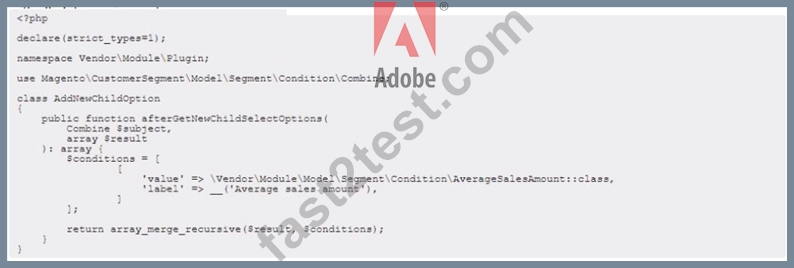

Which two steps should the Architect complete to fix the problem? (Choose two.)
- A.

- B.

- C.

- D.

- E.

Answer: A,C
Explanation:
To fix the problem, the Architect should complete two steps: B) Add the condition to the customer segment conditions tree in the etc/conditions.xml file of the custom module. This file defines the available conditions for customer segments and their hierarchy. D) Implement the getConditionsSql() method in the custom condition class. This method returns the SQL query that filters customers based on the condition value. Option A is incorrect because the condition class does not need to extend \Magento\Rule\Model\Condition\AbstractCondition, but rather \Magento\CustomerSegment\Model\Segment\Condition\AbstractCondition. Option C is incorrect because the condition class does not need to implement \Magento\Framework\DataObject\IdentityInterface, which is used for cache invalidation. Option E is incorrect because the condition class does not need to implement \Magento\Framework\Api\ExtensibleDataInterface, which is used for extension attributes. Reference: https://devdocs.magento.com/guides/v2.4/extension-dev-guide/segmentation.html
NEW QUESTION # 28
Due to a marketing campaign, a website is experiencing a very large number of simultaneously placed orders, which is affecting checkout performance. The website is in the production deploy mode.
Which two website settings can an Architect optimize to decrease the impact on checkout performance?
(Choose two.)
- A. A new database can be created and the Split Database feature can be automatically configured with the following command: bin/Magento setup:db-schema:split-sales-sales --host=''<checkout db host or ip>" -dbname="<name>"
-username""<checkout db username>'' -password=" <password>" - B. Asynchronous email notifications admin panel Setting (stores > Settings > Configuration > Sales > Sales Emails > General Settings > Asynchronous) can be enabled
- C. Multithreaded checkout processing admin panel setting (stores > s ettmgs > Configuration > Sales > Checkout > General Settings > Asynchronous) can be set to a higher value representing the number of PHP threads used exclusively for checkout
- D. Asynchronous indexing admin panel Setting (Stores > Settings > Ccr.f iguraticr. > Advanced > developer > Grid Settings > Asynchronous indexing) can be enabled by executing the following CLI command: tm/magento config:set dev/grid/async_ini*xmg 1
- E. The website deploy mode can be set to si-g- by executing the following CLI command: bin/magento deploy:mode:set siege. Provided that it will be changed back to production as soon as the number of simultaneously placed orders decreases to acceptable levels
Answer: C,D
Explanation:
Explanation
To minimize the impact on checkout performance due to a large number of simultaneously placed orders, an Architect can optimize two website settings: Asynchronous indexing admin panel setting (A) and Multithreaded checkout processing admin panel setting (B). Enabling asynchronous indexing admin panel setting can be done by executing the command tm/magento config:set dev/grid/async_ini*xmg 1, while the multithreaded checkout processing admin panel setting can be set to a higher value representing the number of PHP threads used exclusively for checkout. It is important to note that the website deploy mode should not be set to siege mode and should instead be changed back to production as soon as the number of simultaneously placed orders decreases to acceptable levels.
NEW QUESTION # 29
An Architect is working to implement Adobe Commerce into a pre-built ecosystem in a company.
Communication between different company domains uses event-driven design and is driven via AMQP protocol with using RabbitMQ.
The Architect needs to establish the data flow between the ERP system and Adobe Commerce.
The ERP system stores only customer data excluding customer addresses.
The role of Adobe Commerce is to provide Customer Address data to the enterprise ecosystem.
Primary Customer data should not be changed from Adobe Commerce side; it should only be updated by messages data from ERP.
Which three AMQP configurations should be considered to meet these requirements? (Choose three.)
- A. Create a queue_consumer.xml and communction.xml configuration files for Customer data messages
- B. Create a queue_customer.xml and communication.xml configuration files for Customer Address messages
- C. Create a queue_publisher.xml configuration file for Customer data messages
- D. Create a queue_topology.xml configuration file for Customer Address messages
- E. Create a nueue_publisher.xml configuration file for Customer Address messages
- F. Create a queue_topology.xml configuration file for Customer data messages
Answer: A,D,E
Explanation:
The Architect should consider three AMQP configurations to meet these requirements: A) Create a queue_consumer.xml and communication.xml configuration files for Customer data messages. These files will define the consumer and the topic for receiving customer data messages from the ERP system and updating the customer data in Adobe Commerce accordingly. B) Create a queue_publisher.xml configuration file for Customer Address messages. This file will define the publisher and the topic for sending customer address messages from Adobe Commerce to the enterprise ecosystem. C) Create a queue_topology.xml configuration file for Customer Address messages. This file will define the exchange, binding and queue for routing customer address messages to the appropriate destination. Option B is incorrect because creating a queue_publisher.xml configuration file for Customer data messages will not meet the requirement of not changing the primary customer data from Adobe Commerce side. Option E is incorrect because creating a queue_topology.xml configuration file for Customer data messages is not necessary, as Adobe Commerce only needs to consume these messages, not publish them. Option F is incorrect because creating a queue_consumer.xml and communication.xml configuration files for Customer Address messages is not necessary, as Adobe Commerce only needs to publish these messages, not consume them. Reference: https://devdocs.magento.com/guides/v2.4/extension-dev-guide/message-queues/config-mq.html
NEW QUESTION # 30
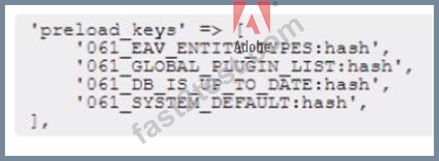
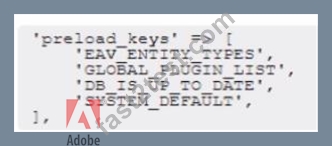
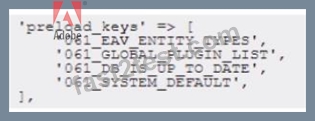
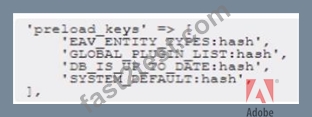
An Architect is configuring the preload.keys for Redis on an Adobe Commerce on-premise instance.
The Architect discovers that the following cache keys are loaded on each frontend request: eav_entity_types, GLOBAL_PLUGIN_LIST, DB_IS_UP_TO_DATE , SYSTEM_DEFAULT.
* The id_prefix of the frontend =>page_cache is set to 061_.
* The id_prefix of frontend => default: is not set.
* The Architect has enabled and configured Redis L2 caching.
How should the preload.keys be configured?
- A.
- B.
- C.
- D.
Answer: C
Explanation:
The preload.keys should be configured as shown in Option D. This is because the preload feature allows Redis to load data that is reused between pages, such as eav_entity_types, GLOBAL_PLUGIN_LIST, DB_IS_UP_TO_DATE , SYSTEM_DEFAULT. The preload keys should include the id_prefix of the cache backend and the suffix ':hash' to indicate the hashed data version. See Use Redis for default cache in the Adobe Commerce Developer Guide1. Reference: https://devdocs.magento.com/guides/v2.3/config-guide/redis/redis-pg-cache.html1
NEW QUESTION # 31
A merchant is using a unified website that supports native Adobe Commerce B2B and B2C with a single store view.
The merchant wants to show the B2B account features like negotiable quotes and credit limits in the header of the site on every page for the logged-in users who are part of a B2B company account.
Each B2B company has its own individual shared catalog and customer group, and many customer groups for non B2B customers change. The merchant requests that this should not be tied to customer groups.
Which two solutions should the Architect recommend considering public data and caching? (Choose two.)
- A. Create a new HTTP Context variable to allow for separate public content to be cached for users in B2B companies where the output can be modified accordingly.
- B. Check if the current user is part of a B2B company within a block class and modify the output accordingly.
- C. Create a new custom condition for customer segments that allow for choosing whether a user is part of a B2B company and then use this segment to modify the output accordingly.
- D. Create a plugin that switches the theme when a user is part of a B2B company so the output can be modified accordingly in the alternate theme.
- E. Set whether the current user is part of a B2B company in the customer session and use that data directly to modify the output accordingly.
Answer: A,C
Explanation:
Explanation
C would involve creating a new custom condition for customer segments that allow for choosing if a user is part of a B2B company, and then use this segment to modify the output accordingly. E would involve creating a new HTTP Context variable to allow for separate public content to be cached for users in B2B companies, where the output can be modified accordingly.
NEW QUESTION # 32
An Adobe Commerce Architect is creating a new GraphQL API mutation to alter the process of adding configurable products to the cart. The mutation accepts configurable product ID. If the given product has only one variant, then the mutation should add this variant to the cart and return not nullable cart type. If the configurable product has more variants, then the mutation should return not nullable conf igurableProduct type.
The mutation declaration looks as follows:
How should the Adobe Commerce Architect declare output of this mutation?
A)
B)
C)
- A. Option B
- B. Option A
- C. Option C
Answer: C
Explanation:
According to the Adobe Commerce Developer Guide2, a union type is a special kind of object that can be one of several types.
It is useful for returning disjoint data types from a single field.
In this case, the output of the mutation can be either Cart or ConfigurableProduct, depending on the number of variants of the given product.
Therefore, a union type should be declared for the output of this mutation, as shown in option C.
The other options are not valid syntax for union types.
NEW QUESTION # 33
A merchant notices that product price changes do not update on the storefront.
The index management page in the Adobe Commerce Admin Panel shows the following:
* All indexes are set to 'update by schedule'
* Their status is 'ready'
* There are no items in the backlog
* The indexes were last updated 1 minute ago
A developer verifies that updating and saving product prices adds the relevant product IDs into the catalog_product_price_cl changelog table.
Which two steps should the Architect recommend to the developer to resolve this issue? (Choose two.)
- A. Manually reindex the catalog_product_price index from the Command line:bin\magentor indexer:reindex catalog_product_price.
- B. Make sure that no custom or third-party modules modify the changelog and indexing process.
- C. Make sure that the version_id for the price indexer in the mview_state table is not higher than the last entry for the same column in the changelog table and re-synchronize.
- D. Reduce the frequency of the cron job to 5 minutes so the items have more time to process.
- E. Invalidate the catalog_product_price indexer in the Adobe Commerce Admin Panel so that it is fully reindexed next time the cron runs.
Answer: B,C
Explanation:
To resolve the issue of product price changes not updating on the storefront, you need to take the following steps:
Make sure that no custom or third-party modules modify the changelog and indexing process. Some modules might interfere with the normal functioning of the indexing mechanism and cause data inconsistency or corruption. You can disable any custom or third-party modules that are related to indexing and check if the issue persists.
Make sure that the version_id for the price indexer in the mview_state table is not higher than the last entry for the same column in the changelog table and re-synchronize. The version_id column in the mview_state table indicates the current state of each indexer. If this value is higher than the last entry in the changelog table, it means that the indexer has skipped some records and needs to be re-synchronized. You can use the bin/magento indexer:reset command to reset the state of the price indexer and then run bin/magento indexer:reindex to reindex it.
Reference:
https://devdocs.magento.com/guides/v2.4/extension-dev-guide/indexing.html
https://devdocs.magento.com/guides/v2.4/config-guide/cli/config-cli-subcommands-index.html
NEW QUESTION # 34
An Adobe Commerce Architect needs to scope a bespoke news section for a merchant's Adobe Commerce storefront. The merchant's SEO agency requests that the following URL structure:
news/{date}/{article_url_key}l where {date} is the publication date of the article, and {article_url_key} is the URL key of the article.
The Architect scopes that a news entity type will be created. The date and URL key data will be stored against each record and autogenerated on save. The values will be able to be manually overridden.
The Architect needs to manage routing this functionality and adhere to best practice.
Which two options should the Architect consider to meet these requirements? (Choose two.)
- A. Create a plugin that intercepts lu^jentoXFraBeworkUppXActien::executed, looks for the news portion of the URL and if it matches, loads the relevant news article by matching the URL date and URL key parts.
- B. Create a standard controller route and mapping the internal URLs (such as news/article/view/id/1) to rewrites that are generated on save and then stored in the URL rewrites table.
- C. Create an observer that listens to the controllers_front_send_response_before event, looks for the mm portion of the URL, and If it matches, loads the relevant news article by matching the URL date and URL key parts.
- D. Create a standard controller route and an Index/Index index controller class that loads the relevant news article by matching the URL date and URL key parts.
- E. Create a custom router that runs before the standard router and matches the news portion of the URL. then looks for and loads a news article by matching the date and URL key parts of the URL.
Answer: B,E
Explanation:
To manage routing for the bespoke news section, the Architect should consider creating a standard controller route and mapping the internal URLs (such as news/article/view/id/1) to rewrites that are generated on save and then stored in the URL rewrites table. This will allow the news articles to have SEO-friendly URLs that match the merchant's requirements. Alternatively, the Architect should consider creating a custom router that runs before the standard router and matches the news portion of the URL, then looks for and loads a news article by matching the date and URL key parts of the URL. This will avoid using the URL rewrites table and provide more flexibility for customizing the routing logic. Option A is incorrect because it will not generate SEO-friendly URLs for the news articles. Option B is incorrect because it will not handle routing at all, but only modify the response after a controller has been executed. Option C is incorrect because it will interfere with the core action execution logic and potentially cause conflicts with other plugins. Reference: https://devdocs.magento.com/guides/v2.4/extension-dev-guide/routing.html https://devdocs.magento.com/guides/v2.4/extension-dev-guide/url-rewrite.html
NEW QUESTION # 35
An Adobe Commerce Architect is working on a scanner that will pull prices from multiple external product feeds. The Architect has a list of vendors and decides to create new config file marketplacejeeds.xml.
Which three steps can the Architect take to ensure validation of the configuration files with unique validation rules for the individual and merged files? (Choose three.)
- A. Provide schema to validate a merged file.
- B. Provide schema to validate an individual file.
- C. Implement validation rules in the Converter class for the Config Reader
- D. Add the Uniform Resource Name to the XSD file in the config XML file.
- E. Create validation rules in marketplace.schema.xsd.
- F. Create a class that implements \Magento\Framework\Config\Datalnterface.
Answer: B,E,F
Explanation:
Explanation
The three steps that the Architect can take to ensure validation of the configuration files with unique validation rules for the individual and merged files are: D. Provide schema to validate an individual file, F. Create validation rules in marketplace.schema.xsd, and E. Create a class that implements
\Magento\Framework\Config\DataInterface. By providing schema to validate individual files, creating validation rules in marketplace.schema.xsd, and creating a class that implements
\Magento\Framework\Config\DataInterface, the Architect can ensure that the configuration files are validated with unique validation rules for the individual and merged files.
NEW QUESTION # 36
An Adobe Commerce Architect needs to customize the workflow of a monthly installments payment extension. The extension is from a partner that is contracted with the default website PSR which has its own legacy extension (a module using deprecated payment method).
The installment payment partner manages only initializing a payment, and then hands the capture to be executed by the PSP. Once the amount is successfully captured, the PSP notifies the website through an IPN.
The goal of the IPN is only to create an "invoice" and save the 'capture information' to be used later for refund requests through the PSP itself.
The Architect needs the most simple solution to capture the requested behavior without side effects.
Which solution should the Architect implement?
- A. Declare a capture command with type Magento\payment\Gateway\Command\NullCommand for the payment method CommandPool in di.zm1
- B. Change the can_ capture attribute for the payment method under config.xml to be
<can_capture>0</can_capture> - C. Add a plugin before the $invoice-> () and changes its input to prevent the call of the $payment-> capture()
Answer: A
Explanation:
Explanation
The best solution for the Adobe Commerce Architect to implement in order to capture the requested behavior without side effects is to declare a capture command with type Magento\payment\Gateway\Command\NullCommand for the payment method CommandPool in di.xml. This will allow the partner to initialize the payment and then hand the capture over to the PSP, while also preventing the website from calling the $payment->capture() method. It will also allow the PSP to notify the website through an IPN, which will create an "invoice" and save the 'capture information' to be used later for refund requests through the PSP itself.
NEW QUESTION # 37
A merchant is utilizing an out-of-the-box Adobe Commerce application and asks to add a new reward card functionality for customers. During the code review, the Adobe Commerce Architect notices the reward_card_number attribute setup created for this functionality is causing the customer attribute to be unavailable in the My account/My rewards page template.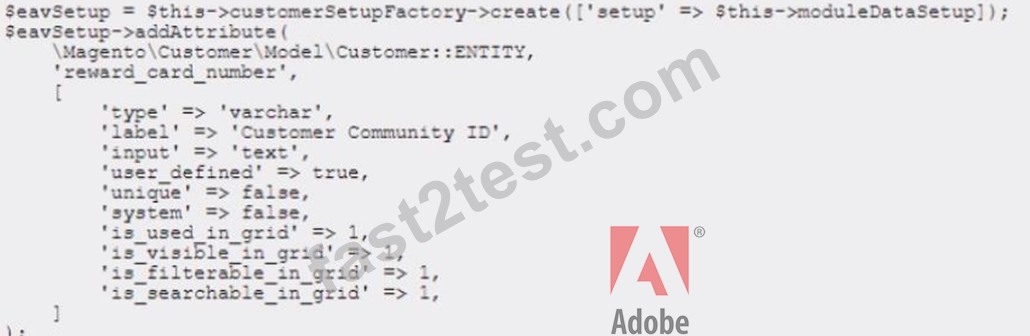
What should be added to set the customer attribute correctly?
- A. system property should be added with a value of true
- B. scope property should be added with a value of global
- C. group property should be added with a value of 1
Answer: C
Explanation:
The group property specifies the attribute group ID that the customer attribute belongs to. By setting the group property to 1, the reward_card_number attribute will be added to the default attribute group and will be available in the My account/My rewards page template. Reference: https://devdocs.magento.com/guides/v2.4/extension-dev-guide/attributes.html#customer-eav-attribute
NEW QUESTION # 38
An Adobe Commerce store owner sets up a custom customer attribute "my.attribute" (type int).
An Architect needs to display customer-specific content on the home page to Customers with "my.attribute" greater than 3. The website is running Full Page Cache.
Using best practices, which two steps should the Architect take to implement these requirements? (Choose two.)
- A. Create a Customer Segment and use "my.attribute" in the conditions
- B. Use customer-data JS library to retrieve "my.attribute" value
- C. Add a new context value of "my.attribute" to Magento\Framework\App\Http\Context
- D. Add a custom block and a phtml template with the content to the cmsjndexjndex.xml layout
- E. Add a dynamic block with the content to the Home Page
Answer: B,D
Explanation:
Explanation
https://docs.magento.com/user-guide/v2.3/stores/attributes-customer.html displaying custom customer attributes on cached pages using best practices involves several steps, such as:
* Creating a custom block and a phtml template with the content to display
* Adding the custom block to the layout file of the page where it should appear
* Creating a section.xml file to declare a new section for the custom attribute
* Creating a plugin for Magento\Customer\CustomerData\SectionPoolInterface to add the custom attribute value to the section data
* Using customer-data JS library to retrieve and display the custom attribute value in the phtml template
NEW QUESTION # 39
......
Get Prepared for Your AD0-E718 Exam With Actual 50 Questions: https://www.fast2test.com/AD0-E718-premium-file.html
Valid AD0-E718 Test Answers Full-length Practice Certification Exams: https://drive.google.com/open?id=125yuUP09RGeeou3ue1sWFAskUFb0e3LD