

Ace Professional-Data-Engineer Certification with 386 Actual Questions
PASS Google Professional-Data-Engineer EXAM WITH UPDATED DUMPS
The Google Professional-Data-Engineer exam is designed for professionals who have experience working with data processing systems in a business environment. Candidates should have a thorough understanding of data modeling, data warehousing, and data transformation. Additionally, they should have experience working with cloud-based data storage and processing systems such as Google Cloud Platform, AWS, or Microsoft Azure.
NEW QUESTION # 15
You are designing a pipeline that publishes application events to a Pub/Sub topic. You need to aggregate events across hourly intervals before loading the results to BigQuery for analysis. Your solution must be scalable so it can process and load large volumes of events to BigQuery. What should you do?
- A. Schedule a Cloud Function to run hourly, pulling all avertable messages from the Pub/Sub topic and performing the necessary aggregations
- B. Create a streaming Dataflow job to continually read from the Pub/Sub topic and perform the necessary aggregations using tumbling windows
- C. Create a Cloud Function to perform the necessary data processing that executes using the Pub/Sub trigger every time a new message is published to the topic.
- D. Schedule a batch Dataflow job to run hourly, pulling all available messages from the Pub-Sub topic and performing the necessary aggregations
Answer: B
NEW QUESTION # 16
You are designing the database schema for a machine learning-based food ordering service that will predict what users want to eat. Here is some of the information you need to store:
The user profile: What the user likes and doesn't like to eat
The user account information: Name, address, preferred meal times
The order information: When orders are made, from where, to whom
The database will be used to store all the transactional data of the product. You want to optimize the data schem a. Which Google Cloud Platform product should you use?
- A. BigQuery
- B. Cloud SQL
- C. Cloud Datastore
- D. Cloud Bigtable
Answer: A
Explanation:
Topic 5, Practice Questions
NEW QUESTION # 17
Your company has recently grown rapidly and now ingesting data at a significantly higher rate than it was previously. You manage the daily batch MapReduce analytics jobs in Apache Hadoop. However, the recent increase in data has meant the batch jobs are falling behind. You were asked to recommend ways the development team could increase the responsiveness of the analytics without increasing costs. What should you recommend they do?
- A. Rewrite the job in Apache Spark.
- B. Rewrite the job in Pig.
- C. Decrease the size of the Hadoop cluster but also rewrite the job in Hive.
- D. Increase the size of the Hadoop cluster.
Answer: B
NEW QUESTION # 18
MJTelco Case Study
Company Overview
MJTelco is a startup that plans to build networks in rapidly growing, underserved markets around the world. The company has patents for innovative optical communications hardware. Based on these patents, they can create many reliable, high-speed backbone links with inexpensive hardware.
Company Background
Founded by experienced telecom executives, MJTelco uses technologies originally developed to overcome communications challenges in space. Fundamental to their operation, they need to create a distributed data infrastructure that drives real-time analysis and incorporates machine learning to continuously optimize their topologies. Because their hardware is inexpensive, they plan to overdeploy the network allowing them to account for the impact of dynamic regional politics on location availability and cost.
Their management and operations teams are situated all around the globe creating many-to-many relationship between data consumers and provides in their system. After careful consideration, they decided public cloud is the perfect environment to support their needs.
Solution Concept
MJTelco is running a successful proof-of-concept (PoC) project in its labs. They have two primary needs:
* Scale and harden their PoC to support significantly more data flows generated when they ramp to more than
50,000 installations.
* Refine their machine-learning cycles to verify and improve the dynamic models they use to control topology definition.
MJTelco will also use three separate operating environments - development/test, staging, and production - to meet the needs of running experiments, deploying new features, and serving production customers.
Business Requirements
* Scale up their production environment with minimal cost, instantiating resources when and where needed in an unpredictable, distributed telecom user community.
* Ensure security of their proprietary data to protect their leading-edge machine learning and analysis.
* Provide reliable and timely access to data for analysis from distributed research workers
* Maintain isolated environments that support rapid iteration of their machine-learning models without affecting their customers.
Technical Requirements
Ensure secure and efficient transport and storage of telemetry data
Rapidly scale instances to support between 10,000 and 100,000 data providers with multiple flows each.
Allow analysis and presentation against data tables tracking up to 2 years of data storing approximately 100m records/day Support rapid iteration of monitoring infrastructure focused on awareness of data pipeline problems both in telemetry flows and in production learning cycles.
CEO Statement
Our business model relies on our patents, analytics and dynamic machine learning. Our inexpensive hardware is organized to be highly reliable, which gives us cost advantages. We need to quickly stabilize our large distributed data pipelines to meet our reliability and capacity commitments.
CTO Statement
Our public cloud services must operate as advertised. We need resources that scale and keep our data secure.
We also need environments in which our data scientists can carefully study and quickly adapt our models.
Because we rely on automation to process our data, we also need our development and test environments to work as we iterate.
CFO Statement
The project is too large for us to maintain the hardware and software required for the data and analysis. Also, we cannot afford to staff an operations team to monitor so many data feeds, so we will rely on automation and infrastructure. Google Cloud's machine learning will allow our quantitative researchers to work on our high- value problems instead of problems with our data pipelines.
You need to compose visualization for operations teams with the following requirements:
* Telemetry must include data from all 50,000 installations for the most recent 6 weeks (sampling once every minute)
* The report must not be more than 3 hours delayed from live data.
* The actionable report should only show suboptimal links.
* Most suboptimal links should be sorted to the top.
* Suboptimal links can be grouped and filtered by regional geography.
* User response time to load the report must be <5 seconds.
You create a data source to store the last 6 weeks of data, and create visualizations that allow viewers to see multiple date ranges, distinct geographic regions, and unique installation types. You always show the latest data without any changes to your visualizations. You want to avoid creating and updating new visualizations each month. What should you do?
- A. Look through the current data and compose a small set of generalized charts and tables bound to criteria filters that allow value selection.
- B. Load the data into relational database tables, write a Google App Engine application that queries all rows, summarizes the data across each criteria, and then renders results using the Google Charts and visualization API.
- C. Look through the current data and compose a series of charts and tables, one for each possible combination of criteria.
- D. Export the data to a spreadsheet, compose a series of charts and tables, one for each possible combination of criteria, and spread them across multiple tabs.
Answer: A
NEW QUESTION # 19
You have a data pipeline with a Cloud Dataflow job that aggregates and writes time series metrics to Cloud Bigtable. This data feeds a dashboard used by thousands of users across the organization. You need to support additional concurrent users and reduce the amount of time required to write the data. Which two actions should you take? (Choose two.)
- A. Configure your Cloud Dataflow pipeline to use local execution
- B. Modify your Cloud Dataflow pipeline to use the CoGroupByKey transform before writing to Cloud Bigtable
- C. Increase the maximum number of Cloud Dataflow workers by setting maxNumWorkers in PipelineOptions
- D. Modify your Cloud Dataflow pipeline to use the Flatten transform before writing to Cloud Bigtable
- E. Increase the number of nodes in the Cloud Bigtable cluster
Answer: C,E
NEW QUESTION # 20
You plan to deploy Cloud SQL using MySQL. You need to ensure high availability in the event of a zone failure. What should you do?
- A. Create a Cloud SQL instance in one zone, and configure an external read replica in a zone in a different region.
- B. Create a Cloud SQL instance in one zone, and create a failover replica in another zone within the same region.
- C. Create a Cloud SQL instance in one zone, and create a read replica in another zone within the same region.
- D. Create a Cloud SQL instance in a region, and configure automatic backup to a Cloud Storage bucket in the same region.
Answer: A
NEW QUESTION # 21
Your company is selecting a system to centralize data ingestion and delivery. You are considering messaging and data integration systems to address the requirements. The key requirements are:
The ability to seek to a particular offset in a topic, possibly back to the start of all data ever captured Support for publish/subscribe semantics on hundreds of topics Retain per-key ordering Which system should you choose?
- A. Apache Kafka
- B. Firebase Cloud Messaging
- C. Cloud Storage
- D. Cloud Pub/Sub
Answer: A
NEW QUESTION # 22
You are operating a Cloud Dataflow streaming pipeline. The pipeline aggregates events from a Cloud Pub
/Sub subscription source, within a window, and sinks the resulting aggregation to a Cloud Storage bucket. The source has consistent throughput. You want to monitor an alert on behavior of the pipeline with Cloud Stackdriver to ensure that it is processing data. Which Stackdriver alerts should you create?
- A. An alert based on an increase of instance/storage/used_bytes for the source and a rate of change decrease of subscription/num_undelivered_messages for the destination
- B. An alert based on a decrease of subscription/num_undelivered_messages for the source and a rate of change increase of instance/storage/used_bytes for the destination
- C. An alert based on an increase of subscription/num_undelivered_messages for the source and a rate of change decrease of instance/storage/used_bytes for the destination
- D. An alert based on a decrease of instance/storage/used_bytes for the source and a rate of change increase of subscription/num_undelivered_messages for the destination
Answer: C
NEW QUESTION # 23
You created an analytics environment on Google Cloud so that your data scientist team can explore data without impacting the on-premises Apache Hadoop solution. The data in the on-premises Hadoop Distributed File System (HDFS) cluster is in Optimized Row Columnar (ORC) formatted files with multiple columns of Hive partitioning. The data scientist team needs to be able to explore the data in a similar way as they used the on-premises HDFS cluster with SQL on the Hive query engine. You need to choose the most cost-effective storage and processing solution. What should you do?
- A. Copy the ORC files on Cloud Storage, then create external BigQuery tables for the data scientist team.
- B. Copy the ORC files on Cloud Storage, then deploy a Dataproc cluster for the data scientist team.
- C. Import the ORC files lo Bigtable tables for the data scientist team.
- D. Import the ORC files to BigOuery tables for the data scientist team.
Answer: A
Explanation:
The requirements are:
Explore ORC formatted files with Hive partitioning.
Mimic the SQL on Hive query engine experience.
Cost-effective storage and processing.
Avoid impacting the on-premises Hadoop solution.
Let's analyze the options:
Option A (Import to Bigtable):Bigtable is a NoSQL database, not suited for SQL-based exploration of ORC files or Hive-style partitioning directly. This would require significant data transformation and a different query paradigm. Not cost-effective for this use case.
Option B (Import to BigQuery native tables):Importing data into BigQuery native storage is an option.
BigQuery can load ORC files. This provides excellent query performance. However, it involves an ETL step (importing) and storage costs for the datawithin BigQuery, which might be higher than keeping it in its original format on Cloud Storage if query patterns are exploratory and not extremely frequent on all data.
Option C (Copy to Cloud Storage, deploy Dataproc):Dataproc allows you to run Hadoop/Spark (and thus Hive) clusters on Google Cloud. This would provide a very similar experience ("SQL on the Hive query engine"). However, running a persistent Dataproc cluster incurs compute costs for the cluster nodes, even when not actively querying. While ephemeral clusters are possible, it adds operational overhead for exploratory queries. Storage on Cloud Storage is cost-effective.
Option D (Copy to Cloud Storage, create external BigQuery tables):This is often the most cost-effective and straightforward solution for this scenario.
Cost-effective Storage:Cloud Storage is a low-cost option for storing files like ORC.
SQL Interface:BigQuery provides a familiar SQL interface.
External Tables:BigQuery can query data directly from Cloud Storage (including ORC files) using external tables. This avoids the need to load data into BigQuery's managed storage, saving on storage costs and ETL effort.
Hive Partitioning:BigQuery external tables support Hive partitioning layouts. When you define the external table, you can specify the partitioning scheme, and BigQuery will use partition pruning to scan only relevant partitions, improving performance and reducing costs for queries that filter on partition keys. This directly mimics the Hive experience.
Processing Cost:You only pay for the data scanned by BigQuery queries, which aligns with exploratory analysis.
Comparing D with B: External tables are generally more cost-effective for storage and initial setup if the data is already in ORC and an ETL process into BigQuery native storage is to be avoided. Query performance might be slightly less than native tables but is often sufficient for exploration, especially with partitioning.
Comparing D with C: BigQuery external tables are serverless, meaning no cluster to manage or pay for when idle. Dataproc requires managing and paying for a cluster. For exploration, the serverless nature of BigQuery is usually more cost-effective.
Therefore, copying ORC files to Cloud Storage and using BigQuery external tables is the most cost-effective solution that meets all requirements.
Reference:
Google Cloud Documentation: BigQuery > External data sources > Querying Cloud Storage data. "You can query data in Cloud Storage by using external tables or federated queries. External tables are tables that read data directly from files in Cloud Storage." Google Cloud Documentation: BigQuery > External data sources > Supported formats and compression types. ORC is a supported format.
Google Cloud Documentation: BigQuery > Creating and using tables > Creating external tables. "External tables let you query data stored in Cloud Storage as if it were a standardBigQuery table. You can use external tables to query data in various formats, including... ORC..." Google Cloud Documentation: BigQuery > Creating and using tables > Querying partitioned external tables.
"You can create an external table that is partitioned on Hive partitioning keys. When you query a Hive partitioned external table, BigQuery performs partition pruning to skip reading unnecessary partitions." This directly addresses the "Hive partitioning" and "explore data in a similar way" requirements.
Google Cloud Blog: "Choosing the right data processing option on GCP: BigQuery vs. Dataproc" (and similar articles) often highlight BigQuery external tables as a cost-effective way to query data in place on Cloud Storage, especially for data lake scenarios.
NEW QUESTION # 24
Your team is building a data lake platform on Google Cloud. As a part of the data foundation design, you are planning to store all the raw data in Cloud Storage You are expecting to ingest approximately 25 GB of data a day and your billing department is worried about the increasing cost of storing old data. The current business requirements are:
* The old data can be deleted anytime
* You plan to use the visualization layer for current and historical reporting
* The old data should be available instantly when accessed
* There should not be any charges for data retrieval.
What should you do to optimize for cost?
- A. Create an Object Lifecycle Management policy to modify the storage class for data older than 30 days to nearlme. 45 days to coldline. and 60 days to archive storage class Delete old data as needed.
- B. Create an Object Lifecycle Management policy to modify the storage class for data older than 30 days to coldline, 90 days to nearline. and 365 days to archive storage class Delete old data as needed.
- C. Create an Object Lifecycle Management policy to modify the storage class for data older than 30 days to nearline, 90 days to coldline. and 365 days to archive storage class. Delete old data as needed.
- D. Create the bucket with the Autoclass storage class feature.
Answer: D
Explanation:
- Autoclass automatically moves objects between storage classes without impacting performance or availability, nor incurring retrieval costs. - It continuously optimizes storage costs based on access patterns without the need to set specific lifecycle management policies.
NEW QUESTION # 25
Case Study: 2 - MJTelco
Company Overview
MJTelco is a startup that plans to build networks in rapidly growing, underserved markets around the world. The company has patents for innovative optical communications hardware. Based on these patents, they can create many reliable, high-speed backbone links with inexpensive hardware.
Company Background
Founded by experienced telecom executives, MJTelco uses technologies originally developed to overcome communications challenges in space. Fundamental to their operation, they need to create a distributed data infrastructure that drives real-time analysis and incorporates machine learning to continuously optimize their topologies. Because their hardware is inexpensive, they plan to overdeploy the network allowing them to account for the impact of dynamic regional politics on location availability and cost. Their management and operations teams are situated all around the globe creating many-to- many relationship between data consumers and provides in their system. After careful consideration, they decided public cloud is the perfect environment to support their needs.
Solution Concept
MJTelco is running a successful proof-of-concept (PoC) project in its labs. They have two primary needs:
Scale and harden their PoC to support significantly more data flows generated when they ramp to more than 50,000 installations.
Refine their machine-learning cycles to verify and improve the dynamic models they use to control topology definition.
MJTelco will also use three separate operating environments ?development/test, staging, and production ?
to meet the needs of running experiments, deploying new features, and serving production customers.
Business Requirements
Scale up their production environment with minimal cost, instantiating resources when and where needed in an unpredictable, distributed telecom user community. Ensure security of their proprietary data to protect their leading-edge machine learning and analysis.
Provide reliable and timely access to data for analysis from distributed research workers Maintain isolated environments that support rapid iteration of their machine-learning models without affecting their customers.
Technical Requirements
Ensure secure and efficient transport and storage of telemetry data Rapidly scale instances to support between 10,000 and 100,000 data providers with multiple flows each.
Allow analysis and presentation against data tables tracking up to 2 years of data storing approximately
100m records/day
Support rapid iteration of monitoring infrastructure focused on awareness of data pipeline problems both in telemetry flows and in production learning cycles.
CEO Statement
Our business model relies on our patents, analytics and dynamic machine learning. Our inexpensive hardware is organized to be highly reliable, which gives us cost advantages. We need to quickly stabilize our large distributed data pipelines to meet our reliability and capacity commitments.
CTO Statement
Our public cloud services must operate as advertised. We need resources that scale and keep our data secure. We also need environments in which our data scientists can carefully study and quickly adapt our models. Because we rely on automation to process our data, we also need our development and test environments to work as we iterate.
CFO Statement
The project is too large for us to maintain the hardware and software required for the data and analysis.
Also, we cannot afford to staff an operations team to monitor so many data feeds, so we will rely on automation and infrastructure. Google Cloud's machine learning will allow our quantitative researchers to work on our high-value problems instead of problems with our data pipelines.
You need to compose visualizations for operations teams with the following requirements:
Which approach meets the requirements?
- A. Load the data into Google BigQuery tables, write a Google Data Studio 360 report that connects to your data, calculates a metric, and then uses a filter expression to show only suboptimal rows in a table.
- B. Load the data into Google Sheets, use formulas to calculate a metric, and use filters/sorting to show only suboptimal links in a table.
- C. Load the data into Google Cloud Datastore tables, write a Google App Engine Application that queries all rows, applies a function to derive the metric, and then renders results in a table using the Google charts and visualization API.
- D. Load the data into Google BigQuery tables, write Google Apps Script that queries the data, calculates the metric, and shows only suboptimal rows in a table in Google Sheets.
Answer: C
NEW QUESTION # 26
Your infrastructure includes a set of YouTube channels. You have been tasked with creating a process for sending the YouTube channel data to Google Cloud for analysis. You want to design a solution that allows your world-wide marketing teams to perform ANSI SQL and other types of analysis on up-to-date YouTube channels log data. How should you set up the log data transfer into Google Cloud?
- A. Use Storage Transfer Service to transfer the offsite backup files to a Cloud Storage Multi-Regional storage bucket as a final destination.
- B. Use BigQuery Data Transfer Service to transfer the offsite backup files to a Cloud Storage Multi-Regional storage bucket as a final destination.
- C. Use BigQuery Data Transfer Service to transfer the offsite backup files to a Cloud Storage Regional storage bucket as a final destination.
- D. Use Storage Transfer Service to transfer the offsite backup files to a Cloud Storage Regional bucket as a final destination.
Answer: D
NEW QUESTION # 27
Does Dataflow process batch data pipelines or streaming data pipelines?
- A. Only Streaming Data Pipelines
- B. Both Batch and Streaming Data Pipelines
- C. None of the above
- D. Only Batch Data Pipelines
Answer: B
Explanation:
Explanation
Dataflow is a unified processing model, and can execute both streaming and batch data pipelines Reference: https://cloud.google.com/dataflow/
NEW QUESTION # 28
A live TV show asks viewers to cast votes using their mobile phones. The event generates a large volume of data during a 3 minute period. You are in charge of the Voting restructure* and must ensure that the platform can handle the load and Hal all votes are processed. You must display partial results write voting is open.
After voting doses you need to count the votes exactly once white optimizing cost. What should you do?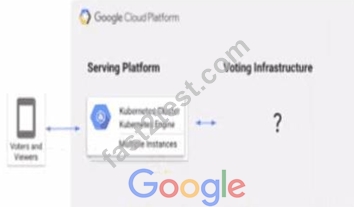
- A. Create a Memorystore instance with a high availability (HA) configuration
- B. Write votes to a Pub Sub tope and have Cloud Functions subscribe to it and write voles to BigQuery
- C. Write votes to a Pub/Sub tope and toad into both Bigtable and BigQuery via a Dataflow pipeline Query Bigtable for real-time results and BigQuery for later analysis Shutdown the Bigtable instance when voting concludes D Create a Cloud SQL for PostgreSQL database with high availability (HA) configuration and multiple read replicas
Answer: C
NEW QUESTION # 29
Data Analysts in your company have the Cloud IAM Owner role assigned to them in their projects to allow them to work with multiple GCP products in their projects. Your organization requires that all BigQuery data access logs be retained for 6 months. You need to ensure that only audit personnel in your company can access the data access logs for all projects. What should you do?
- A. Export the data access logs via a project-level export sink to a Cloud Storage bucket in a newly created projects for audit logs. Restrict access to the project with the exported logs.
- B. Export the data access logs via a project-level export sink to a Cloud Storage bucket in the Data Analysts' projects. Restrict access to the Cloud Storage bucket.
- C. Export the data access logs via an aggregated export sink to a Cloud Storage bucket in a newly created project for audit logs. Restrict access to the project that contains the exported logs.
- D. Enable data access logs in each Data Analyst's project. Restrict access to Stackdriver Logging via Cloud IAM roles.
Answer: C
Explanation:
https://cloud.google.com/iam/docs/roles-audit-logging#scenario_external_auditors
NEW QUESTION # 30
You are developing a new deep teaming model that predicts a customer's likelihood to buy on your ecommerce site. Alter running an evaluation of the model against both the original training data and new test data, you find that your model is overfitting the data. You want to improve the accuracy of the model when predicting new data. What should you do?
- A. Reduce the size of the training dataset, and decrease the number of input features.
- B. Increase the size of the training dataset, and decrease the number of input features.
- C. Reduce the size of the training dataset, and increase the number of input features.
- D. Increase the size of the training dataset, and increase the number of input features.
Answer: B
Explanation:
https://machinelearningmastery.com/impact-of-dataset-size-on-deep-learning-model-skill-and-performance-estim
NEW QUESTION # 31
......
Professional-Data-Engineer Questions PDF [2025] Use Valid New dump to Clear Exam: https://www.fast2test.com/Professional-Data-Engineer-premium-file.html
Passing Google Professional-Data-Engineer Exam Using 2025 Practice Tests: https://drive.google.com/open?id=1do1sjmn0tiPmYWjoCyZjZFk6XUb6Lw3q