

Get Latest Dec-2024 Real CV0-003 Exam Questions and Answers FREE
Truly Beneficial For Your CompTIA Exam (Updated 418 Questions)
CompTIA Cloud+ (CV0-003) Certification Path
Cloud+ is a vendor-neutral certification that validates the knowledge and best practices required of IT practitioners working in cloud computing environments, who must understand and deliver cloud infrastructure. The CompTIA Cloud+ credential proves that you have the skills to maintain and optimize cloud infrastructure services. CompTIA CV0-003 Dumps are the most best way to pass your exam. The topics covered in this exam include general cloud concepts and models, virtualization, infrastructure, security, resource management, data protection, business continuity, and availability. The CompTIA Cloud+ exam is targeted toward IT professionals with at least 24-36 months of experience who work with cloud technologies daily.
The exam covers the increased diversity of knowledge, skills, and abilities required of system administrators to validate what is necessary to perform effectively in data center jobs.
The CV0-003 Exam is a vendor-neutral certification exam that is aimed at IT professionals who have at least two to three years of experience in networking, storage, or data center administration. CV0-003 exam covers a range of topics related to cloud computing, including infrastructure, security, virtualization, and automation. CV0-003 exam consists of 90 multiple-choice and performance-based questions, and candidates are given 90 minutes to complete it.
NEW QUESTION # 103
A cloud administrator is reviewing a new application implementation document. The administrator needs to make sure all the known bugs and fixes are applied, and unwanted ports and services are disabled.
Which of the following techniques would BEST help the administrator assess these business requirements?
- A. Performance testing
- B. Usability testing
- C. Vulnerability testing
- D. Regression testing
Answer: C
NEW QUESTION # 104
Two VMs are in the same subnet 10.120.10.x/24, but the VMs cannot communicate with each other. Which of the following could be causing this problem?
- A. Private IP addresses are not routable
- B. Incorrect VLAN tagging
- C. Incorrect subnetting
- D. Incorrect firewall configuration
Answer: D
NEW QUESTION # 105
A cloud provider wants to make sure consumers are utilizing its IaaS platform but prevent them from installing a hypervisor on the server. Which of the following will help the cloud provider secure the environment and limit consumers' activity?
- A. Scaling
- B. Patch management
- C. Hardening
- D. Log and event monitoring
Answer: C
Explanation:
Explanation
Hardening is the best option to help the cloud provider secure the environment and limit consumers' activity on its IaaS platform. Hardening is a process of reducing the attack surface and vulnerabilities of a system or device by applying security configurations, patches, updates, policies, rules, etc. Hardening can prevent consumers from installing unauthorized or unsupported software on their cloud servers, such as hypervisors.
NEW QUESTION # 106
A cloud security analyst needs to ensure the web servers in the public subnet allow only secure communications and must remediate any possible issue. The stateful configuration for the public web servers is as follows: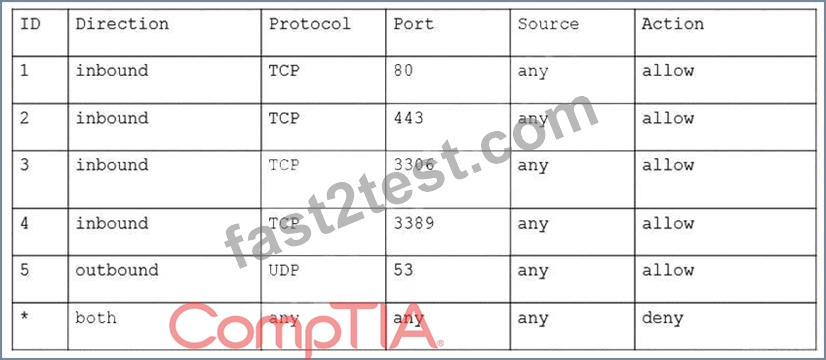
Which of the following actions should the analyst take to accomplish the objective?
- A. Remove rules 1, 3, and 4.
- B. Remove rules 1, 2, and 5.
- C. Remove rules 3, 4, and 5.
- D. Remove rules 2, 3, and 4.
Answer: B
Explanation:
Explanation
To ensure the web servers in the public subnet allow only secure communications and remediate any possible issue, the analyst should remove rules 1, 2, and 5 from the stateful configuration. These rules are allowing insecure or unnecessary traffic to or from the web servers, which may pose security risks or performance issues. The rules are:
Rule 1: This rule allows inbound traffic on port 80 (HTTP) from any source to any destination. HTTP is an unencrypted and insecure protocol that can expose web traffic to interception, modification, or spoofing. The analyst should remove this rule and use HTTPS (port 443) instead, which encrypts and secures web traffic.
Rule 2: This rule allows outbound traffic on port 25 (SMTP) from any source to any destination. SMTP is a protocol that is used to send email messages. The web servers in the public subnet do not need to send email messages, as this is not their function. The analyst should remove this rule and block outbound SMTP traffic, which may prevent spamming or phishing attacks from compromised web servers.
Rule 5: This rule allows inbound traffic on port 22 (SSH) from any source to any destination. SSH is a protocol that allows remote access and management of systems or devices using a command-line interface. The web servers in the public subnet do not need to allow SSH access from any source, as this may expose them to unauthorized or malicious access. The analyst should remove this rule and restrict SSH access to specific sources, such as the administrator's workstation or a bastion host.
NEW QUESTION # 107
A systems administrator wants to ensure two VMs remain together on the same host. Which of the following must be set up to enable this functionality?
- A. A cluster
- B. Affinity
- C. Regions
- D. Zones
Answer: B
Explanation:
Explanation
Affinity is what must be set up to ensure two VMs remain together on the same host. Affinity is a feature that allows customers to specify preferences or requirements for placing VMs on certain hosts or clusters within a cloud environment. Affinity can help to improve performance, availability, compatibility, or security of VMs by ensuring they are located on optimal hosts or clusters. Affinity can also help to keep two VMs together on the same host by creating an affinity rule that binds them together.
NEW QUESTION # 108
A company needs to rehost its ERP system to complete a datacenter migration to the public cloud. The company has already migrated other systems and configured VPN connections.
Which of the following MOST likely needs to be analyzed before rehosting the ERP?
- A. Licensing
- B. Right-sizing
- C. The network
- D. Software
Answer: C
Explanation:
The network is the set of devices, connections, protocols, and configurations that enable communication and data transfer between different systems and applications. The network can affect the rehosting of an ERP system to complete a datacenter migration to the public cloud, as it can influence factors such as bandwidth, latency, availability, security, and compatibility. The network needs to be analyzed before rehosting the ERP system to ensure that the network requirements and specifications are met, the network performance and reliability are maintained or improved, and the network security and integrity are preserved or enhanced. Reference: CompTIA Cloud+ Certification Exam Objectives, page 18, section 3.5
NEW QUESTION # 109
The Chief Information Officer (CIO) has established the requirement to limit data loss to within two hours of a disaster. Which of the following terms describes this requirement?
- A. RTO
- B. MTBF
- C. MTTR
- D. RPO
Answer: D
NEW QUESTION # 110
An organization is conducting a performance test of a public application. The following actions have already been completed:
* The baseline performance has been established.
* A load test has passed.
* A benchmark report has been generated.
Which of the following needs to be done to conclude the performance test?
- A. Test how well the application can resist a DDoS attack.
- B. Assess the application against vulnerabilities and/or misconfiguration exploitation.
- C. Verify the application works well under an unexpected volume of requests.
- D. Conduct a test with the end users and collect feedback.
Answer: C
Explanation:
To conclude the performance test of a public application, the organization needs to verify the application works well under an unexpected volume of requests. This is also known as a stress test, which is a type of performance test that evaluates the behavior and stability of the application under extreme conditions1. A stress test can help identify potential bottlenecks, errors, or failures that may occur when the application is subjected to a sudden surge or spike in demand2. A stress test can also help determine the maximum capacity and scalability of the application3.
NEW QUESTION # 111
A company has decided to get multiple compliance and security certifications for its public cloud environment. However, the company has few staff members to handle the extra workload, and it has limited knowledge of the current infrastructure.
Which of the following will help the company meet the compliance requirements as quickly as possible?
- A. FIM
- B. NAC
- C. DLP
- D. CASB
Answer: D
Explanation:
Explanation
A cloud access security broker (CASB) is a type of security solution that acts as a gateway between cloud service users and cloud service providers. A CASB can help a company get multiple compliance and security certifications for its public cloud environment, as it can provide visibility, control, and protection for cloud data and applications. A CASB can also help the company handle the extra workload and overcome the limited knowledge of the current infrastructure, as it can automate and simplify the enforcement of security policies and compliance requirements across multiple cloud services. References: CompTIA Cloud+ Certification Exam Objectives, page 14, section 2.7
NEW QUESTION # 112
A systems administrator is troubleshooting performance issues with a Windows VDI environment. Users have reported that VDI performance is very slow at the start of the workday, but the performance is fine during the rest of the day. Which of the following is the MOST likely cause of the issue? (Select TWO).
- A. License issues
- B. CPU oversubscription
- C. Affinity rule
- D. RAM usage
- E. Insufficient GPI-J resources
- F. Disk I/O limits
Answer: B,F
Explanation:
The most likely causes of the issue are A. Disk I/O limits and C. CPU oversubscription. Disk I/O limits are the maximum amount of input/output operations per second (IOPS) that a disk can handle. CPU oversubscription is the ratio of virtual CPUs to physical CPUs in a host. Both of these factors can affect the performance of a VDI environment, especially during peak hours when many users log in and launch applications.
Disk I/O limits can cause slow boot times, application lags, and cursor freezes for VDI users12. To avoid this issue, it is recommended to use flash storage or SSDs for VDI workloads, as they have much higher IOPS than traditional hard disk drives31. It is also important to monitor the disk performance and adjust the disk size and configuration as needed1.
CPU oversubscription can also cause performance degradation for VDI users, as it can lead to CPU contention and increased latency42. To avoid this issue, it is recommended to limit the CPU oversubscription ratio to a reasonable level, such as 4:1 or lower42. It is also important to monitor the CPU utilization and balance the load across hosts as needed4.
The other options are less likely to cause the issue. Affinity rules are used to specify which virtual machines should run on which hosts or which virtual machines should not run on the same host. They are not related to the performance of VDI workloads. RAM usage can affect the performance of VDI workloads, but it is usually not a major factor during peak hours, as most users do not consume a lot of memory when they log in or launch applications. Insufficient GPU resources can affect the performance of VDI workloads that require high graphics processing, such as video streaming or 3D rendering, but they are not relevant for most VDI users.
License issues can affect the availability of VDI workloads, but they are not related to the performance of VDI workloads.
NEW QUESTION # 113
A cloud engineer needs to perform a database migration. The database has a restricted SLA and cannot be offline for more than ten minutes per month. The database stores 800GB of data, and the network bandwidth to the CSP is 100MBps Which of the following is the best option to perform the migration?
- A. Use the database import/export method and copy the exported file.
- B. Utilize a third-party tool to back up and restore the data to the new database.
- C. Copy the database to an external device and ship the device to the CSP.
- D. Create a replica database, synchronize the data, and switch to the new instance.
Answer: D
Explanation:
The best option to perform the database migration is to create a replica database, synchronize the data, and switch to the new instance. This option can help meet the restricted SLA and avoid offline time for the database. Creating a replica database can help copy the data from the source to the destination without interrupting the database operations. Synchronizing the data can help ensure that the replica database is updated with any changes that occur in the source database during the migration process. Switching to the new instance can help complete the migration and activate the new database in the cloud. This option can also help avoid the network bandwidth limitation and the large size of the data. References: CompTIA Cloud+ CV0-003 Certification Study Guide, Chapter 7, Objective 7.1: Given a scenario, migrate applications and data to the cloud.
NEW QUESTION # 114
A systems administrator is analyzing a report of slow performance in a cloud application. This application is working behind a network load balancer with two VMs, and each VM has its own digital certificate configured. Currently, each VM is consuming 85% CPU on average. Due to cost restrictions, the administrator cannot scale vertically or horizontally in the environment. Which of the following actions should the administrator take to decrease the CPU utilization? (Choose two.)
- A. Reissue digital certificates on the VMs.
- B. Configure the communication between the load balancer and the VMs to use HTTPS.
- C. Configure the communication between the load balancer and the VMs to use HTTP.
- D. Move the digital certificate to the load balancer.
- E. Configure the communication between the load balancer and the VMs to use a VPN.
- F. Keep the digital certificates on the VMs.
Answer: C,D
Explanation:
Moving the digital certificate to the load balancer and configuring the communication between the load balancer and the VMs to use HTTP are two actions that will decrease the CPU utilization of the VMs that are running behind a network load balancer with two VMs, each with its own digital certificate configured.
Moving the digital certificate to the load balancer will offload the SSL/TLS encryption and decryption tasks from the VMs to the load balancer, which can reduce the CPU overhead and improve performance.
Configuring the communication between the load balancer and the VMs to use HTTP will eliminate the need for encryption and decryption between them, which can also reduce CPU consumption. However, this may introduce security risks if sensitive data is transmitted over HTTP.
NEW QUESTION # 115
A systems administrator is troubleshooting a performance issue with a virtual database server. The administrator has identified the issue as being disk related and believes the cause is a lack of IOPS on the existing spinning disk storage. Which of the following should the administrator do NEXT to resolve this issue?
- A. Upgrade the virtual database server.
- B. Check if other machines on the same storage are having issues.
- C. Move the virtual machine to flash storage and test again.
- D. Document the findings and place them in a shared knowledge base.
Answer: B
NEW QUESTION # 116
A company has a large environment with multiple VPCs across three regions in a public cloud. The company is concerned about connectivity within the regions. Which of the following should the cloud administrator implement?
- A. A load balancer
- B. Network access control
- C. Peering
- D. A firewall
Answer: C
Explanation:
Peering is a networking technique that allows direct and private connection between two or more cloud networks without using the public Internet. Peering can help the cloud administrator improve the connectivity within the regions by reducing the latency, increasing the bandwidth, and enhancing the security of the data transfer. Peering can be implemented between VPCs within the same region or across different regions, depending on the CSP's offerings and the customer's requirements. Peering can also help reduce the network costs by avoiding the use of the Internet gateways or VPNs. References: CompTIA Cloud+ CV0-003 Certification Study Guide, Chapter 3, Objective 3.1: Given a scenario, implement cloud networking solutions.
NEW QUESTION # 117
A systems administrator has finished installing monthly updates to servers in a cloud environment. The administrator notices certain portions of the playbooks are no longer functioning. Executing the playbook commands manually on a server does not work as well.
There are no other reports of issues. Which of the following is the MOST likely cause of this issue?
- A. Job validation issues
- B. Service overload
- C. Change management failure
- D. Deprecated features
- E. Patching failure
Answer: D
NEW QUESTION # 118
A cloud architect is reviewing four deployment options for a new application that will be hosted by a public cloud provider. The application must meet an SLA that allows for no more than five hours of downtime annually. The cloud architect is reviewing the SLAs for the services each option will use: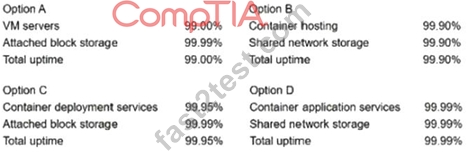
Based on the information above, which of the following minimally complies with the SLA requirements?
- A. Option D
- B. Option C
- C. Option B
- D. Option A
Answer: C
Explanation:
Explanation
Option B is what minimally complies with the SLA (Service Level Agreement) requirements of allowing for no more than five hours of downtime annually for a new application that will be hosted by a public cloud provider. An SLA is a contract or agreement that defines the level of service or performance that a customer expects from a provider, such as availability, reliability, scalability, security, etc. An SLA can help to measure and monitor the quality and satisfaction of service or performance, as well as identify any penalties or rewards for meeting or failing to meet the SLA. Option B minimally complies with the SLA requirements by using services that have availability percentages that are equal to or higher than 99.95%, which translates to no more than five hours of downtime annually. Option B uses services such as:
Compute: This is a service that provides computing resources such as servers, processors, memory, etc., to run applications or functions. Option B uses compute service with availability percentage of 99.95%, which means that it guarantees to be available for 99.95% of the time in a year, and allows for no more than five hours of downtime in a year.
Storage: This is a service that provides storage resources such as disks, volumes, files, etc., to store data or information. Option B uses storage service with availability percentage of 99.99%, which means that it guarantees to be available for 99.99% of the time in a year, and allows for no more than one hour of downtime in a year.
Database: This is a service that provides database resources such as tables, records, queries, etc., to store and retrieve data or information. Option B uses database service with availability percentage of 99.95%, which means that it guarantees to be available for 99.95% of the time in a year, and allows for no more than five hours of downtime in a year.
NEW QUESTION # 119
A systems administrator needs to configure an email client to ensure data integrity of the email messages.
Which of the following provides the BEST mechanism to achieve this goal?
- A. SHA-256 hashes
- B. SHA-1 hashes
- C. Cyclic redundancy check
- D. Digital signature
Answer: D
Explanation:
A digital signature is a type of cryptographic technique that verifies the authenticity, integrity, and non-repudiation of an electronic message or document. A digital signature can help configure an email client to ensure data integrity of the email messages, as it can prove that the email message has not been altered or tampered with during transmission by using a mathematical algorithm to generate a unique code (signature) based on the content and identity of the sender. A digital signature can also help prevent spoofing, phishing, or impersonation attacks, as it can confirm that the email message originates from a legitimate source. Reference: CompTIA Cloud+ Certification Exam Objectives, page 14, section 2.7
NEW QUESTION # 120
A systems administrator is responding to an outage in a cloud environment that was caused by a network-based flooding attack. Which of the following should the administrator configure to mitigate the attack?
- A. NIPS
- B. Network overlay using GENEVE
- C. DoH
- D. DDoS protection
Answer: D
NEW QUESTION # 121
A cloud administrator needs to coordinate and automate the management of a company's secrets and keys for all its cloud services with minimal effort and low cost. Which of the following is the BEST option to achieve the goal?
- A. Implement database as a service
- B. Implement KeePass
- C. Use password as a service
- D. Configure Key Vault
Answer: D
Explanation:
https://docs.microsoft.com/en-us/azure/key-vault/key-vault-whatis
NEW QUESTION # 122
Which of the following would be the BEST option for discussion of what individuals should do in an incident response or disaster recovery scenario?
- A. A root cause analysis
- B. Incident response/disaster recovery documentation
- C. A tabletop exercise
- D. A business continuity plan
Answer: C
Explanation:
A tabletop exercise is the best option for discussion of what individuals should do in an incident response or disaster recovery scenario. A tabletop exercise is a simulated scenario that involves key stakeholders and decision-makers who review and discuss their roles and responsibilities in response to an emergency situation or event. A tabletop exercise can help to test and evaluate plans, procedures, policies, training, and communication.
NEW QUESTION # 123
A systems administrator is about to deploy a new VM to a cloud environment. Which of the following will the administrator MOST likely use to select an address for the VM?
- A. CDN
- B. DNS
- C. IPAM
- D. NTP
Answer: C
Explanation:
IPAM (IP Address Management) is what the administrator will most likely use to select an address for the new VM that is about to be deployed to a cloud environment. IPAM is a tool or service that allows customers to plan, track, and manage the IP addresses and DNS names of their cloud resources or systems. IPAM can help to select an address for the new VM by providing information such as available IP addresses, IP address ranges, subnets, domains, etc., as well as ensuring that the address is unique and valid.
NEW QUESTION # 124
A cloud administrator configured a local cloud-resource pool lo offer 64GB of memory, 64 cores, and 640GB of storage. Thirty-two machines with identical resource allocations are started. but one machine is unable to handle requests. Which of the following is the MOST likely cause?
- A. Insufficient guest bandwidth
- B. Incorrect VLAN assignment
- C. A storage error on the guest
- D. Overwhelmed vCPU
- E. Inadequate memory allocation
Answer: D
Explanation:
Explanation
The most likely cause of one machine being unable to handle requests after deploying a new three-host cluster with identical resource allocations is that it has an overwhelmed vCPU (virtual CPU). An overwhelmed vCPU means that there is more demand for CPU resources than what is available on the host or VM. This could result in poor performance, high latency, or errors for the applications or processes that run on that machine.
The systems administrator should monitor the CPU utilization and load on each machine and adjust them accordingly to balance the workload. Reference: [CompTIA Cloud+ Certification Exam Objectives], Domain
4.0 Troubleshooting, Objective 4.3 Given a scenario, troubleshoot capacity issues within a cloud environment.
NEW QUESTION # 125
......
CompTIA Cloud+ Certification Exam (CV0-003) is a vendor-neutral certification exam designed for IT professionals who want to demonstrate their expertise in cloud computing. CV0-003 exam covers a wide range of topics related to cloud computing, such as cloud architecture, security, deployment, and maintenance. CV0-003 exam is intended for individuals who have at least two to three years of experience in IT networking, storage, or data center administration.
CV0-003 dumps Free Test Engine Verified By It Certified Experts: https://www.fast2test.com/CV0-003-premium-file.html
View All CV0-003 Actual Exam Questions, Answers and Explanations for Free: https://drive.google.com/open?id=1XsVNy58bd4Vw2SclGT4ohPV5RgqsoYj4