

New 2026 Realistic NSE5_FNC_AD-7.6 Dumps Test Engine Exam Questions in here
Updated Official licence for NSE5_FNC_AD-7.6 Certified by NSE5_FNC_AD-7.6 Dumps PDF
NEW QUESTION # 25
An administrator is configuring FortiNAC-F to manage FortiGate VPN users. As part of the configuration, the administrator must configure a few FortiGate firewall policies.
What is the purpose of the FortiGate firewall policy that applies to clients not yet authorized by FortiNAC-F?
- A. To allow access to only the production DNS server
- B. To allow access to only the FortiNAC-F VPN interface
- C. To allow access to only the FortiGate VPN interface
- D. To allow access to only the production DNS server
Answer: B
Explanation:
The firewall policy for clients not yet authorized by FortiNAC-F is designed to restrict their access so they can communicate only with the FortiNAC-F VPN interface. This allows FortiNAC-F to perform authentication and authorization before granting broader network access.
NEW QUESTION # 26
Refer to the exhibits. What would happen if the highlighted port with connected hosts was placed in both the Forced Registration and Forced Remediation port groups?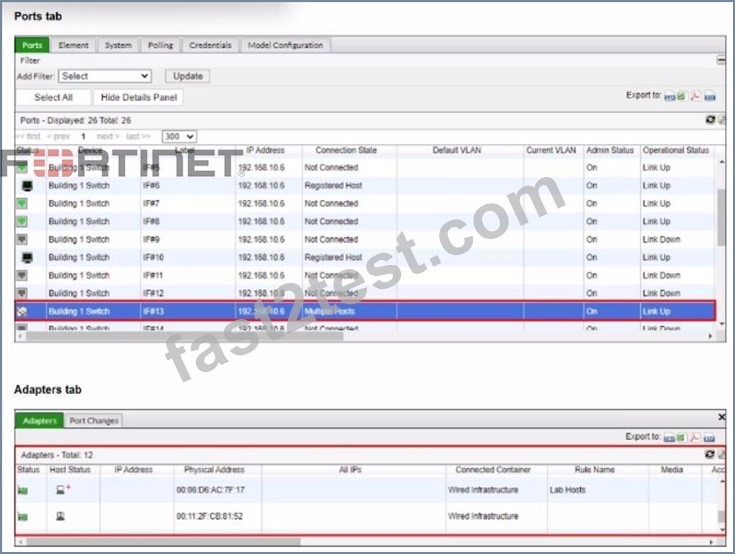
- A. Enforcement would be applied only to rogue hosts
- B. Both types of enforcement would be applied
- C. Only the higher ranked enforcement group would be applied.
- D. Multiple enforcement groups could not contain the same port.
Answer: C
Explanation:
In FortiNAC-F, Port Groups are used to apply specific enforcement behaviors to switch ports.
When a port is assigned to an enforcement group, such as Forced Registration or Forced Remediation, FortiNAC-F overrides normal policy logic to force all connected adapters into that specific state. The exhibit shows a port (IF#13) with "Multiple Hosts" connected, which is a common scenario in environments using unmanaged switches or hubs downstream from a managed switch port.
According to the FortiNAC-F Administrator Guide, it is possible for a single port to be a member of multiple port groups. However, when those groups have conflicting enforcement actions--such as one group forcing a registration state and another forcing a remediation state--FortiNAC-F utilizes a ranking system to resolve the conflict. In the FortiNAC-F GUI under Network > Port Management > Port Groups, each group is assigned a rank. The system evaluates these ranks, and only the higher ranked enforcement group is applied to the port. If a port is in both a Forced Registration group and a Forced Remediation group, the group with the numerical priority (rank) will dictate the VLAN and access level assigned to all hosts on that port.
This mechanism ensures consistent behavior across the fabric. If the ranking determines that
"Forced Registration" is higher priority, then even a known host that is failing a compliance scan (which would normally trigger Remediation) will be held in the Registration VLAN because the port-level enforcement takes precedence based on its rank.
"A port can be a member of multiple groups. If more than one group has an enforcement assigned, the group with the highest rank (lowest numerical value) is used to determine the enforcement for the port. When a port is placed in a group with an enforcement, that enforcement is applied to all hosts connected to that port, regardless of the host's current state."
NEW QUESTION # 27
When working with a FortiNAC-F Manager and cluster management, what will occur when a cluster manager recovers from a non-responsive state?
- A. It will perform a health check and be demoted to standby
- B. It rejoins the cluster as a worker node
- C. It automatically returns to the manager state
- D. It will be removed from the cluster and placed in a standalone group
Answer: B
Explanation:
When a cluster manager recovers from a non-responsive state, it does not automatically reclaim the manager role. Instead, it rejoins the cluster as a worker node to ensure cluster stability and avoid split-brain conditions.
NEW QUESTION # 28
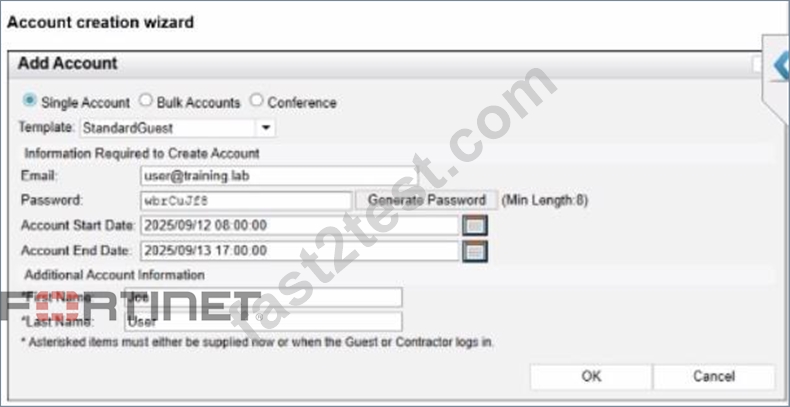
Refer to the exhibits. Based on the given configurations and settings, on which date and time would a guest account created at 8:00 AM on 2025/09/12 expire?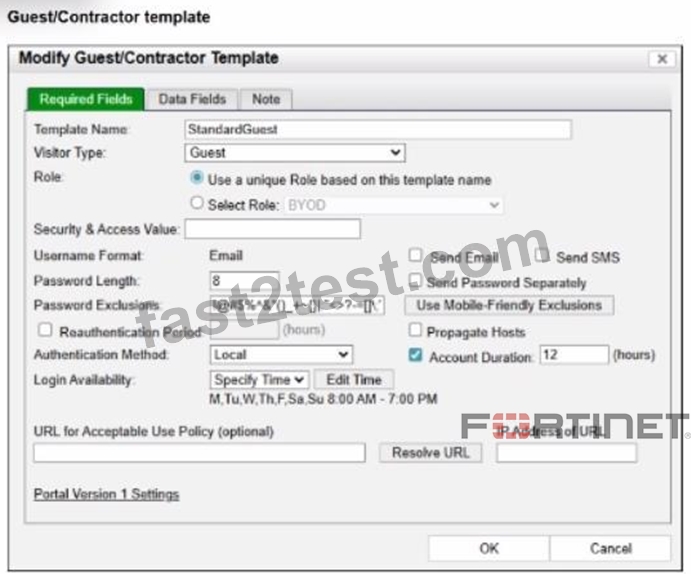
- A. 2025/09/13 at 17:00:00
- B. 2025/09/12 at 7:00 PM
- C. 2025/09/12 at 17:00:00
- D. 2025/09/12 at 8:00 PM
Answer: A
Explanation:
In FortiNAC-F, the expiration of a guest or contractor account is determined by the configuration settings within the Account Creation Wizard and the associated Guest/Contractor Template.
While a template can define a default "Account Duration" (as seen in the 12-hour setting in the second exhibit), the Account Creation Wizard allows an administrator to manually specify or override the start and end parameters for a specific user session.
According to the FortiNAC-F Administration Guide regarding guest management, the Account End Date field in the creation wizard is the definitive timestamp for when the account object will be disabled or deleted from the system. In the provided exhibit (Account Creation Wizard), the administrator has explicitly set the Account Start Date to 2025/09/12 08:00:00 and the Account End Date to 2025/09/13 17:00:00.
Even though the template indicates an "Account Duration" of 12 hours, this value typically serves as a pre-populated default. When a manual date and time are entered into the wizard, those specific values take precedence for that individual account. The account will remain active and valid until 5:00 PM (17:00:00) on the following day, 2025/09/13. It is also important to note the
"Login Availability" from the template (8:00 AM - 7:00 PM); while the account exists until the 13th at 17:00:00, the user would only be able to authenticate during the active hours defined by the login schedule on both days.
"When creating an account, the administrator can select a template to provide default settings.
However, specific values such as the Account End Date can be modified within the Account Creation Wizard. The date and time specified in the 'Account End Date' field determines the absolute expiration of the account. Once this time is reached, the account is moved to an expired state and the user's network access is revoked."
NEW QUESTION # 29
While discovering network infrastructure devices, a switch appears in the inventory topology with a question mark (?) on the icon. What would cause this?
- A. The wrong SNMP community string was entered during discovery.
- B. SNMP is not enabled on the switch.
- C. A read-only SNMP community siring was used.
- D. The SNMP ObjectlD is not recognized by FortiNAC-F.
Answer: D
Explanation:
In FortiNAC-F, the Inventory topology uses specific icons to represent the status and model of discovered network infrastructure. When a switch or other network device is discovered via SNMP, FortiNAC-F retrieves its System ObjectID (sysObjectID) to identify the specific make and model. This OID is then compared against the internal database of supported device mappings.
A question mark (?) icon appearing on a discovered switch indicates that while the discovery process successfully communicated with the device (meaning SNMP credentials were correct), the SNMP ObjectID is not recognized or mapped in the current version of FortiNAC-F. This essentially means the device is "unsupported" by the current software out-of-the-box. Because the OID is unknown, FortiNAC-F does not know which CLI or SNMP command set to use for critical functions like L2 polling (host visibility) or VLAN switching (enforcement). To resolve this, an administrator can manually "Set Device Mapping" to a similar existing model or a "Generic SNMP Device" if only basic L3 visibility is required.
"Discovered devices displaying a '?' icon indicate the currently running version does not have a mapping for that device's System OID (device is not supported). Device mappings are used to manage the device by performing functions such as L2/L3 Polling, Reading, and Switching VLANs."
NEW QUESTION # 30
An administrator is configuring FortiNAC to manage FortiGate VPN users. As part of the configuration, the administrator must configure a few FortiGate firewall policies. What is the purpose of the FortiGate firewall policy that applies to unauthorized VPN clients?
- A. To deny access to only the production DNS server
- B. To allow access to only the production DNS server
- C. To deny access to only the FortiNAC VPN interface
- D. To allow access to only the FortiNAC VPN interface
Answer: D
NEW QUESTION # 31
When FortiNAC-F is managing VPN clients connecting through FortiGate, why must the clients run a FortiNAC-F agent?
- A. To collect user authentication details
- B. To transparently update The client IP address upon successful authentication
- C. To validate the endpoint policy compliance
- D. To collect the client IP address and MAC address
Answer: D
Explanation:
When FortiNAC-F manages VPN clients through a FortiGate, the agent plays a fundamental role in device identification that standard network protocols cannot provide on their own. In a standard VPN connection, the FortiGate establishes a Layer 3 tunnel and assigns a virtual IP address to the client. While the FortiGate sends a syslog message to FortiNAC-F containing the username and this assigned IP address, it typically does not provide the hardware (MAC) address of the remote endpoint's physical or virtual adapter.
FortiNAC-F relies on the MAC address as the primary unique identifier for all host records in its database. Without the MAC address, FortiNAC-F cannot correlate the incoming VPN session with an existing host record to apply specific policies or track the device's history. By running either a Persistent or Dissolvable Agent, the endpoint retrieves its own MAC address and communicates it directly to the FortiNAC-F service interface. This allows the "IP to MAC" mapping to occur.
Once FortiNAC-F has both the IP and the MAC, it can successfully identify the device, verify its status, and send the appropriate FSSO tags or group information back to the FortiGate to lift network restrictions.
NEW QUESTION # 32
Which three communication methods are used by FortiNAC to gather information from and control, infrastructure devices? (Choose three.)
- A. CLI
- B. FTP
- C. RADIUS
- D. SNMP
- E. SMTP
Answer: A,C,D
NEW QUESTION # 33
Refer to the exhibit. A FortiNAC-F N+1 HA configuration is shown.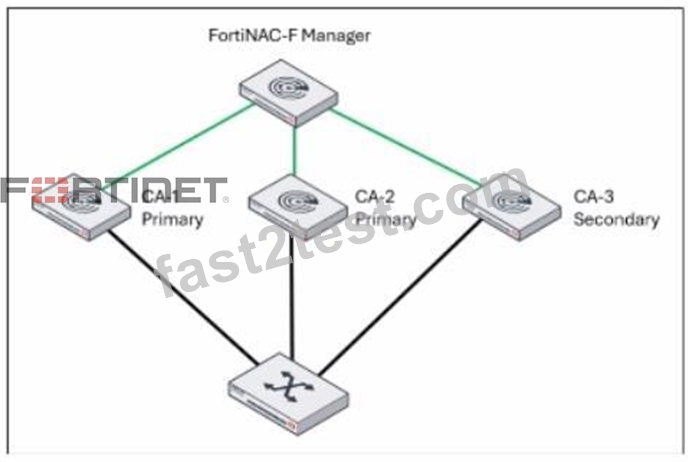
What will occur if CA-2 fails?
- A. CA-1 and CA-3 will operate as a 1+1 HA cluster with CA-3 acting as a hot standby.
- B. CA-3 will continue to operate as a secondary in an N+1 HA configuration.
- C. CA-3 will be promoted to a primary and FortiNAC-F manager will load balance between CA-1 and CA-3.
- D. CA-3 will be promoted to a primary and share management responsibilities with CA-1.
Answer: C
Explanation:
In an N+1 HA architecture managed by a FortiNAC-F Manager, if a primary CA fails, an available secondary CA is automatically promoted to primary. After CA-2 fails, CA-3 is promoted to a primary role, and the FortiNAC-F Manager load balances management and enforcement responsibilities between the remaining primary CAs, CA-1 and CA-3.
NEW QUESTION # 34
Refer to the exhibit. If a host is connected to a port in the Building 1 First Floor Ports group, what must also be true to match this user/host profile?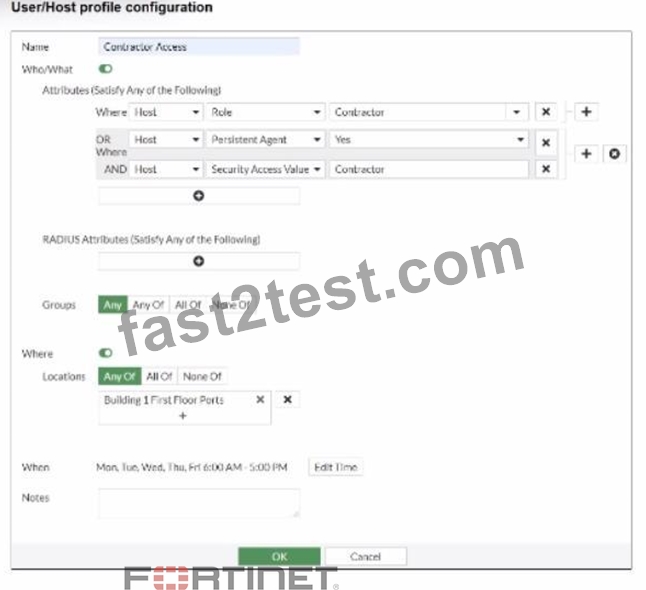
- A. The host must have a role value of contractor, an installed persistent agent or a security access value of contractor, and be connected between 6 AM and 5 PM.
- B. The host must have a role value of contractor or an installed persistent agent or a security access value of contractor, and be connected between 6 AM and 5 PM.
- C. The host must have a role value of contractor or an installed persistent agent, a security access value of contractor, and be connected between 9 AM and 5 PM.
- D. The host must have a role value of contractor or an installed persistent agent and a security access value of contractor, and be connected between 6 AM and 5 PM.
Answer: D
Explanation:
The User/Host Profile in FortiNAC-F is the fundamental logic engine used to categorize endpoints for policy assignment. As seen in the exhibit, the configuration uses a combination of Boolean logic operators (OR and AND) to define the "Who/What" attributes.
According to the FortiNAC-F Administrator Guide, attributes grouped together within the same bracket or connected by an OR operator require only one of those conditions to be met. In the exhibit, the first two attributes are "Host Role = Contractor" OR "Host Persistent Agent = Yes".
This forms a single logical block. This block is then joined to the third attribute ("Host Security Access Value = Contractor") by an AND operator. Consequently, a host must satisfy at least one of the first two conditions AND satisfy the third condition to match the "Who/What" section.
Furthermore, the profile includes Location and When (time) constraints. The exhibit shows the location is restricted to the "Building 1 First Floor Ports" group. The "When" schedule is explicitly set to Mon-Fri 6:00 AM - 5:00 PM. For a profile to match, all enabled sections (Who/What, Locations, and When) must be satisfied simultaneously. Therefore, the host must meet the conditional contractor/agent criteria, possess the specific security access value, and connect during the defined 6 AM to 5 PM window.
"User/Host Profiles use a combination of attributes to identify a match. Attributes joined by OR require any one to be true, while attributes joined by AND must all be true. If a Schedule (When) is applied, the host must also connect within the specified timeframe for the profile to be considered a match. All criteria in the Who/What, Where, and When sections are cumulative."
NEW QUESTION # 35
Which two policy types can be created on a FortiNAC Control Manager? (Choose two.)
- A. Supplicant EasvConnect
- B. Network Access
- C. Endpoint Compliance
- D. Authentication
Answer: B,C
NEW QUESTION # 36
An administrator wants to build a security rule that will quarantine contractors who attempt to access specific websites.
In addition to a user host profile, which two components must the administrator configure to create the security rule? (Choose two.)
- A. Endpoint compliance policy
- B. Action
- C. Trigger
- D. Methods
- E. Security String
Answer: B,C
Explanation:
A security rule requires a trigger to detect the condition, such as contractors accessing specific websites based on security or traffic events. It also requires an action to define the response, such as quarantining the contractor when the trigger condition is met.
NEW QUESTION # 37
Which two requirements must be met to set up an N+1 HA cluster? (Choose two.)
- A. A FortiNAC-F manager
- B. A FortiNAC-F device designated as a secondary
- C. At least two FortiNAC-F devices designated as primary
- D. A dedicated VLAN for primary and secondary synchronization
Answer: A,B
Explanation:
The N+1 High Availability (HA) architecture was introduced in FortiNAC-F version 7.6 to provide a more scalable and flexible redundancy model compared to the traditional 1+1 active/passive setup.
In an N+1 configuration, a single secondary (standby) appliance can provide coverage for multiple primary (active) Control and Application (CA) appliances.
To set up an N+1 HA cluster, there are two fundamental structural requirements:
A FortiNAC-F Manager (FortiNAC-M): Unlike standard 1+1 HA, which can be configured directly between two CAs, N+1 management is centralized. The FortiNAC-M acts as the orchestrator that manages the failover groups, monitors the health of the primaries, and coordinates the promotion of the secondary server if a primary fails.
A FortiNAC-F device designated as a Secondary: The cluster must have one appliance explicitly configured with the Secondary failover role. This device remains in a standby state, receiving database replications from all N primaries in its group until it is called upon to take over the functions of a failed unit
NEW QUESTION # 38
Two FortiNAC-F devices have been configured as a 1+1 HA pair. The primary server went offline and a successful failover to the secondary has occurred.
What happens if the primary server comes back online?
- A. The secondary server will update the primary and the servers will load balance until an administrator forces the primary to resume full control.
- B. The primary server will determine that the secondary has control and power down for maintenance.
- C. The primary and secondary servers will resume communication and the secondary will maintain control.
- D. After five successful heartbeats between the servers, the primary server will resume control.
Answer: C
Explanation:
In a 1+1 HA configuration, once failover has occurred and the secondary assumes control, it remains the active controller when the original primary comes back online. The restored primary rejoins as the standby unit, and control is not automatically reverted.
NEW QUESTION # 39
An administrator wants to control user access to corporate resources by integrating FortiNAC-F with FortiGate using firewall tags defined on FortiNAC-F.
Where would the administrator assign the firewall tag value that will be sent to FortiGate?
- A. Security rule
- B. RADIUS group attribute
- C. Logical network
- D. Device profiling rule
Answer: C
Explanation:
In FortiNAC-F, the integration with FortiGate for Security Fabric and Single Sign-On (FSSO) allows the system to communicate the access level of an endpoint directly to the firewall using firewall tags. This eliminates the need for complex VLAN steering in some environments by allowing the FortiGate to apply policies based on these dynamic tags instead of just a physical or virtual network segment.
The actual assignment of the firewall tag value occurs within a Logical Network. In the FortiNAC- F architectural model, a Logical Network acts as a container for "Access Values". When an administrator configures a Logical Network (located under Network > Logical Networks), they define what that network represents--such as "Corporate Access" or "Contractor Limited". Within that definition, they assign the specific Firewall Tag that matches the tag created on the FortiGate. Once a user or host matches a Network Access Policy, FortiNAC-F identifies the associated Logical Network and pushes the defined tag to the FortiGate via the FSSO connector.
It is important to note that while Network Access Policies (and by extension Security Rules) are the logic engines that trigger the assignment, they do not hold the tag value itself. They simply point to a Logical Network, which serves as the central repository for that specific access configuration.
"To assign firewall tags, navigate to Network > Logical Networks. Select the desired logical network and click Edit. Under the Access Value section, select Firewall Tag as the type and enter the tag name exactly as it appears on the FortiGate. When a Network Access Policy matches a host, FortiNAC sends this tag to the FortiGate as an FSSO message."
NEW QUESTION # 40
In a wireless integration, what method does FortiNAC use to obtain connecting MAC address information?
- A. Link traps
- B. SNMP traps
- C. Endstation traffic monitoring
- D. RADIUS
Answer: D
NEW QUESTION # 41
Refer to the exhibit. An administrator wants to use FortiNAC-F to automatically provision printers throughout their organization. Each building uses its own local VLAN for printers.
Which FortiNAC-F feature would allow this to be accomplished with a single network access policy?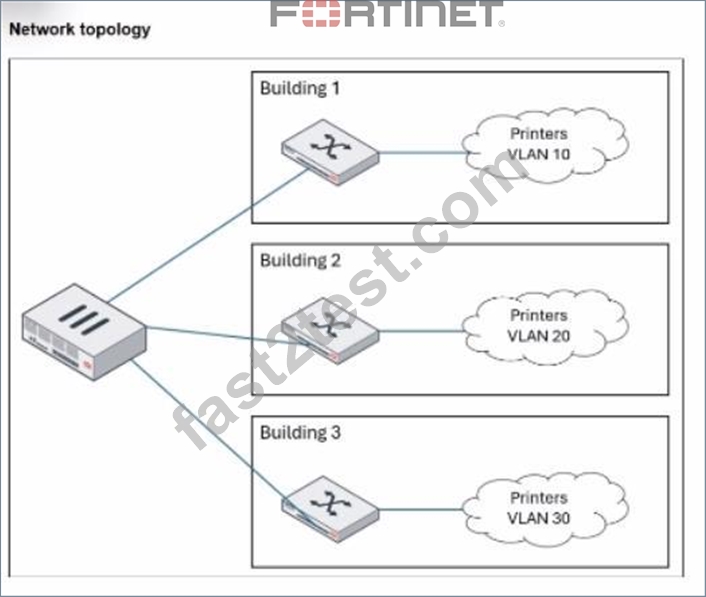
- A. Dynamic host groups
- B. Preferred VLAN designations
- C. Logical networks
- D. Device profiling rules
Answer: C
Explanation:
The FortiNAC-F Logical Network feature is specifically designed to provide an abstraction layer between high-level security policies and the underlying physical network infrastructure. In large- scale deployments where different physical locations (like Building 1, 2, and 3 in the exhibit) use different local VLAN IDs for the same type of device (e.g., VLAN 10, 20, and 30 for printers), managing separate policies for each building would create significant administrative overhead.
By using a Logical Network, an administrator can create a single entity--for example, a logical network named "Printers"--and use it as the "Access Value" in a single Network Access Policy.
The mapping of this logical label to a specific physical VLAN occurs at the Model Configuration level for each network device. When a printer connects to a switch in Building 1, FortiNAC-F evaluates the policy, identifies that the printer should be in the "Printers" logical network, and checks the Model Configuration for that specific switch to see which VLAN ID is mapped to that label (VLAN 10). If the same printer moves to Building 3, the same single policy applies, but FortiNAC-F provisions it to VLAN 30 based on the local mapping for that building's switch.
This architectural approach ensures that policies remain consistent and easy to manage regardless of the complexity or variations in the local network topology.
"Logical Networks provide a way to define a network access requirement once and apply it across many different network devices that may use different VLAN IDs for that access... Each managed device can use different VLAN IDs for the same Logical Network label. You can define the Logical Networks based on requirements and then associate the network to a VLAN ID when the managed device is configured in the Model Configuration."
NEW QUESTION # 42
Refer to the output below.
Examine the communication between a primary FortiNAC-F (192.168.10.10) and a secondary FortiNAC-F (192.168.10.110) configured as a 1+1 HA pair.
What is the current state of the FortiNAC-F HA pair?
- A. Failover from the primary server to the secondary server is in progress.
- B. The primary server is running and in control.
- C. The database replication failed.
- D. The secondary server is running and in control.
Answer: B
Explanation:
The primary server (192.168.10.10) reports inControl true, while the secondary server (192.168.10.110) is Running - Not In Control, indicating the primary is active and controlling the HA pair.
NEW QUESTION # 43
......
Grab latest Fortinet NSE5_FNC_AD-7.6 Dumps as PDF Updated: https://www.fast2test.com/NSE5_FNC_AD-7.6-premium-file.html