

Use the best ways of preparing for MCIA-Level-1 Exam Dumps with Fast2test MuleSoft MCIA-Level-1 dump PDF [2024]
MuleSoft MCIA-Level-1 exam candidates will surely pass the Exam if they consider the MCIA-Level-1 dumps learning material presented by Fast2test.
NEW QUESTION # 32
An organization is building out a test suite for their application using MUnit.
The Integration Architect has recommended using Test Recorder in Anypoint Studio to record the processing flows and then configure unit tests based on the captured events.
What Is a core consideration that must be kept In mind while using Test Recorder?
- A. Tests for flows cannot be created if Mule errors are raised Inside the flows, even if the errors are handled by On-Error Continue error handlers
- B. Mocking values resulting from parallel processes are possible and will not affect theexecution of the processors that follow in the test
- C. The Recorder supports mocking a message before or inside a Foreach processor
- D. The Recorder supports loops where the structure of the data being tested changes inside the Iteration
Answer: A
Explanation:
* MUnit and Test Recorder:
* MUnit is MuleSoft's testing framework designed to create automated tests for Mule applications.
* Test Recorder in Anypoint Studio allows capturing live processing flows and events to automatically generate test cases.
* Core Consideration:
* While using Test Recorder, it is essential to consider how errors within the flows are handled.
* If Mule errors are raised within the flows, Test Recorder will not be able to create tests for these flows, even if the errors are managed by On-Error Continue error handlers.
* This limitation requires careful design and error handling strategies to ensure test cases can be recorded and executed effectively.
* Error Handling in MUnit:
* MUnit allows simulating error scenarios using mocks and spies.
* Proper error handling within the application flow ensures robustness and reliable test creation.
* However, the inability to create tests when errors are raised during recording indicates a need for alternative approaches to manage errors during test case generation.
References:
* MuleSoft Documentation on MUnit: MUnit Documentation
* MuleSoft Blog on MUnit Test Recorder: MUnit Test Recorder
NEW QUESTION # 33
An integration Mute application is being designed to process orders by submitting them to a backend system for offline processing. Each order will be received by the Mute application through an HTTPS POST and must be acknowledged immediately. Once acknowledged, the order will be submitted to a backend system. Orders that cannot be successfully submitted due to rejections from the backend system will need to be processed manually (outside the backend system).
The Mule application will be deployed to a customer-hosted runtime and is able to use an existing ActiveMQ broker if needed.
The backend system has a track record of unreliability both due to minor network connectivity issues and longer outages.
What idiomatic (used for their intended purposes) combination of Mule application components and ActiveMQ queues are required to ensure automatic submission of orders to the backend system, while minimizing manual order processing?
- A. Until Successful component ActiveMQ long retry Queue ActiveMQ Dead Letter Queue for manual processing
- B. Until Successful component MuleSoft Object Store ActiveMQ is NOT needed or used
- C. An On Error scope Non-persistent VM ActiveMQ Dead Letter Queue for manual processing
- D. An On Error scope MuleSoft Object Store ActiveMQ Dead Letter Queue for manual processing
Answer: A
NEW QUESTION # 34
Following MuleSoft best practices, what MuleSoft runtime deployment option best meets the company's goals to begin its digital transformation journey?
- A. Customer-hosted runtimes provisioned by a MuleSoft services partner
- B. Customer-hosted self-provisioned runtimes
- C. CloudHub runtimes
- D. Runtime Fabric on VMs/bare metal
Answer: C
Explanation:
* Digital Transformation Goals:
* The company aims to start its digital transformation journey, which typically involves adopting cloud-based solutions to enhance agility, scalability, and innovation.
* CloudHub Runtimes:
* Fully Managed Service: CloudHub is a fully managed, multi-tenant integration platform as a service (iPaaS) offered by MuleSoft.
* Ease of Use: It simplifies deployment and management, requiring minimal infrastructure setup and maintenance from the customer.
* Scalability: CloudHub provides seamless scalability to handle varying workloads, which is crucial for growing digital transformation initiatives.
* High Availability: CloudHub ensures high availability and reliability through its underlying infrastructure and built-in failover mechanisms.
* Security: MuleSoft ensures that CloudHub meets stringent security and compliance standards, which is essential for enterprise applications.
* Suitability for Digital Transformation:
* Rapid Deployment: CloudHub enables rapid deployment of integrations and APIs, accelerating the digital transformation process.
* Cost-Effective: As a managed service, it reduces the total cost of ownership by eliminating the need for extensive infrastructure investments and ongoing operational costs.
* Integration Capabilities: CloudHub supports a wide range of integration patterns and connectors, facilitating seamless integration with various systems and data sources.
References:
* MuleSoft Documentation on CloudHub: CloudHub
* MuleSoft Digital Transformation Insights: MuleSoft Digital Transformation
NEW QUESTION # 35
An organization is building a test suite for their applications using m-unit. The integration architect has recommended using test recorder in studio to record the processing flows and then configure unit tests based on the capture events What are the two considerations that must be kept in mind while using test recorder (Choose two answers)
- A. Mocking values resulting from parallel processes are possible and will not affect the execution of the processes that follow in the test
- B. A recorded flow execution ends successfully but the result does
not reach its destination because the application is killed - C. The recorder support loops where the structure of the data been tested changes inside the iteration
- D. Recorder supports smoking a message before or inside a ForEach processor
- E. Tests for flows cannot be created with Mule errors raised inside
the flow or already existing in the incoming event
Answer: B,E
NEW QUESTION # 36
A mule application is deployed to a Single Cloudhub worker and the public URL appears in Runtime Manager as the APP URL.
Requests are sent by external web clients over the public internet to the mule application App url. Each of these requests routed to the HTTPS Listener event source of the running Mule application.
Later, the DevOps team edits some properties of this running Mule application in Runtime Manager.
Immediately after the new property values are applied in runtime manager, how is the current Mule application deployment affected and how will future web client requests to the Mule application be handled?
- A. CloudHub will redeploy the Mule application to a NEW Cloudhub worker New web client requests will RETURN AN ERROR until the NEW Cloudhub worker is available
- B. Cloudhub will redeploy the Mule application to the OLD Cloudhub worker New web client requests will RETURN AN ERROR until the Mule application is redeployed to the OLD Cloudhub worker
- C. Cloudhub will redeploy the Mule application to a NEW Cloudhub worker New web client requests are ROUTED to the OLD Cloudhub worker until the NEW Cloudhub worker is available.
- D. Cloudhub will redeploy the mule application to the OLD Cloudhub worker New web client requests are ROUTED to the OLD Cloudhub worker BOTH before and after the Mule application is redeployed.
Answer: C
Explanation:
CloudHub supports updating your applications at runtime so end users of your HTTP APIs experience zero downtime. While your application update is deploying, CloudHub keeps the old version of your application running. Your domain points to the old version of your application until the newly uploaded version is fully started. This allows you to keep servicing requests from your old application while the new version of your application is starting.
NEW QUESTION # 37
In Anypoint Platform, a company wants to configure multiple identity providers (IdPs) for multiple lines of business (LOBs). Multiple business groups, teams, and environments have been defined for these LOBs.
What Anypoint Platform feature can use multiple IdPs across the company's business groups, teams, and environments?
- A. Permissions
- B. Virtual private clouds
- C. MuleSoft-hosted (CloudHub) dedicated load balancers
- D. Client (application) management
Answer: C
Explanation:
To use a dedicated load balancer in your environment, you must first create an Anypoint VPC. Because you can associate multiple environments with the same Anypoint VPC, you can use the same dedicated load balancer for your different environments.
NEW QUESTION # 38
Refer to the exhibit.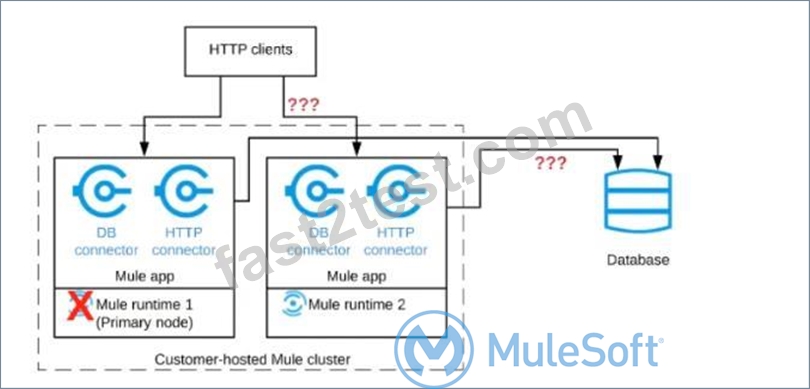
A Mule application is deployed to a cluster of two customer-hosted Mute runtimes. TheMute application has a flow that polls a database and another flow with an HTTP Listener.
HTTP clients send HTTP requests directly to individual cluster nodes.
What happens to database polling and HTTP request handling in the time after the primary (master) node of the cluster has railed, but before that node is restarted?
- A. Database polling stops All HTTP requests are rejected
- B. Database pollingcontinues All HTTP requests continue to be accepted, but requests to the failed node Incur increased latency
- C. Database polling stops All HTTP requests continue to be accepted
- D. Database polling continues Only HTTP requests sent to the remaining node continue to be accepted
Answer: D
NEW QUESTION # 39
Customer has deployed mule applications to different customer hosted mule run times. Mule applications are managed from Anypoint platform.
What needs to be configured to monitor these Mule applications from Anypoint monitoring and what sends monitoring data to Anypoint monitoring?
- A. Install runtime manager agent on each mule runtime
Runtime manager agent since monitoring data from the mule applications to Anypoint monitoring - B. Enable monitoring of individual applications from runtime manager application settings Runtime manager agent sends monitoring data from the mule applications to Anypoint monitoring
- C. Anypoint monitoring agent on each mule runtime
Anypoint monitoring agent sends monitoring data from the mule applications to Anypoint monitoring - D. By default, Anypoint monitoring agent will be installed on each Mule run time Anypoint Monitoring agent automatically sends monitoring data from the Mule applications to Anypoint monitoring
Answer: B
Explanation:
To monitor Mule applications deployed on customer-hosted Mule runtimes from Anypoint Platform, you need to enable monitoring for each application within the Runtime Manager's application settings. This step ensures that the Runtime Manager Agent, which is already part of the Mule runtime, will collect and send monitoring data to Anypoint Monitoring.
The Runtime Manager Agent acts as the intermediary, collecting metrics and operational data from the Mule applications and transmitting this data to Anypoint Monitoring for analysis and visualization. This setup provides real-time insights and allows for effective monitoring and management of Mule applications.
References:
* MuleSoft Documentation on Anypoint Monitoring
NEW QUESTION # 40
A set of integration Mule applications, some of which expose APIs, are being created to enable a new business process. Various stakeholders may be impacted by this. These stakeholders are a combination of semi-technical users (who understand basic integration terminology and concepts such as JSON and XML) and technically skilled potential consumers of the Mule applications and APIs.
What Is an effective way for the project team responsible for the Mule applications and APIs being built to communicate withthese stakeholders using Anypoint Platform and its supplied toolset?
- A. Capture documentation about the Mule applications and APIs inline within the Mule integration flows and use Anypoint Studio's Export Documentation feature to provide an HTML version of this documentation to the stakeholders
- B. Use Anypoint Exchange to register the various Mule applications and APIs and share the RAML definitions with the stakeholders, so they can be discovered
- C. Use Anypoint Design Center to implement the Mule applications and APIs and give the various stakeholders access to these Design Center projects, so they can collaborate and provide feedback
- D. Create Anypoint Exchange entries with pages elaborating the integration design, including API notebooks (where applicable) to help the stakeholders understand and interact with the Mule applications and APIs at various levels of technical depth
Answer: D
NEW QUESTION # 41
What comparison is true about a CloudHub Dedicated Load Balancer (DLB) vs. the CloudHub Shared Load Balancer (SLB)?
- A. Both a DLB and the SLB allow the configuration of access control via IP whitelists
- B. Only a DLB allows the configuration of a custom TLS server certificate
- C. Only the SLB can forward HTTP traffic to the VPC-internal ports of the CloudHub workers
- D. Both a DLB and the SLB implement load balancing by sending HTTP requests to workers with the lowest workloads
Answer: B
Explanation:
* Shared load balancers don't allow you to configure custom SSL certificates or proxy rules
* Dedicated Load Balancer are optional but you need to purchase them additionally if needed.
* TLS is a cryptographic protocol that provides communications security for your Mule app. TLS offers many different ways of exchanging keys for authentication, encrypting data, and guaranteeing message integrity.
* The CloudHub Shared Load Balancer terminates TLS connections and uses its own server-side certificate.
* Only a DLB allows the configuration of a custom TLS server certificate
* DLB enables you to define SSL configurations to provide custom certificates and optionally enforce two-way SSL client authentication.
* To use a DLB in your environment, you must first create an Anypoint VPC. Because you can associate multiple environments with the same Anypoint VPC, you can use the same dedicated load balancer for your different environments.
* MuleSoft Reference: https://docs.mulesoft.com/runtime-manager/dedicated-load-balancer-tutorial Additional Info on SLB Vs DLB: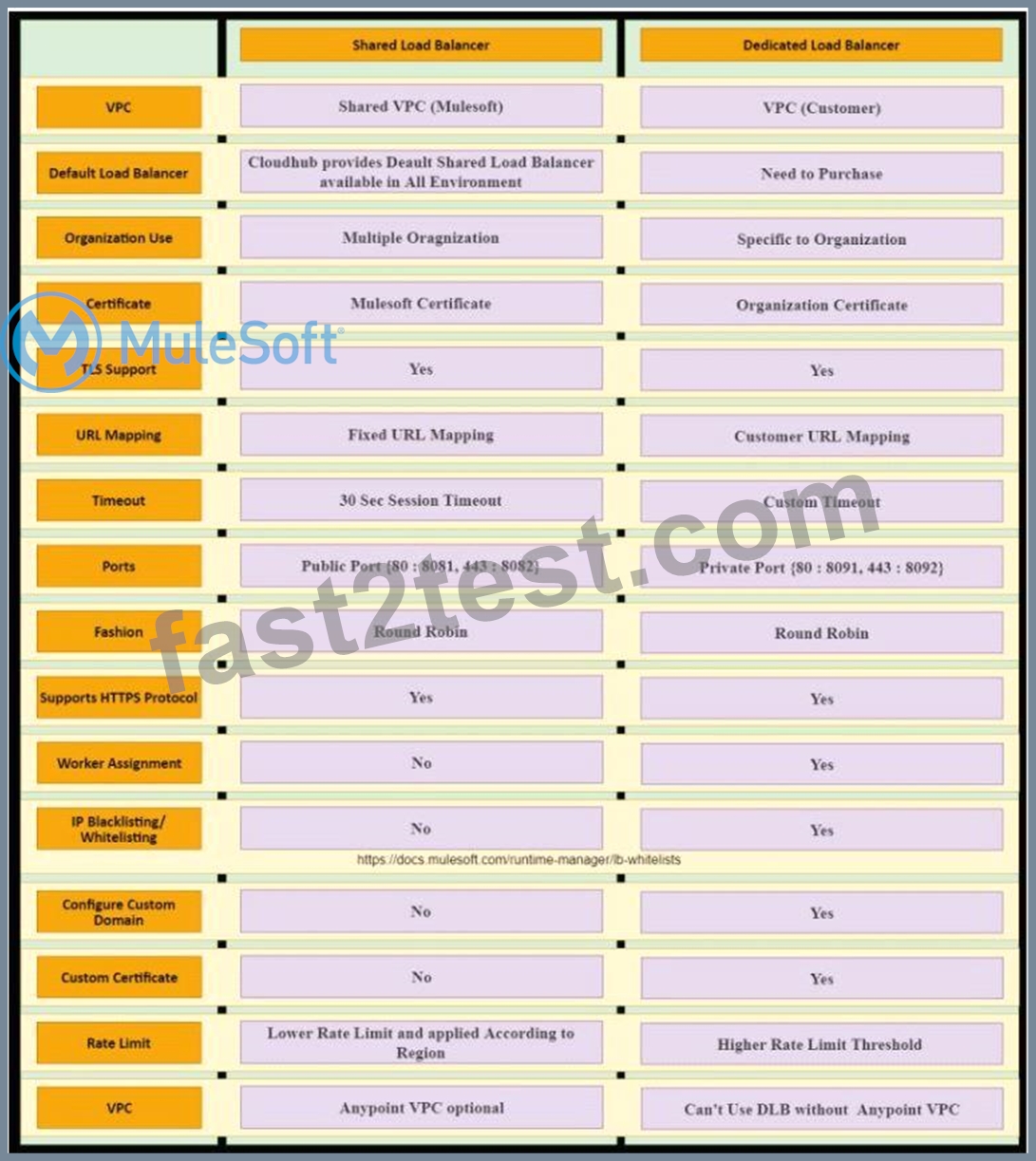
NEW QUESTION # 42
Refer to the exhibit.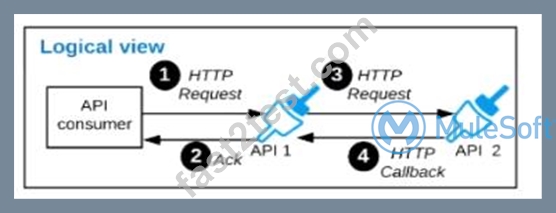
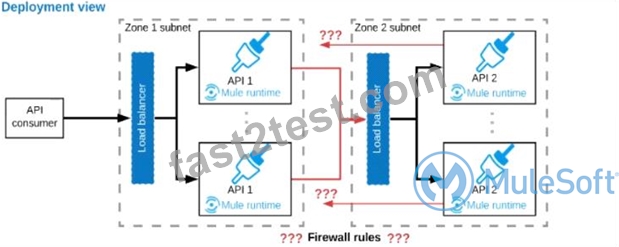
A business process involves two APIs that interact with each other asynchronously over HTTP. Each API is implemented as a Mule application. API 1 receives the initial HTTP request and invokes API 2 (in a fire and forget fashion) while API 2, upon completion of the processing, calls back into API l to notify about completion of the asynchronous process.
Each API Is deployed to multiple redundant Mule runtimes and a separate load balancer, and is deployed to a separate network zone.
In the network architecture, how must the firewall rules be configured to enable the above Interaction between API 1 and API 2?
- A. To enable communication from each API's Mule runtimes and network zone to the toad balancer of the other API
- B. To allow communication between the load balancers used by each API
- C. To authorize the certificates used by both the apis
- D. To open direct two-way communication between the Mule runtimes of both APIs
Answer: A
NEW QUESTION # 43
A banking company is developing a new set of APIs for its online business. One of the critical API's is a master lookup API which is a system API. This master lookup API uses persistent object store. This API will be used by all other APIs to provide master lookup data.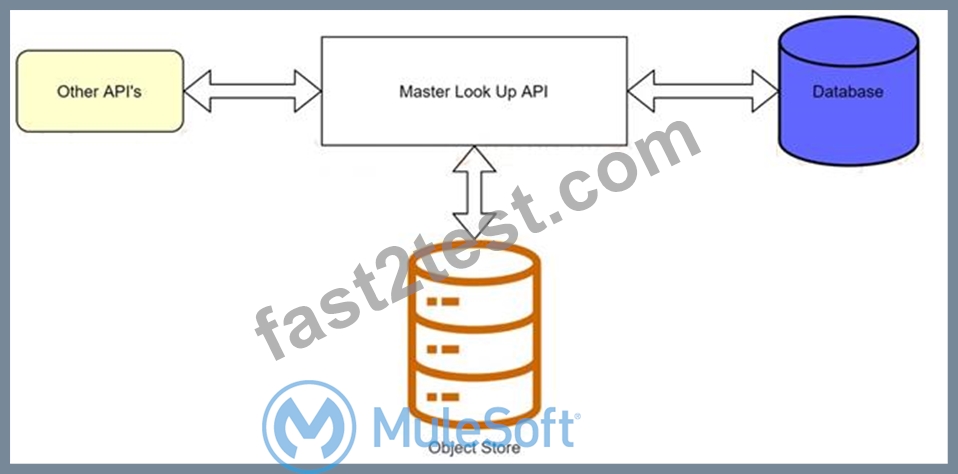
Master lookup API is deployed on two cloudhub workers of 0.1 vCore each because there is a lot of master data to be cached. Master lookup data is stored as a key value pair. The cache gets refreshed if they key is not found in the cache.
Doing performance testing it was observed that the Master lookup API has a higher response time due to database queries execution to fetch the master lookup data.
Due to this performance issue, go-live of the online business is on hold which could cause potential financial loss to Bank.
As an integration architect, which of the below option you would suggest to resolve performance issue?
- A. Implement HTTP caching policy for all GET endpoints for the master lookup API and implement locking to synchronize access to object store
- B. Upgrade vCore size from 0.1 vCore to 0,2 vCore
- C. Implement HTTP caching policy for all GET endpoints for master lookup API
- D. Add an additional Cloudhub worker to provide additional capacity
Answer: A
NEW QUESTION # 44
An organization has chosen Mulesoft for their integration and API platform.
According to the Mulesoft catalyst framework, what would an integration architect do to create achievement goals as part of their business outcomes?
- A. evangelize API's
- B. Measure the impact of the centre for enablement
- C. build and publish foundational assets
- D. agree upon KPI's and help develop and overall success plan
Answer: D
Explanation:
According to the MuleSoft Catalyst framework, an Integration Architect plays a crucial role in defining and achieving business outcomes. One of their key responsibilities is to agree upon Key Performance Indicators (KPIs) and help develop an overall success plan. This involves working with stakeholders to identify measurable goals and ensure that the integration initiatives align with the organization's strategic objectives.
KPIs are critical for tracking progress, measuring success, and making data-driven decisions. By agreeing on KPIs and developing a success plan, the Integration Architect ensures that the organization can objectively measure the impact of its integration efforts and adjust strategies as needed to achieve desired business outcomes.
References:
* MuleSoft Catalyst Knowledge Hub
NEW QUESTION # 45
An organization will deploy Mule applications to Cloudhub, Business requirements mandate that all application logs be stored ONLY in an external splunk consolidated logging service and NOT in Cloudhub.
In order to most easily store Mule application logs ONLY in Splunk, how must Mule application logging be configured in Runtime Manager, and where should the log4j2 splunk appender be defined?
- A. Disable Cloudhub logging in Runtime Manager
Define the splunk appender in EACH Mule application's log4j2.xml file - B. Disable Cloudhub logging in Runtime Manager
Define the splunk appender in ONE global log4j.xml file that is uploaded once to Runtime Manger to support at Mule application deployments. - C. Keep the default logging configuration in Runtime Manager
Define the Splunk appender in EACH Mule application log4j2.xml file - D. Keep the default logging configuration in RuntimeManager
Define the splunk appender in ONE global log4j.xml file that is uploaded once to Runtime Manager to support at Mule application deployments.
Answer: A
NEW QUESTION # 46
Refer to the exhibit.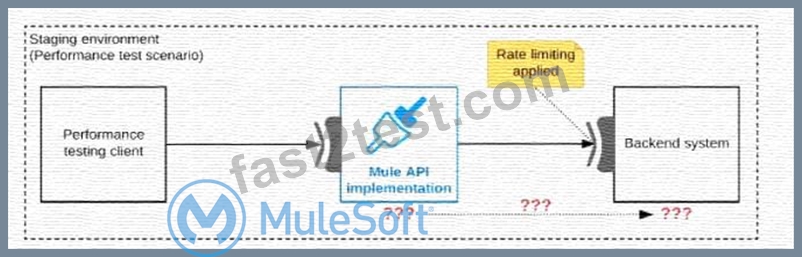
One of the backend systems invoked by an API implementation enforces rate limits on the number of requests a particular client can make. Both the backend system and the API implementation are deployed to several non-production environments in addition to production.
Rate limiting of the backend system applies to all non-production environments. The production environment, however, does NOT have any rate limiting.
What is the most effective approach to conduct performance tests of the API implementation in a staging (non-production) environment?
- A. Conduct scaled-down performance tests in the staging environment against the rate limited backend system then upscale performance results to full production scale
- B. Create a mocking service that replicates the backend system's production performance characteristics.
Then configure the API implementation to use the mocking service and conduct the performance tests - C. Include logic within the API implementation that bypasses invocations of the backend system in a performance test situation. Instead invoking local stubs that replicate typical backend system responses then conduct performance tests using this API Implementation
- D. Use MUnit to simulate standard responses from the backend system then conduct performance tests to identify other bottlenecks in the system
Answer: B
Explanation:
Correct answer is Create a mocking service that replicates the backend system's production performance characteristics. Then configure the API implementation to use the mocking service and conduct the performance tests
* MUnit is for only Unit and integration testing for APIs and Mule apps. Not for performance Testing, even if it has the ability to Mock the backend.
* Bypassing the backend invocation defeats the whole purpose of performance testing. Hence it is not a valid answer.
* Scaled down performance tests cant be relied upon as performance of API's is not linear against load.
NEW QUESTION # 47
A REST API is being designed to implement a Mule application.
What standard interface definition language can be used to define REST APIs?
- A. YAML
- B. AsyncAPI Specification
- C. OpenAPI Specification (OAS)
- D. Web Service Definition Language(WSDL)
Answer: A
NEW QUESTION # 48
A project team uses RAML specifications to document API functional requirements and deliver API definitions. As per the current legal requirement, all designed API definitions to be augmented with an additional non-functional requirement to protect the services from a high rate of requests according to define service level agreements.
Assuming that the project is following Mulesoft API governance and policies, how should the project team convey the necessary non-functional requirement to stakeholders?
- A. Create various SLA's in API manager for the non functional requirement and publish to exchange
- B. Add all non functional requirements as comments to RAML specification and publish to exchange
- C. Create proxies in API manager for the non functional requirement and publish to exchange
- D. Update API definitions with the fragment for the appropriate policy and publish to exchange
Answer: D
Explanation:
To ensure that non-functional requirements, such as rate limiting, are clearly communicated and enforced in the designed API definitions, the project team should use API fragments for the appropriate policy. Here's why option D is correct:
* API Governance and Policies: Mulesoft's API governance framework allows the definition and enforcement of policies across APIs to ensure consistency and compliance with organizational standards. These policies can include security, rate limiting, logging, and more.
* Policy Fragments: By updating API definitions with policy fragments, the team can encapsulate the non-functional requirements within the API specification itself. This approach ensures that these requirements are an integral part of the API design and are automatically applied whenever the API is deployed.
* Publishing to Exchange: Publishing the updated API definitions with the policy fragments to Anypoint Exchange makes them available for reuse and ensures that all stakeholders have access to the latest, compliant API specifications.
Example of adding a rate limiting policy fragment to a RAML file:
#%RAML 1.0 title: Example API version: v1 baseUri: https://api.example.com/v1 ... /* Include the rate limiting policy fragment */ uses: rateLimitPolicy: !include rate-limit-policy.raml The rate-limit-policy.raml fragment might define the specific rate limiting rules as per the service level agreements.
References
* MuleSoft API Manager
* Defining and Using API Fragments
NEW QUESTION # 49
Refer to the exhibit.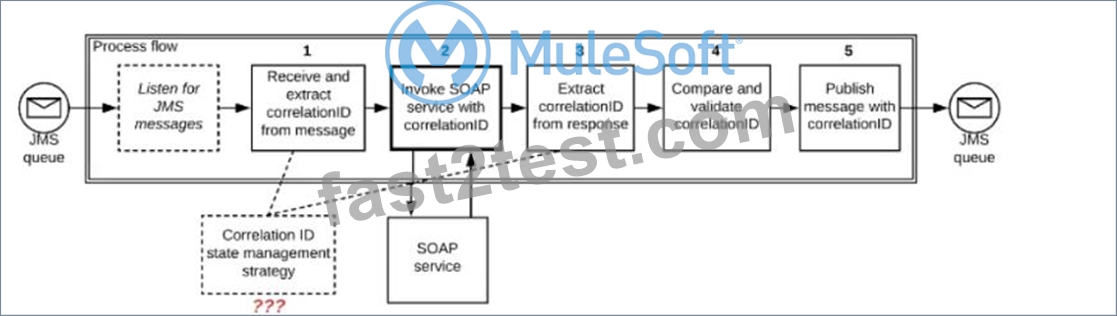
A Mule application is deployed to a multi-node Mule runtime cluster. The Mule application uses the competing consumer pattern among its cluster replicas to receive JMS messages from a JMS queue. To process each received JMS message, the following steps are performed in a flow:
Step l: The JMS Correlation ID header is read from the received JMS message.
Step 2: The Mule application invokes an idempotent SOAP webservice over HTTPS, passing the JMS Correlation ID as one parameter in the SOAP request.
Step 3: The response from the SOAP webservice also returns the same JMS Correlation ID.
Step 4: The JMS Correlation ID received from the SOAP webservice is validated to be identical to the JMS Correlation ID received in Step 1.
Step 5: The Mule application creates a response JMS message, setting the JMS Correlation ID message header to the validated JMS Correlation ID and publishes that message to a response JMS queue.
Where should the Mule application store the JMS Correlation ID values received in Step 1 and Step 3 so that the validation in Step 4 can be performed, while also making the overall Mule application highly available, fault-tolerant, performant, and maintainable?
- A. Both Correlation ID values should be stored in a persistent object store
- B. Both Correlation ID values should be stored as Mule event variable/attribute
- C. The Correlation ID value in Step 1 should be stored in a persistent object store The Correlation ID value in step 3 should be stored as a Mule event variable/attribute
- D. Both Correlation ID values should be stored In a non-persistent object store
Answer: B
NEW QUESTION # 50
When designing an upstream API and its implementation, the development team has been advised to not set timeouts when invoking downstream API. Because the downstream API has no SLA that can be relied upon. This is the only donwstream API dependency of that upstream API. Assume the downstream API runs uninterrupted without crashing. What is the impact of this advice?
- A. A default timeout of 500 ms will automatically be applied by the Mule runtime in which the upstream API implementation executes.
- B. A load-dependent timeout of less than 1000 ms will be applied by the Mule runtime in which the downstream API implementation executes.
- C. An SLA for the upstream API CANNOT be provided.
- D. The invocation of the downstream API will run to completion without timing out.
Answer: C
Explanation:
An SLA for the upstream API CANNOT be provided.
NEW QUESTION # 51
Mule application is deployed to Customer Hosted Runtime. Asynchronous logging was implemented to improved throughput of the system. But it was observed over the period of time that few of the important exception log messages which were used to rollback transactions are not working as expected causing huge loss to the Organization. Organization wants to avoid these losses. Application also has constraints due to which they cant compromise on throughput much. What is the possible option in this case?
- A. External log appender needs to be used in this case
- B. Mixed configuration of asynchronous or synchronous loggers should be used to log exceptions via synchronous way
- C. Logging needs to be changed from asynchronous to synchronous
- D. Persistent memory storage should be used in such scenarios
Answer: B
Explanation:
Correct approach is to use Mixed configuration of asynchronous or synchronous loggers shoud be used to log exceptions via synchronous way Asynchronous logging poses a performance-reliability trade-off. You may lose some messages if Mule crashes before the logging buffers flush to the disk. In this case, consider that you can have a mixed configuration of asynchronous or synchronous loggers in your app. Best practice is to use asynchronous logging over synchronous with a minimum logging level of WARN for a production application. In some cases, enable INFO logging level when you need to confirm events such as successful policy installation or to perform troubleshooting. Configure your logging strategy by editing your application's src/main/resources/log4j2.xml file
NEW QUESTION # 52
A Mule application is deployed to a cluster of two(2) cusomter-hosted Mule runtimes. Currently the node name Alice is the primary node and node named bob is the secondary node. The mule application has a flow that polls a directory on a file system for new files.
The primary node Alice fails for an hour and then restarted.
After the Alice node completely restarts, from what node are the files polled, and what node is now the primary node for the cluster?
- A. Files are polled from Alice node
Alice is now the primary node - B. Files are polled form Bob node
Bob is now the primary node - C. Files are polled from Alice node
Bob is the now the primary node - D. Files are polled form Bob node
Alice is now the primary node
Answer: B
NEW QUESTION # 53
An organization uses a set of customer-hosted Mule runtimes that are managed using the Mulesoft-hosted control plane. What is a condition that can be alerted on from Anypoint Runtime Manager without any custom components or custom coding?
- A. When the Mute runtime license installed on a Mule runtime is about to expire
- B. When a Mule runtime on a given customer-hosted server is experiencing high memory consumption during certain periods
- C. When an SSL certificate used by one of the deployed Mule applications is about to expire
- D. When a Mule runtime's customer-hosted server is about to run out of disk space
Answer: B
NEW QUESTION # 54
An auto mobile company want to share inventory updates with dealers Dl and D2 asynchronously and concurrently via queues Q1 and Q2. Dealer Dl must consume the message from the queue Q1 and dealer D2 to must consume a message from the queue Q2.
Dealer D1 has implemented a retry mechanism to reprocess the transaction in case of any errors while processing the inventers updates. Dealer D2 has not implemented any retry mechanism.
How should the dealers acknowledge the message to avoid message loss and minimize impact on the current implementation?
- A. Dealer D1 and dealer D2 must use AUTO acknowledgement and acknowledge the message after successful processing
- B. Dealer D1 can use auto acknowledgement and dealer D2 can use IMMEDIATE acknowledgement and acknowledge the message of successful processing
- C. Dealer D1 can use AUTO acknowledgement and dealer D2 must use manual acknowledgement and acknowledge the message after successful processing
- D. Dealer D1 must use auto acknowledgement and dealer D2 can use manual acknowledgement and acknowledge the message after successful processing
Answer: C
Explanation:
* Dealer D1 - AUTO Acknowledgment:
* Dealer D1, which has a retry mechanism, can use AUTO acknowledgment. This means that the message is acknowledged automatically once received. The retry mechanism will handle any processing errors and reprocess the message if needed.
* Dealer D2 - Manual Acknowledgment:
* Dealer D2, which does not have a retry mechanism, must use manual acknowledgment. This approach allows D2 to acknowledge the message only after it has been successfully processed, ensuring no message is lost due to processing errors.
* Ensuring Message Delivery:
* Using manual acknowledgment for Dealer D2 ensures that the message is not lost and can be reprocessed if an error occurs during processing, which is crucial since it lacks a retry mechanism.
References:
* MuleSoft Documentation on JMS Acknowledgment
* Best practices for Reliable Messaging
NEW QUESTION # 55
Refer to the exhibit.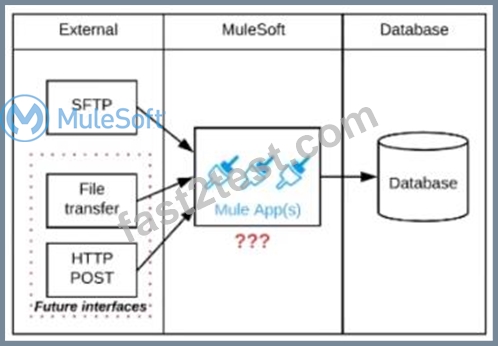
A business process involves the receipt of a file from an external vendor over SFTP. The file needs to be parsed and its content processed, validated, and ultimately persisted to a database. The delivery mechanism is expected to change in the future as more vendors send similar files using other mechanisms such as file transfer or HTTP POST.
What is the most effective way to design for these requirements in order to minimize the impact of future change?
- A. Create an API that receives the file and invokes a Process API with the data contained In the file, then have the Process API process the data using a MuleSoft Batch Job and other System APIs as needed
- B. Use a MuleSoft Scatter-Gather and a MuleSoft Batch Job to handle the different files coming from different sources
- C. Use a composite data source so files can be retrieved from various sources and delivered to a MuleSoft Batch Job for processing
- D. Create a Process API to receive the file and process it using a MuleSoft Batch Job while delegating the data save process to a System API
Answer: A
NEW QUESTION # 56
......
Accurate & Verified Answers As Seen in the Real Exam here: https://www.fast2test.com/MCIA-Level-1-premium-file.html