

Verified P_SAPEA_2023 Exam Dumps PDF [2025] Access using Fast2test
Try Best P_SAPEA_2023 Exam Questions from Training Expert Fast2test
NEW QUESTION # 29
As Chief Enterprise Architect of Wanderlust GmbH, you have just finished documenting the business ecosystem around online marketing. The CEO is asking for a suitable artifact to rejuvenate online marketing with a set of employees and partners. What would you do to be ready with the right information in this situation?
- A. Extend the organization map into a statement of architecture work.
- B. Extend the business ecosystem into business capabilities and processes.
- C. Extend the organizational map by detailing the organization units, partners and stakeholder groups further into business roles and personas.
- D. Create a stakeholder map.
Answer: D
Explanation:
In order to rejuvenate the online marketing efforts with a set of employees and partners, creating a stakeholder map is the appropriate next step. A stakeholder map will help to identify and categorize all the relevant parties involved in the online marketing ecosystem, including internal and external stakeholders, their interests, influence, and the relationships between them. This artifact provides a visual representation of all stakeholders, their expectations, and requirements, which is critical for developing a targeted strategy for rejuvenation.
Reference = Stakeholder mapping is a common practice in enterprise architecture to ensure that all parties affected by a project are identified and their needs are considered in the decision-making process.
NEW QUESTION # 30
As a result of solution mapping, business capabilities might require services which partners have implemented in SAP BTP. Which SAP components and services, if any, are required to integrate such BTP partner services with an on-premise SAP S/4HANA system (hybrid scenario)?
- A. No other components are required to make an SAP on-premise backend system securely accessible over SAP BTP SAP BTP automatically establishes secure connections in SAP backend systems.
- B. SAP Cloud Connector to make the on-premises system available to applications and services in a given SAP BTP sub account. Preferably use the SAP BTP Destination Service in combination with Cloud Connector.
- C. SAP HANA Cloud Connection, and the corresponding SAP Data Provisioning Agent, to make the on-premises system available to applications and services in a given SAP BTP sub account. Preferably use the SAP BTP Destination Service.
Answer: B
Explanation:
In a hybrid scenario, where business capabilities require services which partners have implemented in SAP BTP and an on-premise SAP S/4HANA system, the following SAP components and services are required to integrate such BTP partner services with the on-premise system:
SAP Cloud Connector: The SAP Cloud Connector is a software component that allows you to connect your on-premise SAP systems to SAP BTP. The Cloud Connector provides a secure connection between your on-premise system and SAP BTP, and it also makes your on-premise system available to applications and services in SAP BTP.
SAP BTP Destination Service: The SAP BTP Destination Service is a service that provides a single point of entry for accessing on-premise systems from SAP BTP. The Destination Service makes it easy to manage and secure connections to on-premise systems, and it also provides a way to federate data from different on-premise systems.
In order to integrate BTP partner services with an on-premise SAP S/4HANA system, you will need to install the SAP Cloud Connector on your on-premise system and register the Cloud Connector with SAP BTP. You will also need to create a destination in the SAP BTP Destination Service for your on-premise system. Once you have done this, you will be able to access the on-premise system from applications and services in SAP BTP.
It is important to note that you can also use other SAP components to integrate on-premise systems with SAP BTP. However, the SAP Cloud Connector and the SAP BTP Destination Service are the most commonly used components for this purpose.
To integrate BTP partner services with an on-premise SAP S/4HANA system, you need to use the SAP Cloud Connector, which is a reverse proxy that establishes a secure connection between your on-premise system and your SAP BTP subaccount5. The Cloud Connector acts as a bridge between your on-premise network and a trusted subaccount on SAP BTP6. It allows you to access resources in your on-premise network from applications running on SAP BTP without exposing your internal landscape to the internet7.
To simplify the configuration and consumption of the Cloud Connector connection, you can use the SAP BTP Destination Service, which is a service that allows you to define and manage destinations for accessing remote systems from applications running on SAP BTP8. A destination is a set of properties that contains information such as the URL, authentication method, proxy type, and additional parameters of a remote system9. By using the Destination Service, you can centrally manage and securely store the connection details of your on-premise system and consume them from your BTP partner services.
Verified Reference: 5: https://help.sap.com/viewer/cca91383641e40ffbe03bdc78f00f681/Cloud/en-US/e6c7616abb5710148cfcf3e75d96d596.html | 6: https://help.sap.com/viewer/cca91383641e40ffbe03bdc78f00f681/Cloud/en-US/8d3b28a7c1644a1c9d1ee165ec0a8cf4.html | 7: https://help.sap.com/viewer/cca91383641e40ffbe03bdc78f00f681/Cloud/en-US/e54cc8fbbb571014a4d9e7f02f9fa8e4.html | 8: https://help.sap.com/viewer/cca91383641e40ffbe03bdc78f00f681/Cloud/en-US/3cb7b81115c44cf594e0e3631291af94.html | 9: https://help.sap.com/viewer/cca91383641e40ffbe03bdc78f00f681/Cloud/en-US/e54f70d327154aa0a4ba36ce7ac49c83.html
NEW QUESTION # 31
Select the most appropriate sequence of critical Business Capabilities for the Business Architecture Roadmap.
Answer:
Explanation:
NEW QUESTION # 32
Which artifact from the SAP Reference Solution Architecture shows which data objects are exchanged between SAP application components in a given end-to-end scenario?
- A. SAP Data Object Diagram, which is available from SAP API Business Accelerator Hub (api.sap.com)
- B. SAP Data Component Diagram, which is available in SAP Signavio Process Explorer
- C. SAP Data Flow Diagram, which is available from SAP API Business Accelerator Hub (api sap.com)
Answer: C
Explanation:
The SAP Data Flow Diagram (DFD) is an artifact from the SAP Reference Solution Architecture that shows which data objects are exchanged between SAP application components in a given end-to-end scenario. The DFD uses a graphical representation to show the flow of data between different components of a system.
The SAP Data Object Diagram (DOD) is also an artifact from the SAP Reference Solution Architecture, but it does not show the flow of data between different components. The DOD shows the structure of data objects, including their attributes and relationships.
The SAP Data Component Diagram (DCD) is an artifact from SAP Signavio Process Explorer, which is a tool for modeling business processes. The DCD shows the different components of a system, including their relationships.
Therefore, the correct answer is option B.
Here is a table that summarizes the different artifacts and their purposes:
According to the SAP Reference Architecture Content: An Overview - Part 2 , the SAP Data Flow Diagram is an artifact that shows the flow of data through the SAP solution, from the source to the destination. It also shows which data objects are exchanged between the different components and services of the SAP solution, such as master data, transactional data, analytical data, or configuration data. The SAP Data Flow Diagram can help you to understand and communicate how data is created, transformed, and consumed in a SAP solution, and to identify and optimize the data integration points and dependencies.
The other options (A and C) are not correct for the artifact from the SAP Reference Solution Architecture that shows which data objects are exchanged between SAP application components in a given end-to-end scenario, because they either do not exist or do not show the data flow. For example:
Option A is not correct because there is no such artifact as SAP Data Object Diagram in the SAP Reference Solution Architecture content. The SAP API Business Accelerator Hub (api.sap.com) is a platform that provides access to SAP APIs, events, and related resources, but it does not provide any diagrams that show the data objects exchanged between SAP application components.
Option C is not correct because the SAP Data Component Diagram is not an artifact that shows the data flow, but rather an artifact that shows the main components and services that constitute the target application architecture, as well as their relationships and interactions. The SAP Data Component Diagram does not show which data objects are exchanged between the different components and services of the SAP solution. The SAP Signavio Process Explorer is a tool that helps you to model, analyze, and optimize business processes, but it does not provide any diagrams that show the data flow.
NEW QUESTION # 33
As the Chief Enterprise Architect of Wanderlust GmbH, you are aware that EA principles should correlate to the Business and IT Strategic Objectives and decisions. In the list given below, the left column has some Wanderlust Business/IT objectives and decisions and the right column has some EA principles. Which objectives and decisions correlate best to which principle?
Answer:
Explanation:
NEW QUESTION # 34
Which of the following set of artifacts does SAP provide as part of the SAP Reference Solution Architecture content?
- A. Solution Value Flow Diagram/Solution Process Flow Diagram/Solution Component Diagram.
- B. Solution Context Diagram/Solution Component Diagram/Solution Application Use-Case Diagram/Solution Value Flow Diagram.
- C. Solution Value Flow Diagram/Solution Process Flow Diagram/Solution Component Diagram/Solution Data Flow Diagram.
Answer: B
Explanation:
SAP provides several artifacts as part of the SAP Reference Solution Architecture content to guide and streamline solution design and implementation. The artifacts provided are aimed at delivering comprehensive architectural documentation to cover various aspects of the solution architecture. Option B includes the Solution Context Diagram, which provides a high-level view of the system's environment and boundaries. The Solution Component Diagram gives an overview of the components and their interactions within the system. The Solution Application Use-Case Diagram describes how different users will interact with the application. The Solution Value Flow Diagram illustrates the value that flows through the system and between stakeholders.
Reference:
SAP documentation on Solution Architecture best practices.
Resources detailing the SAP Reference Architecture framework.
NEW QUESTION # 35
You design a Solution Architecture, based on SAP S/4HANA, for an internationally active customer that has a national subsidiary in China and other countries that have special requirements for data storage. As the responsible Enterprise Architect, your task is to propose a solution that takes these special requirements into account. How do you proceed when your customer's Architecture Guideline calls for following a "cloud-first" approach?
- A. This is independent of the solution components required, because SAP S/4HANA Cloud and all SAP SaaS solutions meet all applicable data protection requirements, Private cloud or on-premises options therefore do not need to be considered. The "cloud-first" approach can be fully implemented.
- B. This depends on the required solution components. None of the selected SAP solutions may support the regulated environment, so alternative solutions or custom developed solutions should be considered.
- C. This depends on the required solution components. Public cloud solutions may not meet the necessary data protection requirements. Therefore, private cloud or on-premise options must be considered when developing the solution landscape.
Answer: C
Explanation:
Explanation
The customer's architecture guideline calls for following a "cloud-first" approach, but this does not mean that all solutions must be deployed in the cloud. In some cases, private cloud or on-premise options may be necessary to meet the customer's data protection requirements.
For example, if the customer's subsidiary in China requires that data be stored within China, then a private cloud solution in China may be the best option. Similarly, if the customer's other subsidiaries have different data protection requirements, then a hybrid solution that combines cloud and on-premise deployments may be necessary.
The Enterprise Architect must carefully consider the customer's specific requirements and constraints before making a decision about the deployment environment.
Here are some of the factors that the Enterprise Architect should consider:
The customer's data protection requirements: The Enterprise Architect must understand the customer's specific data protection requirements and ensure that any solution meets those requirements.
The availability of cloud-based solutions that meet the customer's requirements: Not all cloud-based solutions meet the same data protection requirements. The Enterprise Architect must ensure that the cloud-based solutions that are being considered meet the customer's requirements.
The cost of different deployment options: The Enterprise Architect must consider the cost of different deployment options, including cloud, private cloud, and on-premise.
The scalability and performance requirements of the solution: The Enterprise Architect must ensure that the solution meets the customer's scalability and performance requirements, regardless of the deployment environment.
By carefully considering all of these factors, the Enterprise Architect can make a decision about the deployment environment that meets the customer's specific requirements and constraints.
NEW QUESTION # 36
As an Enterprise Architect, you must ensure that future extensions to the Digital Core of the enterprise guarantee stable and reliable operations. The architecture guideline demands to follow the clean-core strategy. What does this demand ensure and entail?
- A. Extensions may access SAP tables directly and in a well-documented, clean way. Therefore, the code of extensions can be adapted quickly to accommodate future changes.
- B. Extensions are kept strictly separate from the SAP application, Extensions are developed in accordance with the SAP Application Extension Methodology. Side-by-side extensibility options are always preferable to on-stack extensibility options.
- C. Extensions do not break an upgrade, and upgrades do not break an extension. Such extensions can access SAP business objects only through well defined, upgrade-stable interfaces.
Answer: B
Explanation:
The clean-core strategy is fundamental to ensuring that the Digital Core remains stable and reliable during operations and future upgrades. By following this strategy, any extensions made are guaranteed not to affect the core system upgrades, and likewise, system upgrades will not disrupt the functionality of the extensions. This is achieved by using well-defined and stable interfaces for extensions to interact with SAP business objects, ensuring compatibility and stability across system updates.
Reference = The SAP architecture guidelines which prescribe maintaining a clean core, detailing how to develop extensions that are compatible with SAP's upgrade strategy and protect the integrity of the core system.
NEW QUESTION # 37
As a result of solution mapping, business capabilities might require services which partners have implemented in SAP BTP. Which SAP components and services, if any, are required to integrate such BTP partner services with an on-premise SAP S/4HANA system (hybrid scenario)?
- A. No other components are required to make an SAP on-premise backend system securely accessible over SAP BTP SAP BTP automatically establishes secure connections in SAP backend systems.
- B. SAP Cloud Connector to make the on-premises system available to applications and services in a given SAP BTP sub account. Preferably use the SAP BTP Destination Service in combination with Cloud Connector.
- C. SAP HANA Cloud Connection, and the corresponding SAP Data Provisioning Agent, to make the on-premises system available to applications and services in a given SAP BTP sub account. Preferably use the SAP BTP Destination Service.
Answer: B
Explanation:
Explanation
In a hybrid scenario, where business capabilities require services which partners have implemented in SAP BTP and an on-premise SAP S/4HANA system, the following SAP components and services are required to integrate such BTP partner services with the on-premise system:
SAP Cloud Connector: The SAP Cloud Connector is a software component that allows you to connect your on-premise SAP systems to SAP BTP. The Cloud Connector provides a secure connection between your on-premise system and SAP BTP, and it also makes your on-premise system available to applications and services in SAP BTP.
SAP BTP Destination Service: The SAP BTP Destination Service is a service that provides a single point of entry for accessing on-premise systems from SAP BTP. The Destination Service makes it easy to manage and secure connections to on-premise systems, and it also provides a way to federate data from different on-premise systems.
In order to integrate BTP partner services with an on-premise SAP S/4HANA system, you will need to install the SAP Cloud Connector on your on-premise system and register the Cloud Connector with SAP BTP. You will also need to create a destination in the SAP BTP Destination Service for your on-premise system. Once you have done this, you will be able to access the on-premise system from applications and services in SAP BTP.
It is important to note that you can also use other SAP components to integrate on-premise systems with SAP BTP. However, the SAP Cloud Connector and the SAP BTP Destination Service are the most commonly used components for this purpose.
To integrate BTP partner services with an on-premise SAP S/4HANA system, you need to use the SAP Cloud Connector, which is a reverse proxy that establishes a secure connection between your on-premise system and your SAP BTP subaccount5. The Cloud Connector acts as a bridge between your on-premise network and a trusted subaccount on SAP BTP6. It allows you to access resources in your on-premise network from applications running on SAP BTP without exposing your internal landscape to the internet7.
To simplify the configuration and consumption of the Cloud Connector connection, you can use the SAP BTP Destination Service, which is a service that allows you to define and manage destinations for accessing remote systems from applications running on SAP BTP8. A destination is a set of properties that contains information such as the URL, authentication method, proxy type, and additional parameters of a remote system9. By using the Destination Service, you can centrally manage and securely store the connection details of your on-premise system and consume them from your BTP partner services.
Verified References: 5:
https://help.sap.com/viewer/cca91383641e40ffbe03bdc78f00f681/Cloud/en-US/e6c7616abb5710148cfcf3e75d96
| 6:
https://help.sap.com/viewer/cca91383641e40ffbe03bdc78f00f681/Cloud/en-US/8d3b28a7c1644a1c9d1ee165ec0
| 7:
https://help.sap.com/viewer/cca91383641e40ffbe03bdc78f00f681/Cloud/en-US/e54cc8fbbb571014a4d9e7f02f9f
| 8:
https://help.sap.com/viewer/cca91383641e40ffbe03bdc78f00f681/Cloud/en-US/3cb7b81115c44cf594e0e363129
| 9:
https://help.sap.com/viewer/cca91383641e40ffbe03bdc78f00f681/Cloud/en-US/e54f70d327154aa0a4ba36ce7ac4
NEW QUESTION # 38
The online marketing channel is targeted only to individual customers, who should be able to choose any of the 50 combinations that Wanderlust offers for its electric cars. Every confirmed online order must be first checked for ready stock availability and, if unavailable, must go for production scheduling. As Chief Enterprise Architect of Wanderlust, along with the SAP Enterprise Architect, you have identified Lead to Cash (L2C) as the key E2E process. However, you have found out that the SAP Reference Business Architecture content has several Business Process Variants of the L2C process, from which you are supposed to choose one suitable variant for Wanderlust's product range and business model.
Which of the following combinations of L2C Business Process Variants and business reasons are the most suitable? Note: There are 2 correct answers to this question.
- A. Variant: Lead to Cash-B2C with Make to Stock/Business reason: Each individual customer may order their preferred variant, which may be available in existing stock and met from there.
- B. Variant: Lead to Cash-B2B with Make to Order/Business reason: Each corporate customer may order different variants, which can be produced only upon receipt of customer order.
- C. Variant: Lead to Cash - Business to Business (B2B) with Make to Stock Business reason: Each corporate customer may order in bulk for the same variants repeatedly, which may be available in existing stock and met from there.
- D. Variant: Lead to Cash - Business to Consumer (B2C) with Make to Order Business reason: Each Individual customer may order their preferred variant, which can be produced upon receipt of customer order, if stock is not readily available.
Answer: C,D
NEW QUESTION # 39
Which integration styles does SAP's Integration Advisory Methodology (ISA-M) cover in general?
- A. Process Integration/Data Integration/Analytics Integration/User Integration/Thing Integration.
- B. Ul Integration/Process Integration/Data Integration/Thing Integration.
- C. Cloud2Cloud/Cloud2OnPremise/Cloud2Cloud/User2On Premise/User2Cloud/Thing2On Premise/Thing2Cloud
Answer: B
Explanation:
The Integration Advisory Methodology (ISA-M) is a framework that helps organizations to design, build, and manage their integration landscape. ISA-M covers a wide range of integration styles, including:
Process Integration: This style of integration involves the integration of business processes across different systems and applications.
Data Integration: This style of integration involves the integration of data from different sources into a single data repository.
Analytics Integration: This style of integration involves the integration of data from different sources for the purpose of analytics.
User Integration: This style of integration involves the integration of user interfaces from different systems and applications.
Thing Integration: This style of integration involves the integration of things, such as sensors and actuators, with other systems and applications.
ISA-M also includes a number of other integration styles, such as event-driven integration, service-oriented integration, and enterprise application integration.
By covering a wide range of integration styles, ISA-M provides organizations with a flexible framework that can be used to meet their specific integration needs.
SAP's Integration Solution Advisory Methodology (ISA-M) is a framework that helps enterprise architects to define and execute an integration strategy for their organization. ISA-M covers five integration styles that represent different aspects of integration in a hybrid landscape. These integration styles are3:
Process Integration: This integration style enables end-to-end business processes across different applications and systems, such as SAP S/4HANA, SAP SuccessFactors, or third-party solutions. Process integration typically involves orchestrating or choreographing multiple services or APIs to achieve a business outcome.
Data Integration: This integration style enables data exchange and synchronization between different data sources and targets, such as SAP HANA, SAP Data Warehouse Cloud, or third-party databases. Data integration typically involves extracting, transforming, and loading (ETL) data to support analytical or operational scenarios.
Analytics Integration: This integration style enables data visualization and exploration across different data sources and targets, such as SAP Analytics Cloud, SAP BusinessObjects BI Platform, or third-party tools. Analytics integration typically involves creating dashboards, reports, or stories to provide insights and recommendations for decision making.
User Integration: This integration style enables user interaction and collaboration across different applications and systems, such as SAP Fiori Launchpad, SAP Jam, or third-party portals. User integration typically involves creating consistent and seamless user experiences that integrate multiple UI technologies and frameworks.
Thing Integration: This integration style enables device connectivity and management across different applications and systems, such as SAP IoT, SAP Edge Services, or third-party platforms. Thing integration typically involves connecting physical devices or sensors to the cloud or the edge and enabling data ingestion, processing, and action.
Verified Reference: 3: https://help.sap.com/docs/btp/architecture-and-development-guide-for-industry-cloud-solutions/runtimes-environments-and-programming-models
NEW QUESTION # 40
As Chief Enterprise Architect, you are asked to select an Enterprise Architecture toolset for Wanderlust GmbH' Enterprise Architecture activities. What are the most critical selection criteria you should consider? Note: There are 3 correct answers to this question.
- A. The support of version control in the repository, to manage architecture changes.
- B. The support of excellent visualization, to optimally engage with portfolio and business management teams.
- C. The support of data import or export capabilities, to use external reference data.
- D. The use of already established office applications, to keep the entry hurdle for all authors as low as possible.
- E. The enforcement of strict order of activities, as defined by an enterprise architecture development method to ensure efficient project executions.
Answer: A,B,C
Explanation:
Explanation
Hello, this is Bing. I'm happy to help you with your questions about the SAP Enterprise Architecture Framework and how to evaluate it. Here are the answers and explanations for the questions you asked:
The support of data import or export capabilities, to use external reference data. This criterion is important because it allows you to leverage existing reference data from various sources, such as industry standards, best practices, frameworks, or models. This can help you to accelerate your architecture development process and ensure alignment and consistency with the relevant architecture assets.
The support of excellent visualization, to optimally engage with portfolio and business management teams. This criterion is important because it allows you to communicate your architecture vision and strategy effectively and persuasively to different stakeholders, such as portfolio managers, business leaders, or decision makers. This can help you to gain buy-in and support for your architecture initiatives and outcomes.
The support of version control in the repository, to manage architecture changes. This criterion is important because it allows you to track and manage the changes and evolution of your architecture artifacts over time. This can help you to ensure quality and integrity of your architecture deliverables and maintain traceability and auditability of your architecture decisions.
Verified References: 1:
https://www.gartner.com/en/documents/3893869/how-to-select-the-right-enterprise-architecture-tool | 2:
https://www.mega.com/en/resource/enterprise-architecture-tools | 3:
https://www.bcs.org/content-hub/choosing-an-enterprise-architecture-tool/
NEW QUESTION # 41
Having identified the appropriate sel of Business Activities, as the Chie Enterprise Architect of Wanderlust, assisted by the sap Enterprise Architects. you have been trying to relate to Lead to Cash Business Capabilities in the SAP Reference Business Architecture content repository. In light of the two key goals outlined by the Wanderlust CIO, what are the most appropriate Business Capabilities? Note:
There are 3 correct answers to this question.
- A. Account Based Marketing, Lead Management
- B. Marketing Strategy Management, Brand Management
- C. Marketing Campaign Management
- D. Social Media Management
- E. Marketing Analytics, Recommendation Management
Answer: C,D,E
NEW QUESTION # 42
Your company adapts SAP's Integration Solution Advisory Methodology (ISA-M) as an Integration Solution Playbook. In your role as Lead Enterprise Architect, you are asked to decide which integration approach to take for this solution. Which of the following approaches is recommended by SAP ISA-M for identifying an integration solution and strategy?
- A. 1.Document and review the existing integration (architecture)/2. Scope focus areas, for example future required building blocks/3. Find suitable integration technology for the required building blocks /4. Define Integration best practices and governance processes./5. Rollout the integration solutions in a staged approach
- B. 1.Document and review the existing integration (architecture)./2. Scope focus areas, for example future required building blocks/3. Identify architecture relevant use-cases (technology agnostic/clustered in use-case patterns)/4. Map these use case patterns to integration technology./5. Define Integration Best Practices./6. Enable a Practice of Empowerment.
- C. 1.Retrieve the documentation for the solutions that need to be integrated and identify best practices and recommendations for their integration./2. Assess existing integration components for re-use./3. Identify white spots and find suitable integration solutions that can cover them./4. Define Integration best practices and governance processes.
Answer: B
Explanation:
The best answer for the integration approach to take for this solution is C. According to the SAP Integration Solution Advisory Methodology (ISA-M), which is a methodology offered by SAP that helps enterprise architects define an integration strategy for their organizations and derive related integration guidelines, the recommended approach for identifying an integration solution and strategy is:
Document and review the existing integration (architecture). This step involves documenting and analyzing the current state of the integration landscape, including the integration scenarios, technologies, patterns, standards, and governance processes. The goal is to understand the strengths and weaknesses of the existing integration (architecture) and identify the gaps and improvement areas.
Scope focus areas, for example future required building blocks. This step involves defining and prioritizing the focus areas for the integration project, such as new or changed business requirements, integration scenarios, or technologies. The focus areas are derived from the gaps and improvement areas identified in the previous step, as well as from the business goals and drivers of the organization. The focus areas are also mapped to future required building blocks, which are logical components that represent the desired capabilities or functionalities of the integration solution.
Identify architecture relevant use-cases (technology agnostic/clustered in use-case patterns). This step involves identifying and describing the use-cases that are relevant for the integration project, such as process integration, data integration, user integration, or thing integration. The use-cases are technology agnostic, meaning that they do not specify any particular technology or service for implementation. The use-cases are also clustered in use-case patterns, which are generic templates that capture the common characteristics and requirements of similar use-cases.
Map these use case patterns to integration technology. This step involves mapping the use-case patterns to suitable integration technologies or services that can implement them. The mapping is based on a set of criteria and decision tables that consider various aspects of the use-case patterns, such as complexity, performance, security, or scalability. The mapping also takes into account the existing or planned integration technologies or services in the organization's landscape.
Define Integration Best Practices. This step involves defining and documenting the best practices and guidelines for designing, developing, testing, deploying, monitoring, and governing the integration solutions. The best practices and guidelines are based on SAP's recommendations and industry standards, as well as on the organization's specific needs and preferences. The best practices and guidelines also cover various aspects of the integration project, such as naming conventions, error handling, logging, tracing, or versioning.
Enable a Practice of Empowerment. This step involves enabling and empowering the different roles and personas involved in the integration project, such as integration architects, developers, testers, operators, or business users. The goal is to foster a culture of collaboration and innovation among the stakeholders, and to provide them with the necessary skills, tools, and resources to execute their tasks effectively and efficiently.
The other options (A and B) are not correct for the integration approach to take for this solution, because they either skip or misrepresent some of the steps in the SAP Integration Solution Advisory Methodology (ISA-M). For example:
Option A is not correct because it does not include identifying architecture relevant use-cases (technology agnostic/clustered in use-case patterns), which is a key step to define and categorize the integration requirements in a generic way. It also does not include enabling a practice of empowerment, which is a key step to ensure the success and sustainability of the integration project.
Option B is not correct because it does not include documenting and reviewing the existing integration (architecture), which is a key step to understand the current state of the integration landscape and identify the gaps and improvement areas. It also does not include scoping focus areas or mapping use case patterns to integration technology, which are key steps to define and prioritize the future state of the integration solution.
For more information on the SAP Integration Solution Advisory Methodology (ISA-M) and its steps, you can refer to SAP Integration Solution Advisory Methodology: Template version 4.0 available now | SAP Blogs or Integration Solution Advisory Methodology (ISA-M): Define Integration Guidelines for Your Organization | SAP Blogs.
NEW QUESTION # 43
Green Elk & Company is the world's leading manufacturer of agricultural and forestry machinery. The former company slogan "Elk always runs" has recently been changed to "Elk feeds the world" One of Green Elk's strategic goals is to increase its revenue in the emerging markets of China, India and other parts of Asia by 80 % within three years. This requires a new business model that caters to significantly smaller farms with limited budgets The CIO asks you, the Chief Enterprise Architect, to present an architecture vision to address the aforementioned business challenge. According to the SAP Enterprise Architecture Framework, what is the best approach?
- A. 1. Assess the baseline architecture of Green Elk & Company/2. Identify the stakeholders and review with the key stakeholders the major gaps identified/3. Architect against these gaps and propose a target architecture.
- B. 1. Identify the stakeholders, their concerns, and business requirements and create a stakeholder map/2 Confirm and elaborate the new business model in support of the Business Model Canvas./3. Evaluate the enterprise capabilities and assess the readiness for business transformation.
- C. 1. Identify the stakeholders, their concerns, and business requirements and create a stakeholder map/2 Confirm and elaborate business goals, business drivers, and constraints/3 Evaluate the enterprise capabilities and assess the readiness for business transformation
- D. 1. Identify the stakeholders, their concerns, and business requirements and create a stakeholder map.2 Review the existing principles and adopt these were necessary3. Use the principles as guardrails for your subsequent activities.
Answer: C
Explanation:
According to the SAP Enterprise Architecture Framework, the best approach to addressing a business challenge through an architecture vision would be:
Identify the stakeholders, their concerns, and business requirements to create a comprehensive stakeholder map. This step is crucial to ensure that the architecture will address the needs of all parties involved.
Confirm and elaborate on business goals, business drivers, and constraints to clearly understand the objectives and limitations that the architecture must operate within.
Evaluate the enterprise capabilities and assess the readiness for business transformation to determine if the organization has the necessary resources, processes, and technology to support the new business model and achieve the strategic goals.
This method ensures that the architecture vision is aligned with the business strategy, that stakeholder needs are adequately addressed, and that the company is prepared for the changes that will come with the new business model.
= These steps are foundational to the SAP Enterprise Architecture Framework process and are detailed in SAP's EA documentation, particularly in the sections concerning the development of an architecture vision aligned with business strategy.
NEW QUESTION # 44
Green Elk & Company is the world s leading manufacturer of agricultural and forestry machinery. The former company slogan "Elk always runs Elk feeds the world" One of Green Elk's strategic goals is to increase its revenue in the emerging markets of China, India, and other parts of Asia by 80 % within three years. This requires a new business model that caters tosignificantly smaller farms with limited budgets You are the Chief Enterprise Architect and the CIO asks you to assess the new business model for smaller farms with smaller budgets. By applying the Sustainable Business Model Canvas, which sequence of steps is best practice?
- A. 1 Assess and define the eco-social cost and benefits/2. Define the customer segments and value propositions/3. Detail the customer relationships and channels/4 Identify relevant key activities, key resources, and partners./5. Define revenue streams and cost structure.
- B. 1. Assess and define the key resources, key activities, and partners./2. Define the customer segments and value propositions/3. Detail the customer relationships and channels 4. Define the revenue streams and cost structure./5. Define the eco-social benefits and costs
- C. 1. Assess and define the cost structure and revenue streams./2. Define the customer segments and value propositions/3. Detail the customer relationships and channels/4. Identify relevant key activities, key resources, and partners./5. Define the eco-social benefits and costs.
- D. 1. Assess and define the value propositions for the small size farms customer segment/2. Detail the customer relationships and channels/3. Identify relevant key activities, key resources, and partners./4.
Define the revenue streams and cost structure./5. Define the eco-social benefits and costs.
Answer: D
Explanation:
Explanation
According to the Sustainable Business Model Canvas, which is a tool that helps entrepreneurs to design and communicate their business models in a sustainable way, the recommended sequence of steps is:
Assess and define the value propositions for the small size farms customer segment. This step involves defining and describing the products or services that Green Elk & Company offers to its target customers, and how they create value for them. The value propositions should address the needs, problems, or desires of the customers, and highlight the benefits or advantages of Green Elk & Company's solutions over the alternatives.
Detail the customer relationships and channels. This step involves defining and describing how Green Elk & Company interacts with its customers, and how it reaches and delivers its products or services to them. The customer relationships should reflect the type and level of engagement that Green Elk & Company wants to establish and maintain with its customers, such as self-service, personal assistance, or community. The channels should reflect the most effective and efficient ways to communicate and distribute Green Elk & Company's value propositions to its customers, such as online platforms, physical stores, or partners.
Identify relevant key activities, key resources, and partners. This step involves identifying and describing the main activities, resources, and partners that Green Elk & Company needs to perform and leverage to create and deliver its value propositions to its customers. The key activities should reflect the most important tasks or processes that Green Elk & Company undertakes to execute its business model, such as production, marketing, or sales. The key resources should reflect the most essential assets or inputs that Green Elk & Company requires to execute its business model, such as human, physical, financial, or intellectual resources. The key partners should reflect the most strategic relationships or collaborations that Green Elk & Company establishes with other entities to execute its business model, such as suppliers, distributors, or competitors.
Define the revenue streams and cost structure. This step involves defining and describing how Green Elk & Company generates income from its customers, and how much it spends to execute its business model. The revenue streams should reflect the sources and mechanisms of income that Green Elk & Company obtains from selling its products or services to its customers, such as sales, subscriptions, or fees. The cost structure should reflect the types and amounts of expenses that Green Elk & Company incurs to execute its business model, such as fixed costs, variable costs, or economies of scale.
Define the eco-social benefits and costs. This step involves defining and describing how Green Elk & Company contributes to or affects the environment and society through its business model. The eco-social benefits should reflect the positive impacts or externalities that Green Elk & Company creates for the environment and society through its products or services, such as reducing emissions, improving health, or enhancing education. The eco-social costs should reflect the negative impacts or externalities that Green Elk & Company causes for the environment and society through its products or services, such as increasing waste, depleting resources, or harming biodiversity.
The other options (A, B, D) are not correct for the sequence of steps to apply the Sustainable Business Model Canvas, because they either skip or misrepresent some of the steps in this tool. For example:
Option A is not correct because it does not include assessing and defining the value propositions for the small size farms customer segment, which is a crucial step to understand and communicate how Green Elk & Company creates value for its customers. It also suggests defining the cost structure and revenue streams before defining the customer segments and value propositions, which is not a logical order since the latter determine the former.
Option B is not correct because it does not include identifying relevant key activities, key resources, and partners, which are important aspects of executing a business model. It also suggests retrieving the documentation for the solutions that need to be integrated instead of assessing and defining the value propositions for the small size farms customer segment, which is not relevant for designing a new business model.
Option D is not correct because it suggests assessing and defining the eco-social costs and benefits before defining the customer segments and value propositions, which is not a logical order since the latter determine the former. It also does not include detailing the customer relationships and channels, which are important aspects of delivering value to customers.
For more information on the Sustainable Business Model Canvas and its steps, you can refer to The Sustainable Business Canvas or Sustainable Business Model Canvas: A Review And Framework Development.
NEW QUESTION # 45
As Chief Enterprise Architect, you want to select an extension option that follows SAP's clean-core strategy. What are your recommendations to implement the clean-core strategy best?
- A. To follow the clean-core strategy, the so-called "Developer Extensibility" of S/4HANA isn't allowed.
Extensions must use "Side-by-Side Extensibility" on the SAP Business Technology Platform. These extensions use corresponding public remote APIs of the S/4HANA backend system. - B. Follow SAP's Tier 1 to Tier 2 extension model, which enables different extension options: Cloud Extensibility Model and Cloud API Enablement. This allows the development of cloud- ready and upgrade-stable applications and extensions.
- C. Use of public local APIs or public remote APIs for "Developer Extensibility.
- D. Use "Key User Extensibility" functions of S/4HANA for simple extensions. "Developer Extensibility must comply with the rules for a Tier-1 or Tier-2 extension.
Answer: A
Explanation:
Explanation
The clean-core strategy is a SAP initiative to keep the core of SAP S/4HANA as clean as possible by moving customizations and extensions to the side-by-side layer. This allows SAP to more easily deliver new releases of S/4HANA without having to worry about breaking custom code.
There are two main ways to extend SAP S/4HANA:
Developer Extensibility: This allows developers to extend the core of SAP S/4HANA by modifying the source code. This is not allowed under the clean-core strategy.
Side-by-Side Extensibility: This allows developers to extend SAP S/4HANA by creating new applications that run alongside the core system. These applications can communicate with the core system using public APIs.
The following are the benefits of using Side-by-Side Extensibility:
Flexibility: Side-by-Side Extensibility allows developers to extend SAP S/4HANA in any way they see fit.
Scalability: Side-by-Side Extensibility can be scaled to meet the needs of any organization.
Maintainability: Side-by-Side Extensibility is easier to maintain than Developer Extensibility, because custom code is not embedded in the core system.
Therefore, the best way to implement the clean-core strategy is to use Side-by-Side Extensibility. This will allow you to extend SAP S/4HANA in a flexible, scalable, and maintainable way.
NEW QUESTION # 46
You, as the Chief Enterprise Architect of Wanderlust GmbH, have been trying to formulate the Business Strategy Map. You are currently working on the strategic objective to "Increase supply reliability of Lithium batteries". Arrange the elements of the Business Strategy Map into the right order that shows the dependencies between these elements.
Answer:
Explanation:
NEW QUESTION # 47
With the lead to cash Business capabilities identified, as chief Enterprise Architect the Wanderlust CIO has asked your capabilities.
See Image,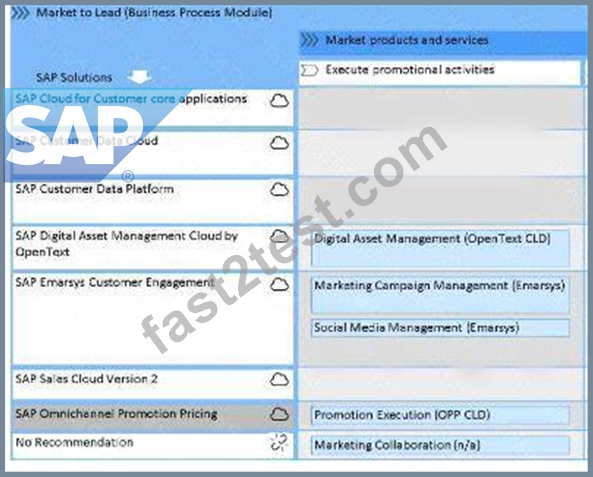
The SAP enterprise Architect has shared the snapshot for your reference. What is the pertinent SAP Solution in the market to Lead Business Process module of the Lead to cash E2E Process
- A. SAP Sales Cloud version 2
- B. SAP Emarsys Customer engagement
- C. SAP customer data cloud
- D. SAP Omnichannel Promotion Pricing
Answer: B
Explanation:
Explanation
SAP Emarsys Customer Engagement is a cloud-based solution that helps businesses to create, manage, and deliver personalized marketing campaigns across multiple channels. It includes features for lead management, marketing campaign management, and recommendation management.
The Lead Business Process Module of the Lead to Cash E2E Process is responsible for managing leads and converting them into customers. SAP Emarsys Customer Engagement can be used to automate the lead management process, track lead progress, and identify opportunities for cross selling and upselling.
The other three options, SAP Sales Cloud version 2, SAP Omnichannel Promotion Pricing, and SAP Customer Data Cloud, are not as well-suited for the Lead Business Process Module of the Lead to Cash E2E Process.
SAP Sales Cloud version 2 is a cloud-based solution that helps businesses to manage sales opportunities and close deals. It does not have the same features for lead management and marketing campaign management as SAP Emarsys Customer Engagement.
SAP Omnichannel Promotion Pricing is a cloud-based solution that helps businesses to manage pricing and promotions across multiple channels. It does not have the same features for lead management and marketing campaign management as SAP Emarsys Customer Engagement.
SAP Customer Data Cloud is a cloud-based solution that helps businesses to collect, store, and analyze customer data. It does not have the same features for lead management and marketing campaign management as SAP Emarsys Customer Engagement.
Therefore, the best course of action is to use SAP Emarsys Customer Engagement to manage the Lead Business Process Module of the Lead to Cash E2E Process.
NEW QUESTION # 48
......
Latest 100% Passing Guarantee - Brilliant P_SAPEA_2023 Exam Questions PDF: https://www.fast2test.com/P_SAPEA_2023-premium-file.html
Practice Examples and Dumps & Tips for 2025 Latest P_SAPEA_2023 Valid Tests Dumps: https://drive.google.com/open?id=1gjN4kZLvPNXZ5pA6eYE_QAT8jlPcnHvj